Overwatch
An MCP server that gives Claude a persistent engagement graph for offensive security operations.
The core problem with LLM-driven pentesting: context windows are finite but engagements aren't. Every credential, lateral movement path, and discovered host matters — and they accumulate faster than they fit in a prompt. Overwatch solves this by moving state out of the context window entirely. The LLM calls tools. A persistent server holds the graph. Compaction, restarts, and agent handoffs lose nothing.
What it does
You run Overwatch as an MCP server alongside Claude. As you work an engagement, every discovery feeds into a directed property graph: hosts, credentials, services, users, cloud identities, and the relationships between them. The LLM queries this graph to plan next steps, validates actions against scope and OPSEC constraints, and dispatches sub-agents for parallel work — all without you having to manually track state between sessions.
After a compaction or restart, one call to get_state() reconstructs a full engagement briefing from the graph. You pick up exactly where you left off.
Key Features
- Graph-based state — 23 node types, 73 edge types. Every attack path is a traversable route through the engagement graph, not a list of notes.
- Inference engine — 61 built-in rules that fire when findings land (e.g., "OIDC audience matches AWS STS → probable AssumeRoleWithWebIdentity"). Surfaces follow-on opportunities as scored frontier items automatically.
- Credential lifecycle intelligence — Captured tokens track status (active/stale/expired), reachability via confirmed edges, expiry estimation, and provenance. The Credentials dashboard tab shows all of this at a glance.
- 60+ MCP tools — State management, action logging, graph queries, BloodHound/AzureHound ingestion, 50 output parsers, persistent interactive sessions, credential playbooks, and pentest report generation.
- Credential-driven playbooks — Five tools (
expand_aws_credential,expand_github_credential,expand_oidc_capture,exchange_refresh_token,expand_entra_credential) that turn a captured credential into a sequenced recon plan queued through the approval gate. - 34 offensive skills — RAG-searchable methodology library covering AD, cloud, web, and infrastructure.
- Scope and OPSEC enforcement — Hard constraints live in the deterministic layer. The LLM handles reasoning. Out-of-scope calls fail closed.
- Persistent sessions — Long-lived interactive shells (SSH, local PTY, reverse shell) with cursor-based I/O and TTY quality tracking.
- Live dashboard — Real-time graph visualization, approval queue, frontier view, agent status, credential tracker, findings panel with report generation.
- Tamper-evident audit trail — Optional hash-chained activity log and JSON-RPC tape proxy. Retrospectives can prove the AI did exactly what it claimed, in the order it claimed.
By the Numbers
| 60+ MCP tools | 34 offensive skills |
| 50 output parsers (nmap, nxc, certipy, secretsdump, kerbrute, hashcat, responder, ldapsearch, enum4linux, rubeus, web dir enum, linpeas, nuclei, nikto, testssl, pacu, prowler, sqlmap, wpscan, and more) | 61 built-in inference rules |
| 2775+ tests across 127 files | 23 node types, 73 edge types |
Quick Start
Just want to get running?
The Getting Started guide is a tight 5-minute path: clone, copy a template, wire the MCP config, launch claude. Everything else here is reference material you can come back to.
git clone https://github.com/professor-moody/overwatch.git
cd overwatch
npm install && npm run build
cp engagement-templates/internal-pentest.json engagement.json
# edit scope.cidrs and scope.domains, then add to ~/.claude/settings.json
claude
Full walk-through with template list, dashboard tour, and "what to say to the AI first" prompts: Getting Started. Or jump straight to a lab workflow.
Architecture at a Glance
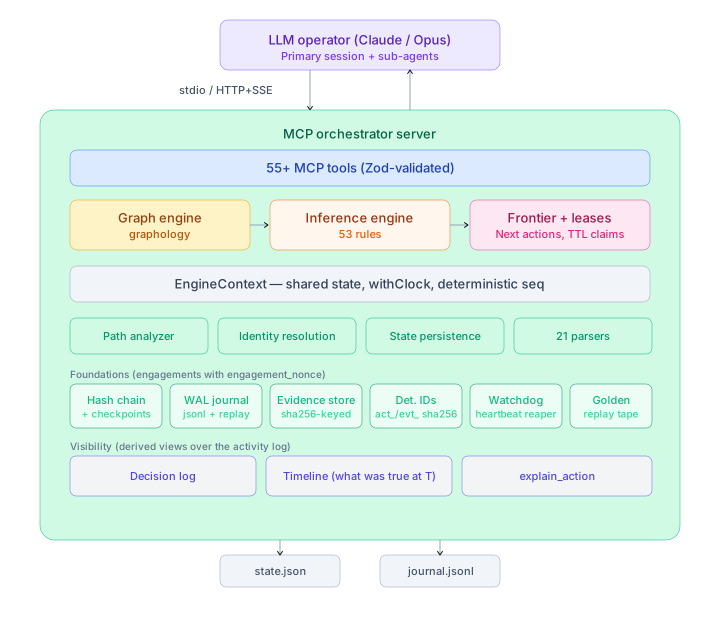
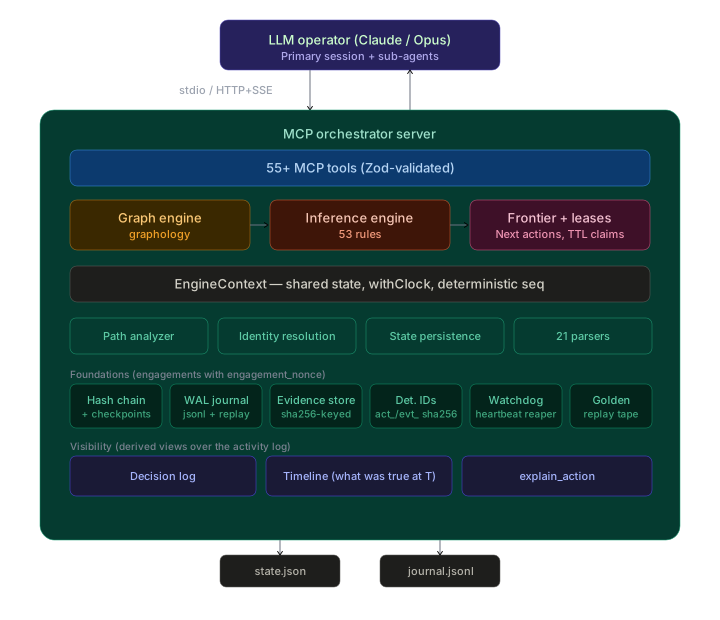
Learn more in Architecture, explore Key Concepts, or jump to the Tool Reference.
Where to Go Next
- First time here? → Getting Started for the 5-minute install + first engagement.
- Want to understand the design? → Architecture covers the system diagram, components, and design decisions. Then Key Concepts for the engagement-graph vocabulary (frontier, inference, OPSEC, audit trail).
- Auditing or threat-modeling? → Threat Model states explicitly what the system trusts, what it defends against, and what residual risks remain.
- Building or extending? → Tool Reference for every MCP tool. Development for project structure and testing.
- Running an actual engagement? → Operator Playbook walks through GOAD AD labs, HTB single-host, network engagements.