Secant is a Rust and PyTorch toolkit for inspecting, editing, and auditing language-model weights directly on disk. Its Rust CLI and C-ABI library operate on .safetensors and .gguf checkpoints via memory-mapped I/O without loading full models into GPU RAM, while its Python package (secant.nn, secant.capture) captures contrastive activation subspaces and constrains PyTorch LoRA fine-tuning.
Standard model adaptation and safety pipelines leave three practical gaps:
Editing weights without re-quantizing whole checkpoints: Modifying a single behavior in a multi-gigabyte checkpoint typically requires loading full
BF16weights into memory, applying an update, and re-quantizing the entire file. Secant calibrates sparse rank-1 updates against a layer’s reference activation and patches only the intersecting 34-byteQ8_0blocks or floating-point columns in place, leaving every untouched block bit-for-bit identical (0.20%of bytes modified in theQwen3.5-4Btest) and verified by pre/post SHA-256 receipts.Preventing post-edit LoRA fine-tuning from erasing surgical edits: When a patched model is fine-tuned with LoRA under AdamW, AdamW’s coordinate-wise second-moment scaling (
sqrt(v_hat_t) + eps) can rotate even orthogonalized gradients back into the edited subspace.ProjectThenHealLinearenforces a twice-appliedfloat64orthogonal projection (B_locked = P_perp(P_perp(B_tilde))) inside the forward pass, keeping adapter updates in the left nullspace of the protected directions down to the working-dtype precision floor (5e-18to1e-17max-absolute infloat64,~1e-10infloat32).Auditing numerical payload invariants (“Boundary 3”) before native kernels execute: Structural container validators verify header offsets and byte lengths without inspecting payload values.
secant sanitize,secant probe, andsecant audit-trojanaudit weight matrices, quantized block scales (Rule B3-2Apermitting legitimateQ8_0/Q4_KFP16 subnormals while catchingNaN/Infheaders), divisor scales (Rule B3-2B), integer routing tables (Rule B3-3), and spectral rank-1 anomalies without a GPU.
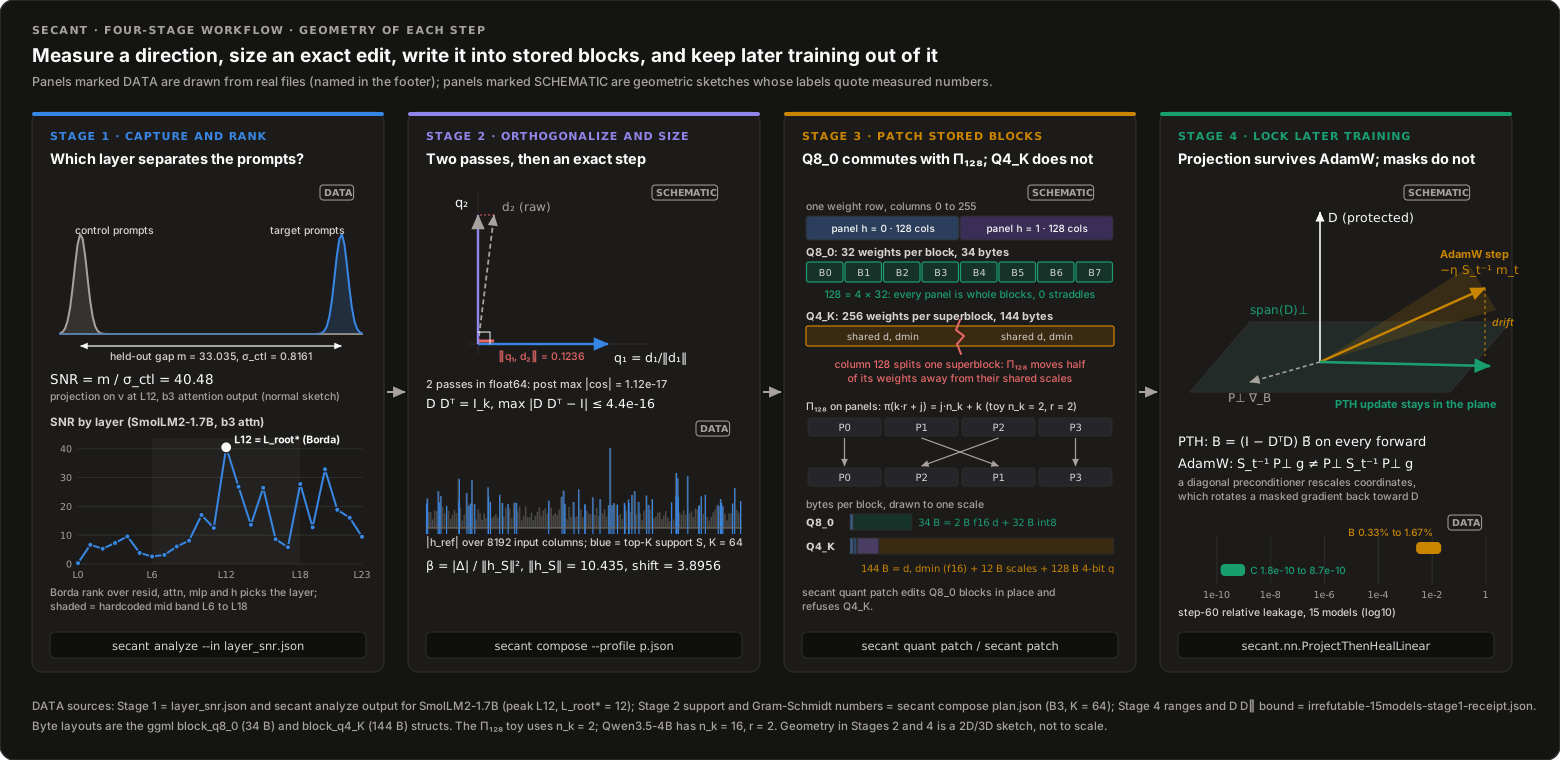
Figure 1:The four stages and the geometry behind each one. 1. Capture and rank: the target prompts’ projections separate from the control prompts’ by m / σ = 40.48 at L12, and secant analyze picks that layer by Borda rank over four activation streams. 2. Orthogonalize and size: two float64 Gram-Schmidt passes take the two directions from cosine 0.1236 to 1.12e-17, and the B3 edit touches only the 64 input columns where the reference activation is largest. 3. Patch stored blocks: a 128-column panel holds exactly four Q8_0 blocks, but cuts a Q4_K superblock in half. 4. Lock later training: ProjectThenHealLinear keeps the adapter update in the plane perpendicular to D. AdamW’s per-coordinate scaling tilts a gradient-masked update back out of that plane. Panels marked DATA are drawn from real files; panels marked SCHEMATIC are sketches whose labels quote measured values.
What You Can Do
Inspect weights without running the model.
secant inspectlists tensors and their storage layout.secant readmeasures matrix structure and can map leading directions to vocabulary scores. These scores describe static weights, not generated answers.Choose and size an edit. Capture differences between prompt groups, rank candidate layers with
secant analyze, and create a plan withsecant compose. Target-Shift Calibration sizes an edit for one reference activation; held-out prompts test whether it changes behavior as intended.Edit a checkpoint and check its bytes.
secant patchhandles supported floating-point weights.secant quant patchhandlesQ8_0, a compressed format that stores 32 weights per block. Both write a copy by default.secant verify-patchchecks that the header and tensors outside your change list stayed identical.Constrain later fine-tuning.
secant.nn.ProjectThenHealLinearremoves the protected components from the adapter on every forward pass.secant healapplies that projection once to an existing adapter. Verify again after merging or changing storage precision.Check unusual weight values.
secant sanitizescans supported payloads for non-finite values and other configured findings. A clean scan is limited to those checks; it is not a runtime safety certificate.
See It Run
This is a real terminal recording, not a drawing: secant patch edits two tensors in a copy of the 3.4 GB SmolLM2-1.7B-Instruct checkpoint, and the output hash matches the one recorded when the original experiment ran. The roughly 30 s of disk I/O spent copying and hashing is cut from the recording so there is no blank pause. The quickstart shows all six steps, from inspect to verify-patch, with their tapes and text transcripts.
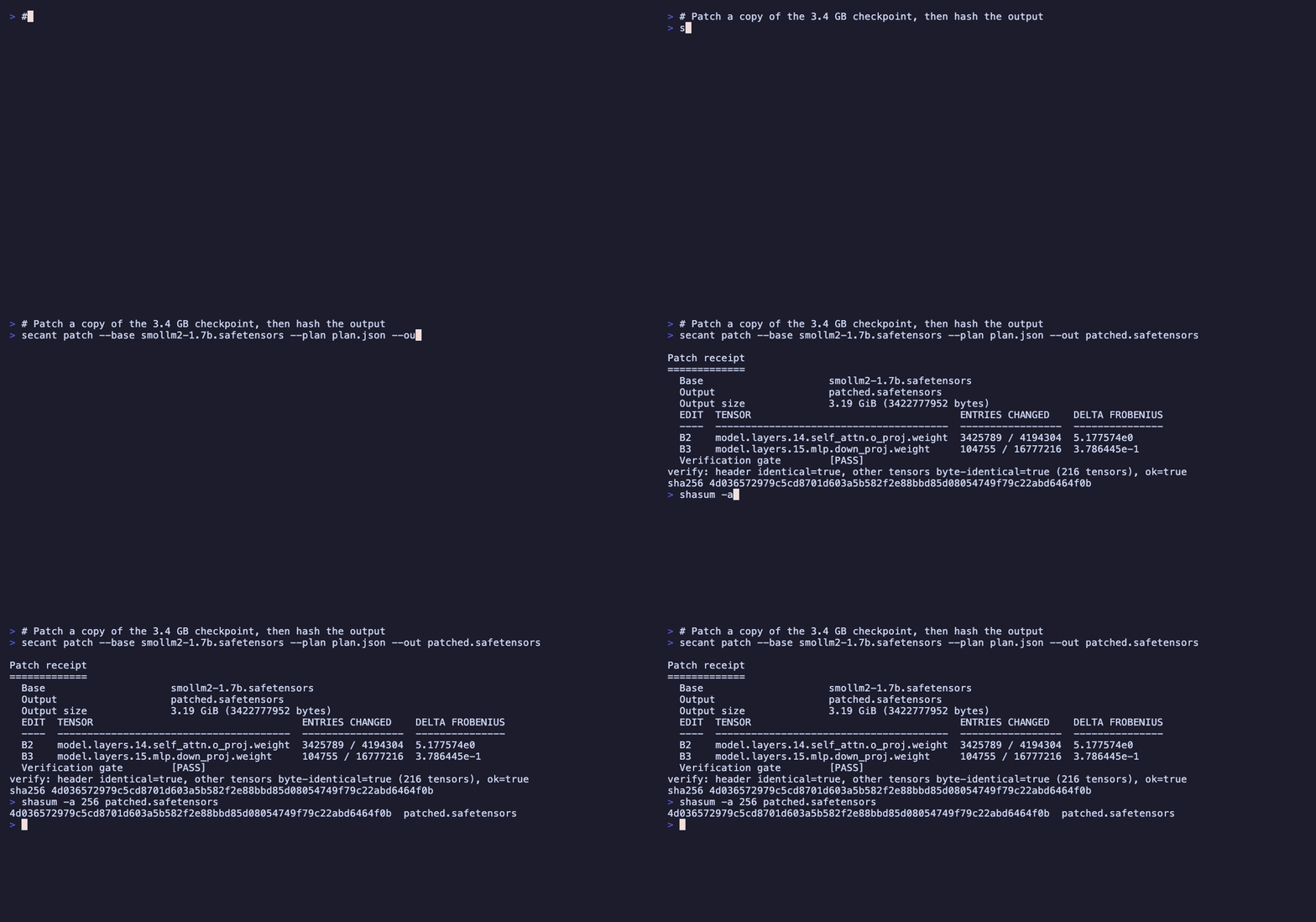
Figure 2:secant patch on a real checkpoint: 104,755 of 16,777,216 entries change in the L15 MLP writer, and every tensor outside the plan stays byte-identical.
What the Reported Experiments Show
Different experiments answer different questions. The paper reports results across checkpoints from 0.8B to 72.7B parameters, but the two largest stress tests used a single checkpoint shard. No single experiment establishes every capability across that range.
| Experiment | Result | What it establishes |
|---|---|---|
Qwen3.5-0.8B MATH-500 4-arm control (n = 100, 4,096 tokens) | base_thinking_on 1.0% (1% closed); base_thinking_off 48.0%; secant_b1_edit 24.0% (64% closed, 31.0% whole-response); random_norm_matched 0.0% (2% closed, p = 1.19e-7 vs. secant_b1_edit) | enable_thinking=False reaches 48.0%, close to the 48.1% Takehi et al. reported for the weight edit under a different protocol (32,768 tokens, stochastic decoding), while with <think> enabled the targeted B1 edit raises </think> completion 64x and beats a norm-matched random edit (24.0% vs. 0.0%). |
Reference-activation calibration, 15 models (0.8B to 32.8B) | Maximum float64 shift error <= 7.99e-15 | The solved step size realizes the exact target shift at the reference activation across model widths. |
Public benchmarks after the edit, 14 models (0.8B to 32.8B) | Calibrated 1.0x edits stay within -2.0 to +2.1 points of base across GSM8K, MATH-500, MMLU-Pro, HumanEval, and ASan-30 | Pooled, unhealed surgical edits leave general benchmarks within about 2 points of base, with one significant pooled cost (MMLU-Pro -2.0); single 100-item cells range from -12 to +19. |
Reasoning-loop test, Qwen3.5-4B, 30 crash traces | Completion within the token limit rose from 0/30 (base and copied 0.8B ratio) to 21/30 (1.0x) and 30/30 (1.5x, 19/30 strict root cause) | On this one model (n = 30, one run per arm), reference-activation sizing closed 21/30 at 1.0x and 30/30 once the loop edit was raised to 1.5x, whereas copying a fixed norm ratio closed 0/30. |
LoRA comparison, 15 models (0.8B to 32.8B) | Gradient-projected AdamW leaked 0.33% to 1.67%; ProjectThenHealLinear stayed at 1.78e-10 to 8.67e-10 (F32) | Forward-pass double projection locks LoRA updates out of the removed subspace under AdamW across all 15 tested architectures. |
Live causal-LM healing & RMS-relative dosing (8 models, 0.8B to 14B) | float64 leakage 5.21e-18..9.87e-18 (max-absolute) and 3.18e-17..5.07e-17 (relative); ProjectThenHealLinear lifted Qwen2.5-Math-7B GSM8K 87% -> 93% and Qwen2.5-Coder-7B HumanEval 36% -> 42% | On looping models (Qwen3-8B), both targeted and random edits lift GSM8K 18% -> 30% by shortening <think> timeouts, showing why random controls are mandatory; direct heal-the-base and healed-random controls show the 87% -> 93% Qwen2.5-Math-7B GSM8K gain comes from the 60-step LoRA pass itself (93% on both controls while ProjectThenHealLinear cuts domain leakage from 4.75% to 5.08e-17), while on Qwen2.5-Coder-7B HumanEval heal-the-base (37%) and healed-random (35%) do not reproduce 42% (p = 0.332 and 0.189, neither surviving Holm correction). |
Paired ASAN-120 vulnerability & benign twins (9 models x 7 arms, 7,560 rows) | 60 vulnerable C/C++ functions paired with 60 patched benign twins. Non-reasoning models (0.8B to 8B) collapse to one-sided guessing (BA = 0.475..0.533). On <think> reasoning models, the composed_rms_1p0x edit beats its random control 4/4 on balanced accuracy (sign test p = 0.125 across 9 models) and lifts strict root-cause recall from 45% to 55% on Qwen3-14B (95% CI 0 to +21.7; no Holm survivor) | Patched benign twins expose models that label almost every snippet VULNERABLE (93% to 100% false-positive rate on Llama-3.1-8B and SmolLM2-1.7B). |
Two-stage spectral Trojan detector (secant audit-trojan, 24 audits) | Whole-matrix spectral metrics trigger near (tested to 16% dose; no signal at the pre-specified 0.10% to 4.00% doses; trigger token in the top 2 of the vocabulary projection at 8%, rank #1 at 10%, sibling flag at 12%) | Stage 1 peels outlier singular values against the Marchenko-Pastur bulk and checks row/column spikes; Stage 2 adds the cross-layer sibling Z-score and --vocab-tensor projection. Together they flag a planted rank-one edit once it approaches the layer’s top singular value; below that, single-file inspection shows no signal. |
Role-aware Boundary-3 sanitization (secant sanitize, 10 GGUF formats & SafeTensors) | Scans 186,870,528 quantized blocks (10 / 10 checkpoints, six GGUF and four SafeTensors including small test models, with 8.99M benign subnormal Q4_K scales) with 0 observed false positives (B3-1 and B3-2A on that corpus; B3-2B and B3-3 validated at rule level on synthetic GPTQ/AWQ/FP8/routing fixtures) | Separating multiplicative block scales (B3-2A) from divisor scales (B3-2B) and routing indices (B3-3) eliminates subnormal false alarms on production GGUF models. |
Static spectral atlas (46-file inventory, 2,619 weight matrices) | 2,619 analyzed 2D tensors across 14 full-model reads and 16 scoped variants; SafeTensors and GGUF copies agree bit-for-bit | Baseline spectral distribution of unedited open-weight models across .safetensors and .gguf. |
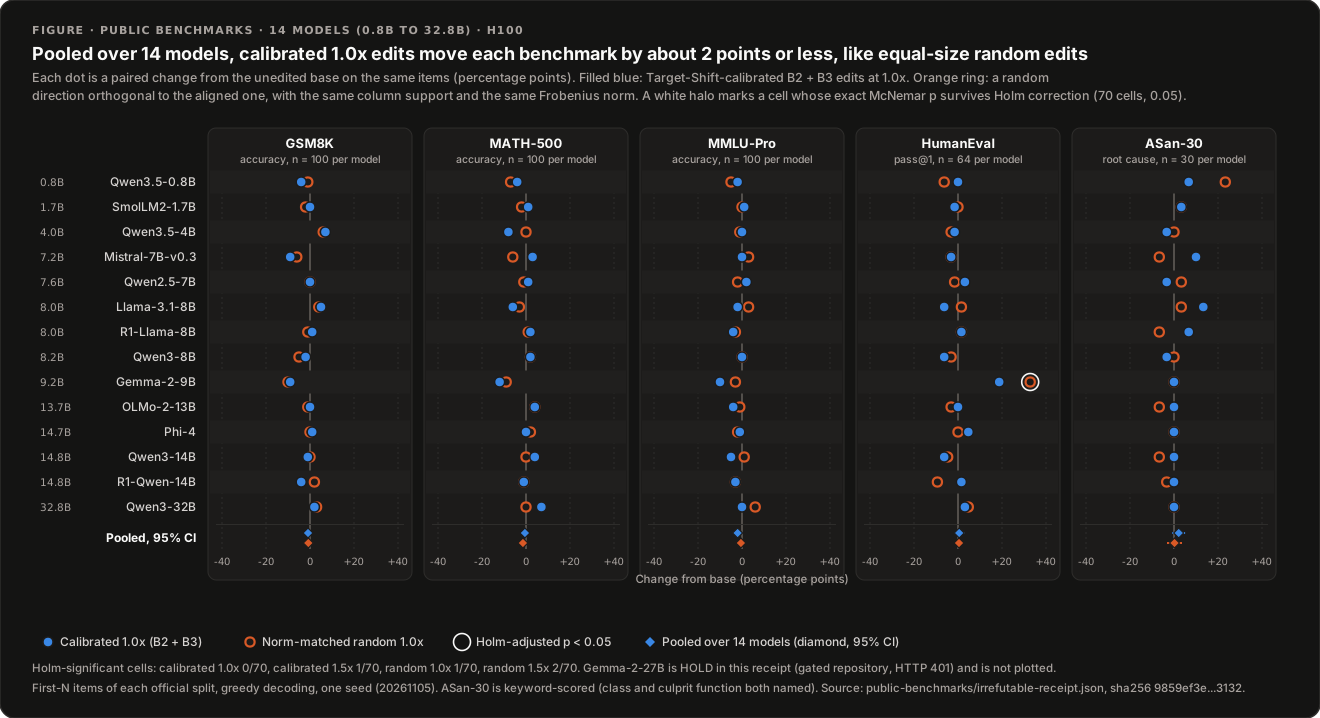
Figure 3:What a calibrated B2 + B3 edit does to public benchmarks on 14 models. Each dot is a paired change from the same model’s unedited score on the same items. Blue is the calibrated edit; orange is a random direction with the same columns and the same Frobenius norm. Almost every dot sits near zero, and blue and orange overlap. Pooled over all 14 models, each benchmark moves by about 2 points or less. The full method and every number are in the paper, Section 4.2.
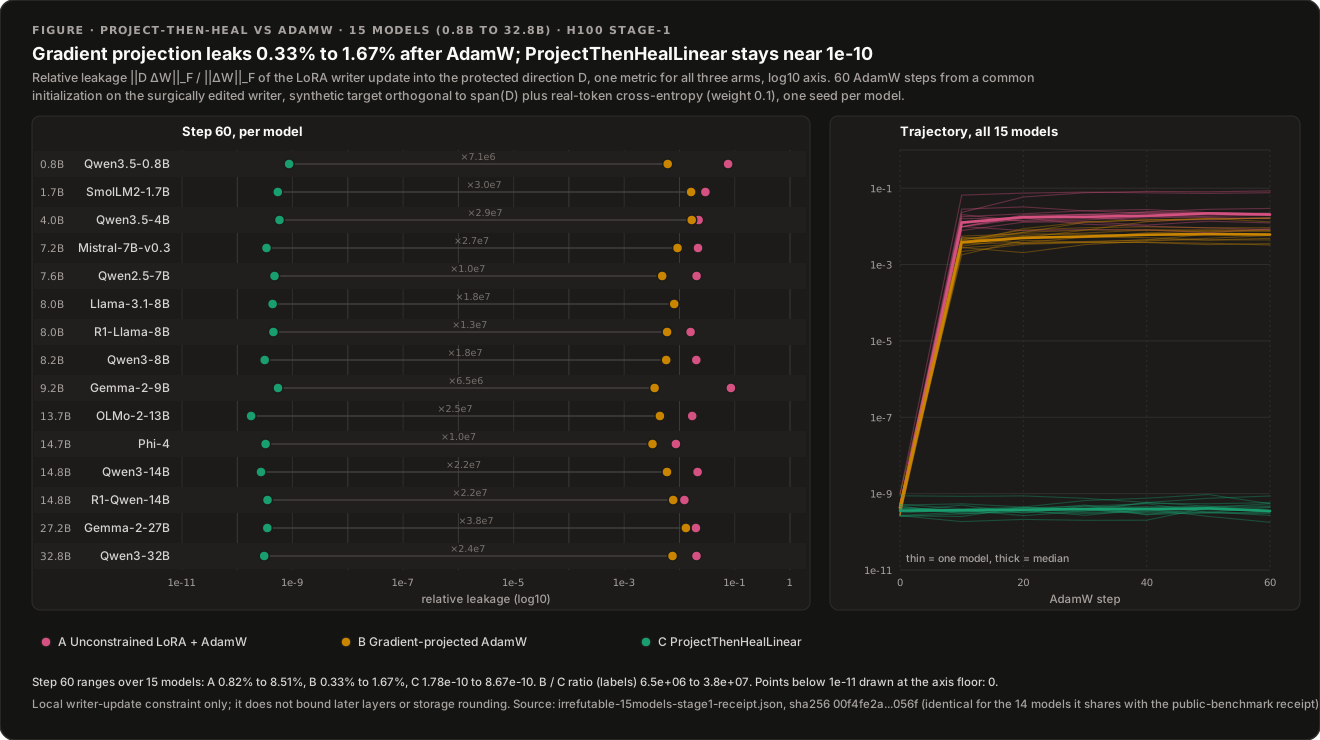
Figure 4:Leakage into the protected direction after 60 AdamW steps, on a log scale. Masking the gradient (yellow) still leaks 0.33% to 1.67%. ProjectThenHealLinear (green) stays between 1.78e-10 and 8.67e-10 on all 15 models, 6.5 million to 38 million times lower than the gradient-masked arm on the same model.

Figure 5:On this 30-prompt test, the calibrated edit completed 21 answers at the standard dose. Increasing only the loop-edit component (B1) to 1.5 times that dose completed all 30, with 23 correct culprit frames and 19 correct root causes. The other two edit components stayed at their standard dose.
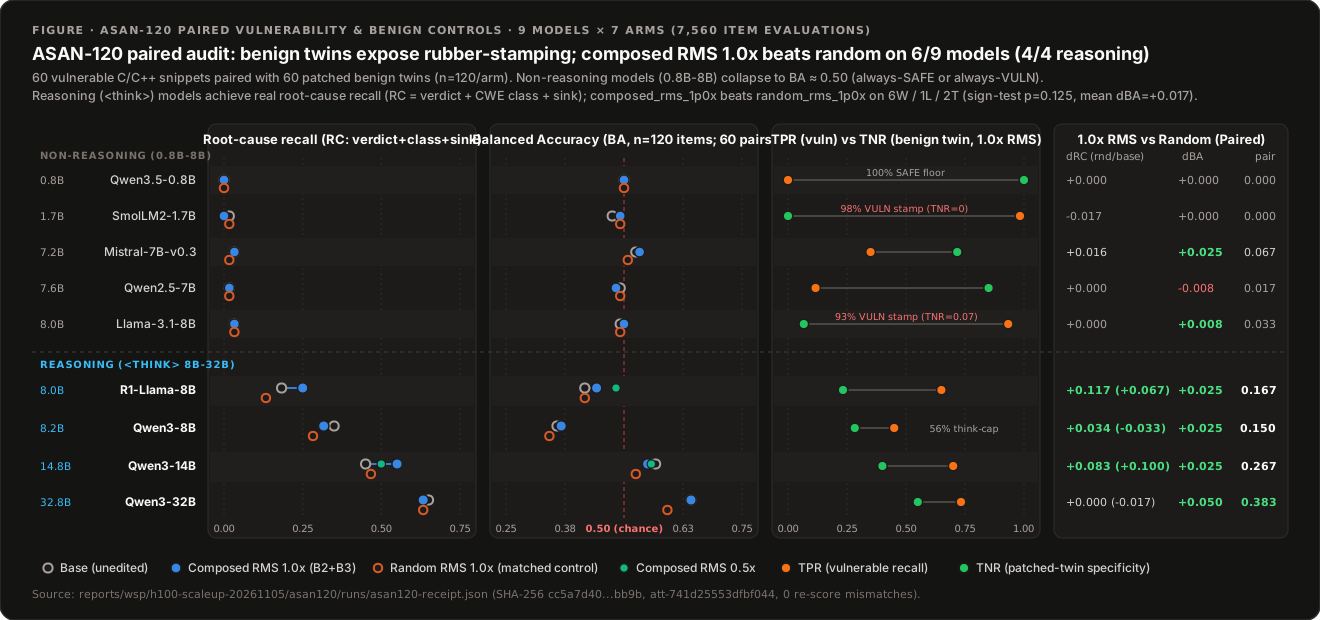
Figure 6:Paired ASAN-120 evaluation across 9 models (60 vulnerable C/C++ snippets paired with 60 patched benign twins, 7,560 completions). Non-reasoning models (0.8B to 8B) collapse to trivial one-sided predictors (BA ≈ 0.50, RC <= 0.067), whereas on the 4 <think> reasoning models composed_rms_1p0x beats random_rms_1p0x 4/4 on balanced accuracy (6W / 1L / 2T overall) and lifts strict root-cause recall (RC) from 0.183 to 0.250 on R1-Llama-8B and from 0.450 to 0.550 on Qwen3-14B. Method and tables: paper, Section 4.5.
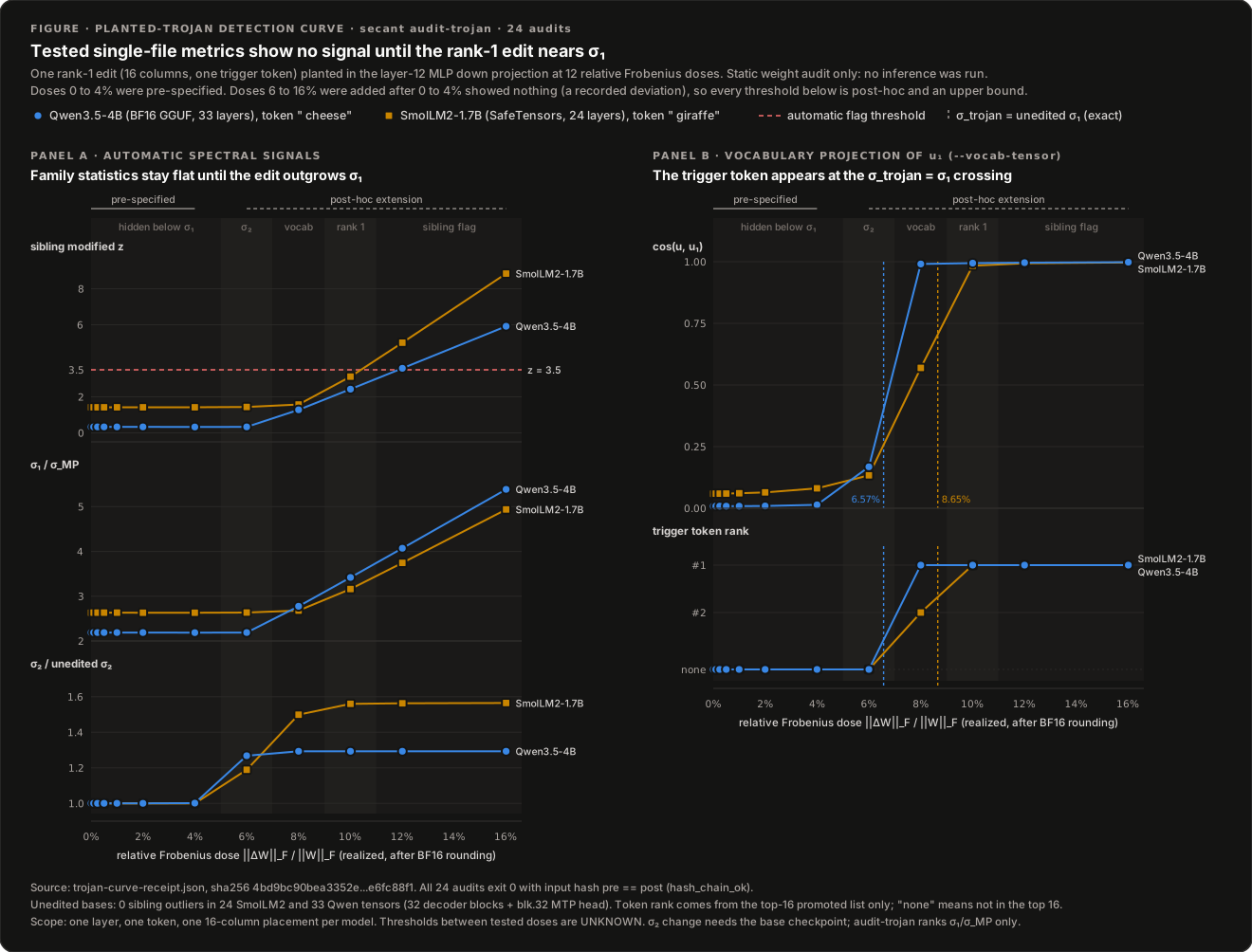
Figure 7:The audit side of the same tools. A rank-1 edit planted in one layer showed no signal at the pre-specified 0.10% to 4.00% doses. The tested post-hoc doses bracket the nominal crossover (6.57% Qwen, 8.65% SmolLM2): moved at 6%, the trigger token reached rank 1 or 2 in the vocabulary projection at 8%, and the automatic sibling test flagged the layer at 12%. Method and tables: payload checks, Section 5.1.
Where to Start
Quickstart: build the tools, try a small local example, and watch the retained terminal recordings.
Theory and calibration: understand direction selection, non-overlapping edits, and reference-based edit sizing before the equations.
Editing quantized weights: understand which compressed blocks can change and why
Q4_Kpatching is refused.Project-Then-Heal: understand the training constraint, its numerical limits, and the measured results.
CLI, Python, and C reference: find command templates, API signatures, exit codes, and receipt fields.
Payload checks: learn what the static scanner checks and what each result means.
Scientific paper: read the derivations, experimental tables, related work, and limitations together.
Secant builds on weight-space programming, representation engineering, and constrained model editing Takehi et al., 2026Zou et al., 2023Zou et al., 2024Arditi et al., 2024. The paper separates prior work from the methods evaluated here.
- Takehi, R., Teoh, J., Zhang, A., & Khattab, O. (2026). Sparks of Weight-Space Programming: LLMs can natively read & write neural network weights. MIT CSAIL. https://rikiyat.github.io/blog/weight-space-programming/
- Zou, A., Phan, L., Chen, S., Campbell, J., Guo, P., Ren, R., Pan, A., Yin, X., Mazeika, M., Dombrowski, A.-K., & others. (2023). Representation Engineering: A Top-Down Approach to AI Transparency. arXiv Preprint arXiv:2310.01405.
- Zou, A., Phan, L., Wang, J., Duenas, D., Lin, M., Andriushchenko, M., Wang, R., Kolter, Z., Fredrikson, M., & Hendrycks, D. (2024). Improving Alignment and Robustness with Circuit Breakers. arXiv Preprint arXiv:2406.04313.
- Arditi, A., Obeso, O., Syed, A., Paleka, D., Panickssery, N., Gurnee, W., & Nanda, N. (2024). Refusal in Language Models Is Mediated by a Single Direction. Advances in Neural Information Processing Systems (NeurIPS).