This guide covers five workflows: inspect weights, prepare an edit, patch a checkpoint, constrain an adapter, and check a small test file. The examples use the standalone Rust secant CLI and the Python package.
Start with the small local self-test if you do not have a model ready, or watch the real terminal recordings of a full edit on a 1.7B checkpoint first. Workflows 1 to 4 are templates: supply your own checkpoint, captured activations, profile, and tensor names. They are not a single runnable experiment or a reproduction of the paper’s benchmarks.
1. Build and Install
Run from the repository root with Rust/Cargo and Python installed. Installation time depends on your machine and cached dependencies.
# 1. Build the Rust CLI (secant) and C-ABI library (libsecant) in release mode
cargo build --release --workspace

# 2. Show the available commands
./target/release/secant --help
export PATH="$PWD/target/release:$PATH"

# 3. Install the Python package (PyTorch ProjectThenHealLinear + contrastive capture)
pip install -e "./python[torch,test]"

# 4. Optional: run the Rust and Python test suites
cargo test --workspace
pytest python/tests
Commands Used in This Guide
| Stage | Subcommand | What It Does |
|---|---|---|
| 01 · Audit & Read | secant profiles | Lists research profiles, such as think-loop-fix and security-auditor-b1b2b3, and their edit slots. |
| secant inspect | Lists tensor names, shapes, storage types, and byte offsets. | |
| secant read | Measures matrix size, leading directions, and optional vocabulary scores. | |
| secant sanitize | Static weight-value scanner and optional repair for NaN, Inf, divisor scales, and routing IDs. Q8_0 and Q4_K zero or FP16 subnormal block scales pass by default; --flush-subnormal is opt-in. | |
| secant probe | Deterministic generator for boundary-value test fixtures (class1..class4). | |
| 02 · Analyze & Compose | secant analyze | Combines layer rankings from captured signal-to-noise measurements. |
| secant compose | Makes supplied directions perpendicular, selects layers from --analysis, and sizes edits from reference activations. | |
| 03 · Patch | secant patch | Edits supported BF16, F16, and F32 weights, writing a copy by default. |
| secant verify-patch | Checks header identity and byte identity outside the supplied tensor allowlist. | |
| secant quant patch | Edits selected Q8_0 blocks, writing a new checkpoint by default. | |
| secant quant witness (verify) | Measures quantization error and optional reordering of 128-column panels. | |
| secant quant roundtrip | Encodes and decodes a matrix to measure compression error. | |
| 04 · Lock & Heal | secant heal | Removes protected output components from an existing adapter and optionally merges it. |
| secant verify-subspace | Compares a base and healed checkpoint at selected tensors, checking leakage against --tol. |
2. Workflow 1: Inspect a Checkpoint and Read Its Weights
inspect lists the tensors in a checkpoint. read measures matrix structure and can score vocabulary tokens against its leading directions. Neither command runs inference. Treat the vocabulary scores as clues about static weights, not predictions of what the model will say. A memory map lets the program access file bytes without first loading the whole checkpoint into a framework.
# 1. Inspect tensor names, dtypes, shapes, and exact byte offsets on disk
secant inspect --model Qwen3.5-4B.safetensors --json

# 2. Read the top singular directions of layer 15's MLP writer and project onto the vocabulary
secant read \
  --model Qwen3.5-4B.safetensors \
  --tensor "model.layers.15.mlp.down_proj.weight" \
  --vocab-tensor "model.embed_tokens.weight" \
  --top-k-singular 3 \
  --top-cols 8 \
  --detect-anomalies \
  --json
What to look for in the JSON receipt (secant.wsp.read.v1):
input_unchanged: true: the model’s SHA-256 matched before and after the read.singular[]: the top singular values , convergence residuals, and the highest-energy input column indices (top_columns) that feed that singular direction.vocab_projection: when--vocab-tensoris supplied, each singular vector is dotted against the vocabulary matrix to surface the highest-affinity and most-suppressed token IDs directly from static weights.
Takeaway: You can see a checkpoint’s layout and the structure of any matrix without loading the model, and the
readreceipt confirms the file was not modified.
3. Workflow 2: Capture Directions and Prepare an Edit
A contrastive direction is the difference between the average activations of two prompt groups. The snippet below assumes you have already collected those activations at the final prompt token. Check that a direction separates held-out examples before using it in an edit:
from secant.capture import capture_contrastive_directions, write_vectors

# activations: dict mapping (stream_name, layer_idx) -> (pos_acts [n_pos, d], neg_acts [n_neg, d])
results = capture_contrastive_directions(activations=activations, seed=20261104)

# Inspect held-out signal-to-noise (snr_proj) and split-half cosine to pick the sharpest layer
valid = {key: r for key, r in results.items() if r.status == "ok"}
for (stream, layer), r in sorted(valid.items(), key=lambda kv: -kv[1].snr_proj)[:5]:
    print(f"{stream} L{layer}: status={r.status} snr_proj={r.snr_proj:.1f} cos={r.split_half_cosine:.3f}")

# Save float64 direction vectors only (d_*.npy); reference inputs are separate
write_vectors("./vectors", valid)
write_vectors saves direction files only. It does not save reference activations or the layer_snr.json input expected by analyze. Before composing, prepare those inputs and a profile that matches your model:
The capture stream names become
d_<stream>_L<layer>.npy; they must match the profile’s direction tokens.A
rank1-columnsslot also needs the corresponding writer-input reference activation, such ash_<token>_L<layer>.npy. This has the writer’s input width, which may differ from the output-direction width.Store metrics outside the vectors directory. The composer interprets vector-directory JSON files as vectors.
layer_snr.jsonmust follow an input layout supported bysecant analyze; it is not generated by the snippet above. See Native WSP Extensions.
With those inputs ready, analyze combines per-stream layer rankings using Borda voting: each stream contributes points based on rank. compose removes overlap between directions and calculates an edit size from the reference activation. Inspect the resulting plan’s layers, tensor names, signs, and sizes before patching.
# 1. Rank layers by empirical SNR_proj across resid / attn / mlp / h streams
secant analyze \
  --in layer_snr.json \
  --profile security-auditor-b1b2b3 \
  --out analysis.json \
  --json

# 2. Orthogonalize directions in float64, bind auto slots from analysis.json, and solve target-shift step
secant compose \
  --profile security-auditor-b1b2b3 \
  --vectors ./vectors \
  --analysis analysis.json \
  --target-shift -7.382 \
  --out plan-b1b2b3.json \
  --json
What calibration guarantees: The requested shift is calculated for the supplied reference activation. Different inputs and lower-precision storage can change the realized shift. The profile supplies each slot’s sign; the flag is not a universal “make every edit negative” switch. The reported
Qwen3.5-4Bcompletion results also depend on the specific directions, prompts, and doses described in the paper.
Takeaway:
analyzepicks layers,composeturns directions into a reviewable plan. Nothing touches a checkpoint until you runpatch.
4. Workflow 3: Write and Verify a Patched Copy
Use the model revision and tensor layout for which you prepared the plan. Set the shell variable CHANGED_TENSORS to the exact comma-separated checkpoint tensor names allowed to change in that plan. The verifier does not infer this list, and allowing a change does not prove that the intended numerical edit happened.
Option A: Floating-Point Weights
Use secant patch for supported floating-point tensors. Keep the base file for verification.
secant patch \
  --base Qwen3.5-4B-BF16.gguf \
  --plan plan-b1b2b3.json \
  --out Qwen3.5-4B-BF16-patched.gguf \
  --json

secant verify-patch \
  --base Qwen3.5-4B-BF16.gguf \
  --patched Qwen3.5-4B-BF16-patched.gguf \
  --expect-changed "$CHANGED_TENSORS" \
  --json
Option B: Compressed Q8_0 Weights
A Q8_0 block stores 32 weights in 34 bytes. The patcher decodes and re-encodes blocks that intersect the edit, while retaining untouched block bytes. You need a plan and vectors prepared for this same model and layout. The example writes a new file; --in-place is a separate choice that mutates the input.
# 1. Optional: measure quantization error along compatible output directions
secant quant witness --model Qwen3.5-4B-Q8_0.gguf \
  --tensor blk.15.ffn_down.weight --vectors directions.npy --format q8_0 --json

# 2. Patch selected Q8_0 blocks in a new copy
secant quant patch \
  --base Qwen3.5-4B-Q8_0.gguf \
  --plan plan-b1b2b3.json \
  --out Qwen3.5-4B-Q8_0-patched.gguf \
  --json

# 3. Verify the header and tensors outside the allowed change list
secant verify-patch \
  --base Qwen3.5-4B-Q8_0.gguf \
  --patched Qwen3.5-4B-Q8_0-patched.gguf \
  --expect-changed "$CHANGED_TENSORS" \
  --json
Format limit: Four
Q8_0blocks fit in a 128-column panel. AQ4_Ksuperblock spans two such panels and shares encoding parameters across them.secant quant patchtherefore refusesQ4_K. Block alignment does not guarantee that a behavioral edit will succeed; the guide’s numerical results are measurements from specific experiments.
Takeaway: Patch a copy, then let
verify-patchprove that only the tensors you named changed. Steps 4 and 5 of the recordings show this on a real checkpoint.
5. Workflow 4: Constrain a LoRA Adapter
LoRA learns an adapter while the original weights stay fixed. Ordinary LoRA can add a component along a direction you removed earlier. Projecting only the gradient may not prevent this because AdamW rescales the gradient’s coordinates.
ProjectThenHealLinear removes those components whenever the adapter runs. It calculates the projection in float64 and casts the result back to the working dtype. The constraint is local to the wrapped layer; measure leakage again after a merge or precision change. In this snippet, edited_linear is an existing edited torch.nn.Linear, and directions.npy contains compatible output directions. Replace the original layer in your model with locked_layer before training.
import torch
from secant.nn import ProjectThenHealLinear

# Wrap any edited nn.Linear layer; D is [k, d_out] (tensor, numpy array, or .npy path)
locked_layer = ProjectThenHealLinear.from_linear(
    edited_linear,
    rank=16,
    directions="vectors/directions.npy",
    alpha=16.0,
    module_name="model.layers.15.mlp.down_proj",
)

# Train lora_A and lora_B_tilde normally with AdamW
optimizer = torch.optim.AdamW([locked_layer.lora_A, locked_layer.lora_B_tilde], lr=2e-4)

# Measure the maximum protected component in the working-dtype adapter
print("max |D B_locked|:", locked_layer.leakage())

# Export locked LoRA adapter to .safetensors
locked_layer.export_lora("trained-locked.safetensors")
The CLI can project an existing adapter once and optionally merge it. Further ordinary LoRA training can undo that one-time constraint. The following uses separate .safetensors inputs, not the GGUF outputs above. Keep only compatible protected directions in protected-vectors/; use the adapter’s actual alpha/r scale (shown here as 1.0). Choose output names that do not already exist:
secant heal \
  --lora lora_adapter.safetensors \
  --vectors ./protected-vectors \
  --out lora_locked.safetensors \
  --base patched.safetensors \
  --merge-out healed.safetensors \
  --scale 1.0 \
  --json

secant verify-subspace \
  --base patched.safetensors \
  --healed healed.safetensors \
  --vectors ./protected-vectors \
  --tensors model.layers.15.mlp.down_proj.weight \
  --tol 1e-5 \
  --json
Takeaway: Use
ProjectThenHealLinearwhile training andsecant healfor an adapter that already exists, then measure leakage again after any merge or precision change.
6. Workflow 5: Try a Small Local Self-Test
This small example needs no model download or GPU. It creates a test file with non-finite values, writes a repaired copy, and checks the changed tensor boundaries. Run it in a fresh scratch directory because these commands refuse existing outputs. The hashes below are retained expected values, not timing guarantees. This checks the file tools, not inference-runtime safety.
# 1. Generate a deterministic 736-byte fixture with 72 NaNs and 18 Infs
secant probe --class class3 --format safetensors \
  --out-dir fixtures --receipt probe-receipt.json --attempt-id quickstart-1
# -> sha256 = 22ffbb02b3e4d9c5560967bc7908f6991629fae9edf5d23c2b4419731555d503

# 2. Inspect its 3 tensors on disk
secant inspect --model fixtures/class3-nan-sort-arrays.safetensors --json

# 3. Scan for non-finite values and remediate into a clean copy
secant sanitize --model fixtures/class3-nan-sort-arrays.safetensors \
  --receipt clean-receipt.json --attempt-id quickstart-1 \
  --clamp-nonfinite --out clean.safetensors
# -> exit 0, status="remediated", clean.safetensors sha256 = 1e0b8f013a3f2e78e291fb1976f3b24372b3492716a88dbe64a7137df4f2a403

# 4. Compute the leading singular value on the repaired tensor
secant read --model clean.safetensors --tensor 'blk.0.*' --top-k-singular 1 --top-cols 2 --json
# -> status="ok", sigma = 24494.89743144648, residual = 2.715678131663147e-16

# 5. Verify header parity and changed-tensor boundaries
secant verify-patch --base fixtures/class3-nan-sort-arrays.safetensors --patched clean.safetensors \
  --expect-changed blk.0.router_scores.weight,blk.1.router_scores.weight,blk.2.router_scores.weight --json
# -> header_bytes_identical=true, other_tensors_byte_identical=true, ok=true (exit 0)
Takeaway: If your hashes match the ones above, your build reproduces the reference outputs byte for byte.
7. Watch It Run: Real Terminal Recordings
The six terminal captures below show the compiled secant release binary running each step of an edit on HuggingFaceTB/SmolLM2-1.7B-Instruct (3.4 GB BF16 .safetensors, SHA-256 f55217be...a0e8), producing the patched file (4d036572...4f0b) from the paper’s live-healing experiment (Regime A).
Step 1: secant inspect reads the file layout without loading the model. It reports 218 BF16 tensors behind a 25,184-byte header.
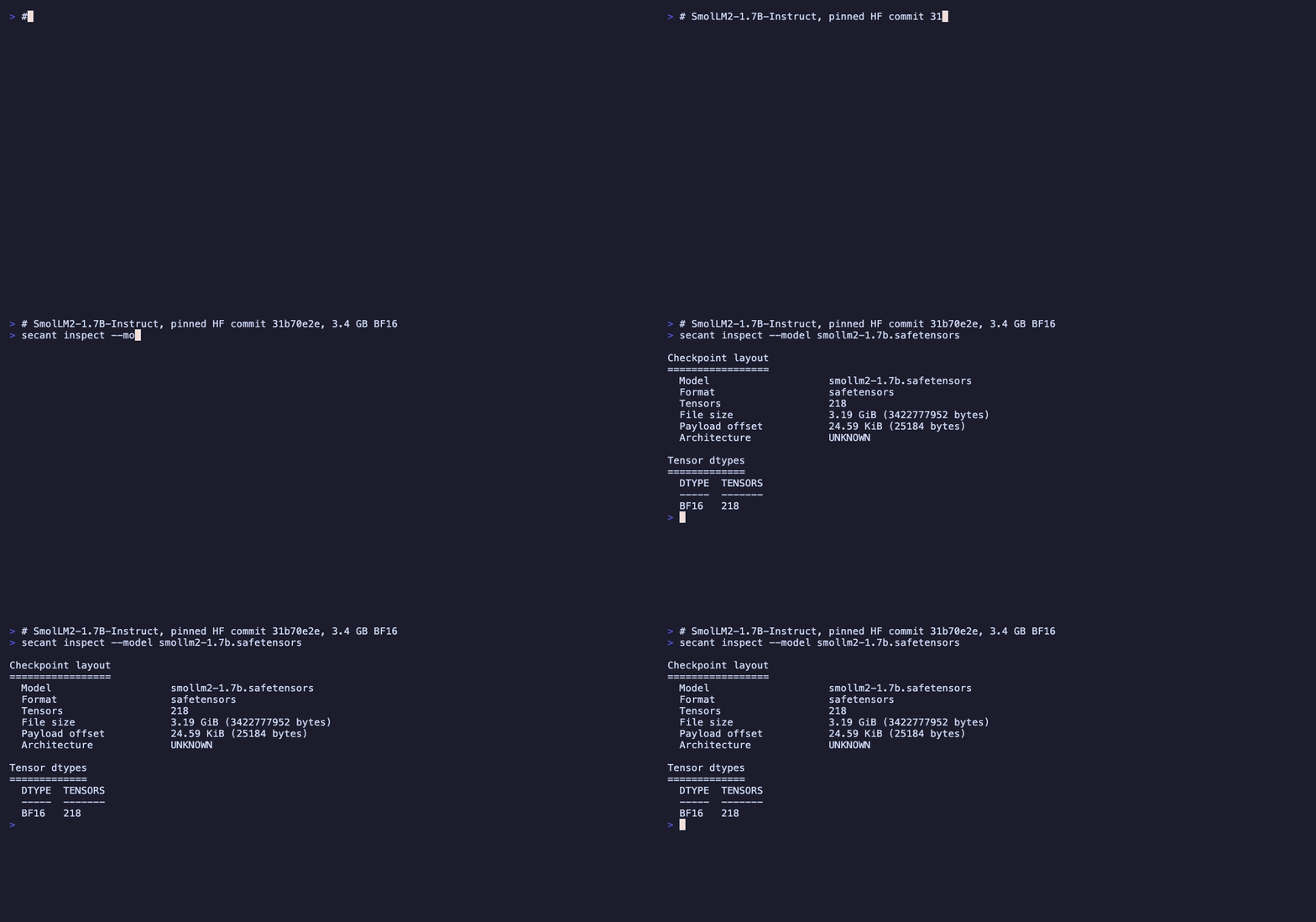
Figure 1:secant inspect --model smollm2-1.7b.safetensors
Step 2: secant analyze ranks layers from the captured signal-to-noise ratios. For each behavior it combines the rankings from four activation streams (Borda count). The b2 family peaks at L11 and b3 at L12. The tool also reports where the hard-coded mid-layer default (L15/L19) ranks instead.
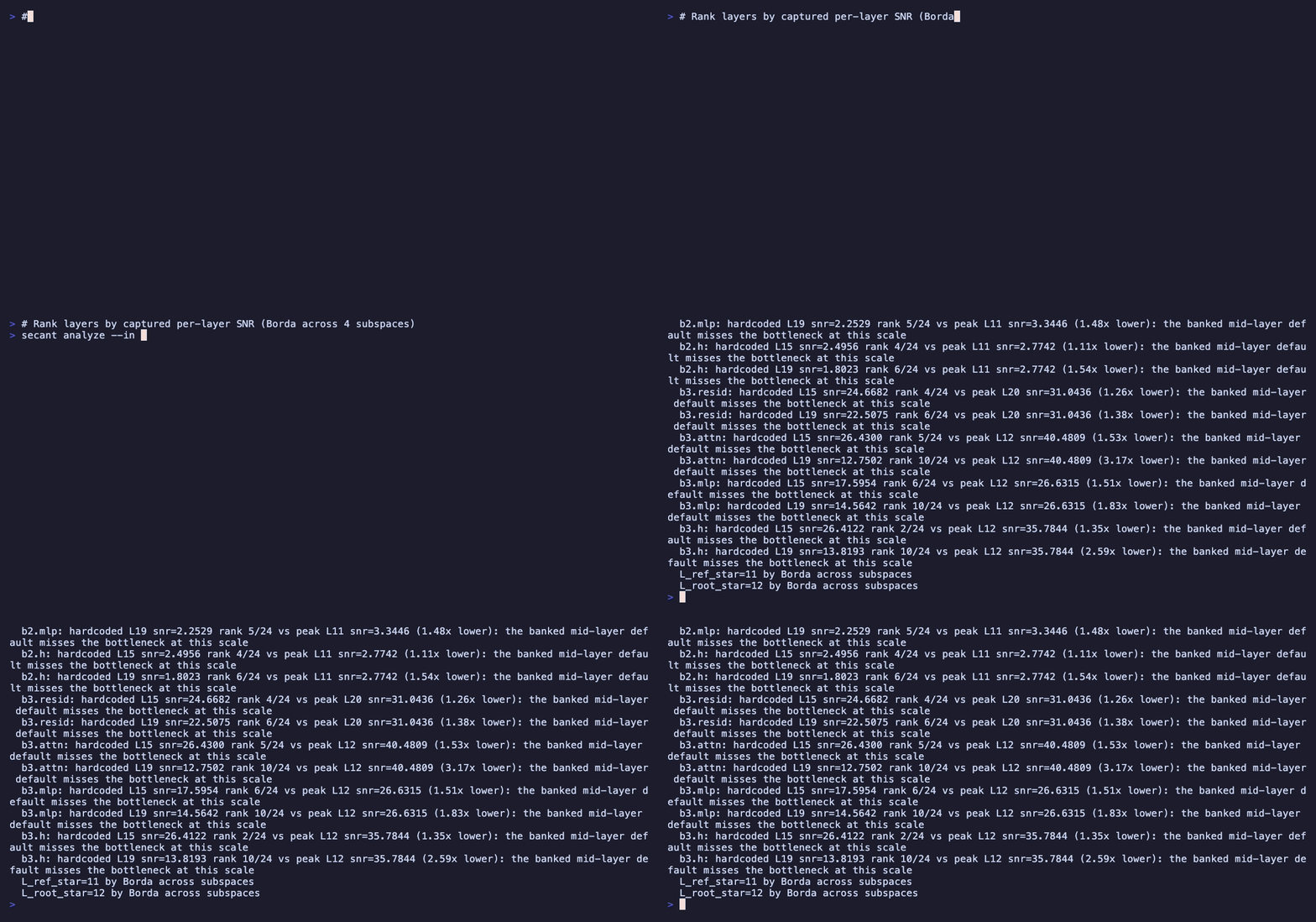
Figure 2:secant analyze --in layer_snr.json --out analysis.json
This profile pins its layers explicitly (B2 at L14, B3 at L15), so the next step does not read analysis.json. To bind layers from the ranking instead, use a profile whose slots set layer: -1 and pass --analysis analysis.json to compose.
Step 3: secant compose turns directions into an edit plan. Gram-Schmidt leaves a largest cosine of 1.125e-17 between the two directions, far below the 1e-12 gate. B3 edits 64 columns, sized so the shift at its reference activation is +3.895616.
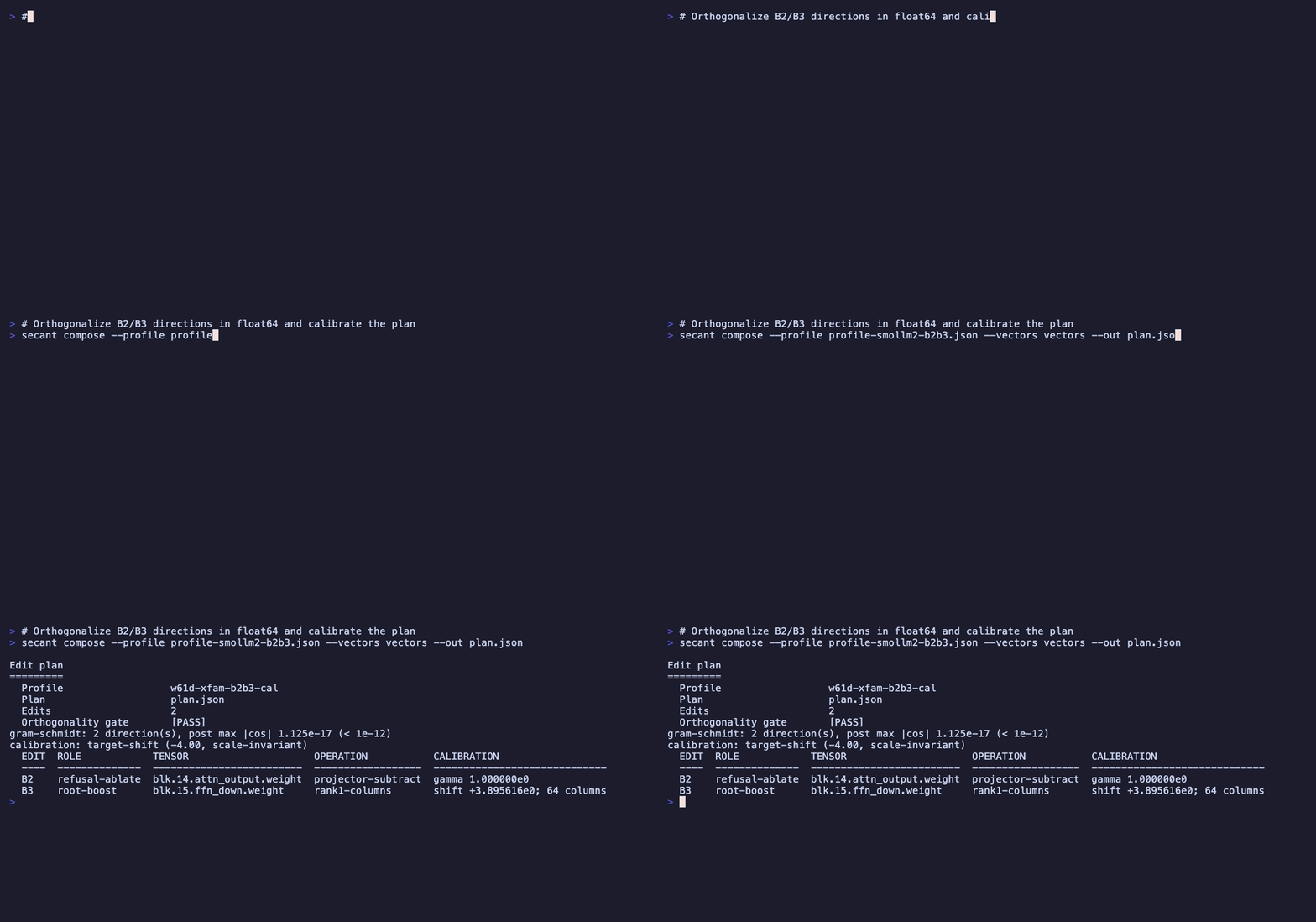
Figure 3:secant compose --profile profile-smollm2-b2b3.json --vectors vectors --out plan.json
Step 4: secant patch writes the edits into a copy of the file. B2 changes 3,425,789 of 4,194,304 entries in model.layers.14.self_attn.o_proj.weight. B3 changes only 104,755 of 16,777,216 entries (0.6%) in model.layers.15.mlp.down_proj.weight. shasum then confirms the output hash.
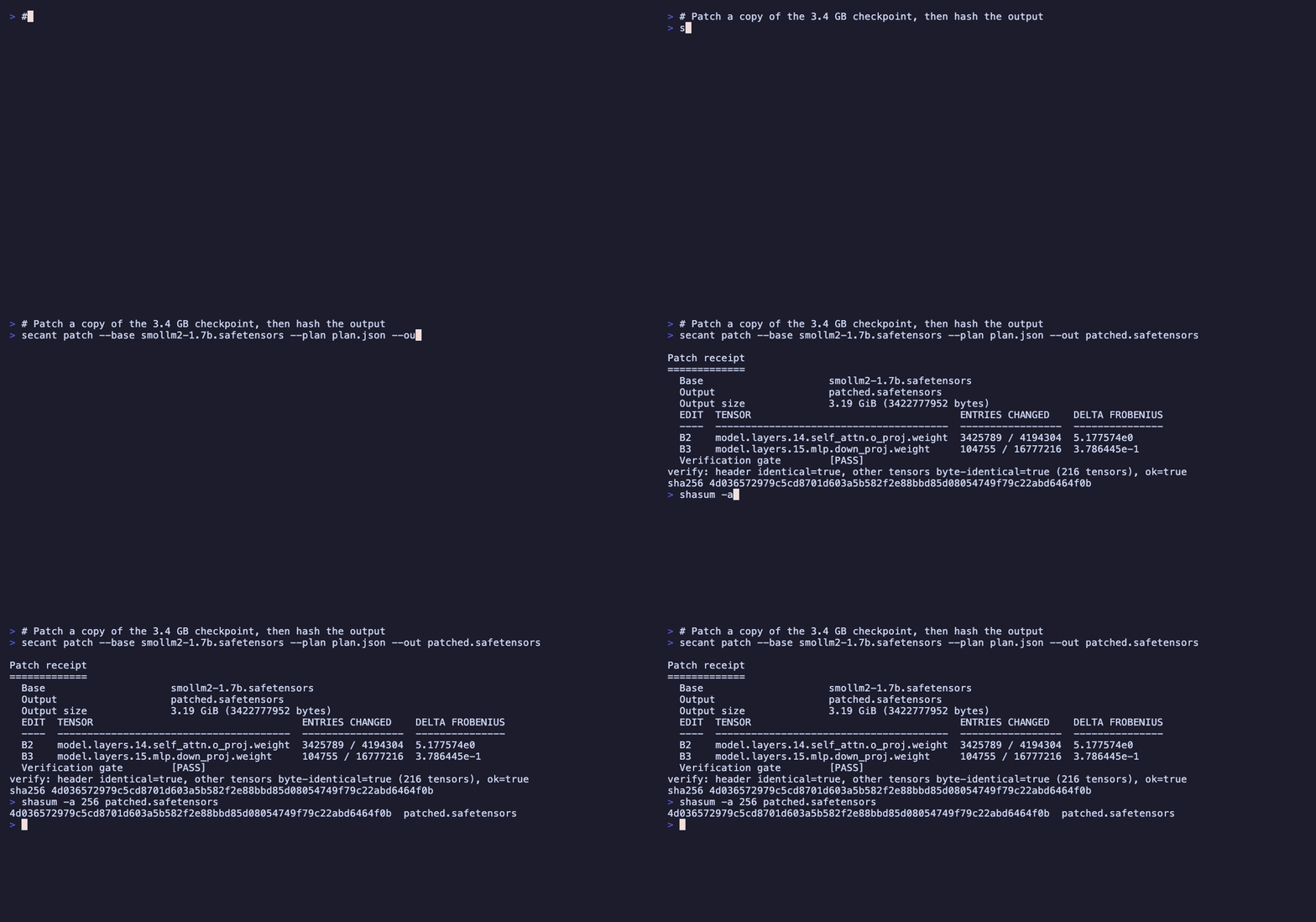
Figure 4:secant patch --base smollm2-1.7b.safetensors --plan plan.json --out patched.safetensors
Step 5: secant verify-patch proves nothing else moved. The header is byte-identical, only the two named tensors differ, and the other 216 tensors are byte-identical to the base.
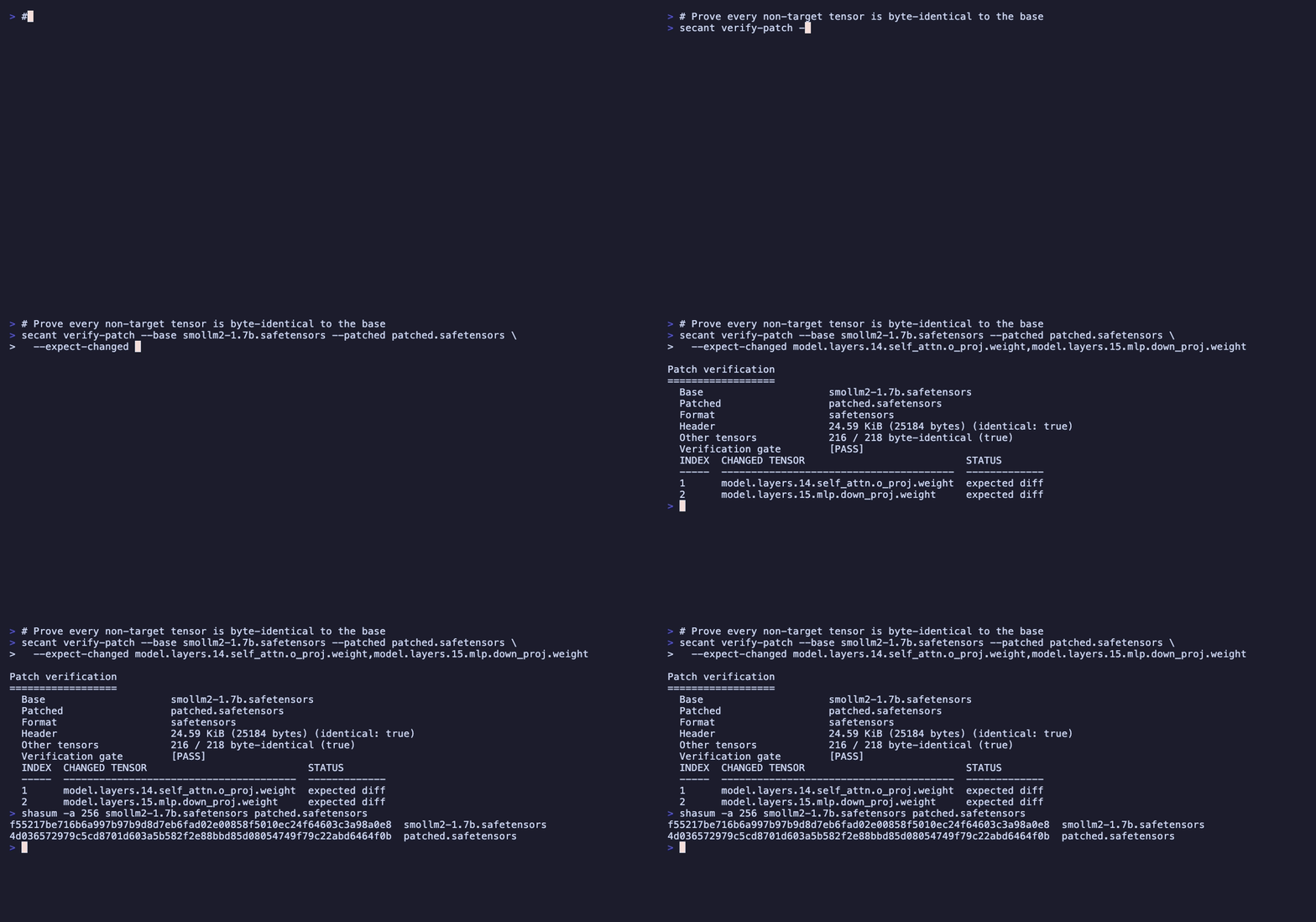
Figure 5:secant verify-patch --base smollm2-1.7b.safetensors --patched patched.safetensors --expect-changed ...
Step 6: secant probe generates the self-test fixtures. It writes the same NaN/Inf fixture as both .safetensors and .gguf, then inspects the .gguf copy.
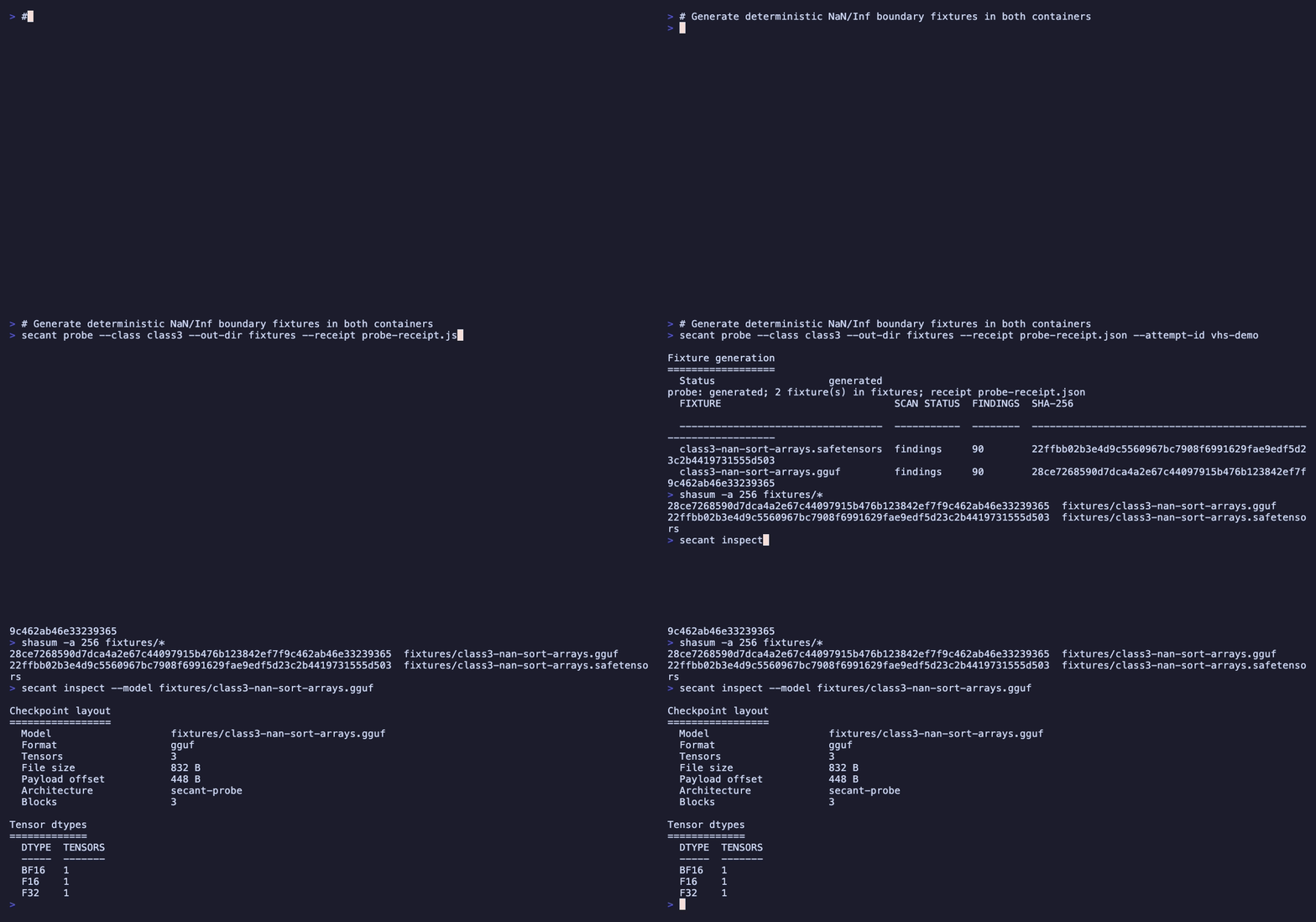
Figure 6:secant probe --class class3 --out-dir fixtures --receipt probe-receipt.json --attempt-id vhs-demo
The CLI, Python & C-ABI Reference documents all sixteen root commands, including fetch-tensor, rotation-test, audit-trojan and scan-sinks.