Abstract
Editing a language model’s weights can change how it responds without retraining the whole model. Turning that idea into a reliable workflow requires answering three questions: how large should an edit be, which bytes should change in a compressed checkpoint, and how can later fine-tuning respect the edited directions?
Secant combines Rust checkpoint tools with a PyTorch adapter layer. Target-Shift Calibration sizes an edit to produce a requested change at a chosen layer’s reference activation. The equality is exact in real arithmetic; reported numerical tests across 15 models have a maximum float64 error of about 7.99e-15. Quantized block editing updates only the affected groups of 32 weights in Q8_0 files. Reordering complete 128-column panels preserves those blocks, whereas Q4_K groups 256 weights together and does not generally preserve the same boundary. The standalone patch command therefore refuses Q4_K. Project-Then-Heal constrains a LoRA adapter, a small trainable addition to a frozen model, so its output is perpendicular to supplied directions. It applies the constraint during each forward pass because projecting gradients alone need not survive AdamW’s coordinate-wise scaling.
The reported experiments measure both local numerical properties and model responses across six evaluation domains (MATH-500, GSM8K, MMLU-Pro, HumanEval, ASan-30, and paired ASAN-120; 59,440 retained H100 evaluation rows: 59,140 completed-cohort rows across 17 completed benchmark model identities in the Stage-2 + RMS suites from 0.8B to 32.8B plus 300 partial Gemma-2-27B baseline rows, alongside a 17-checkpoint PTH study from 0.8B to 72.7B, a 15-model calibration/adapter study, and a 4-arm Qwen3.5-0.8B MATH-500 attribution test), directly extending Takehi et al.'s Qwen3.5-0.8B loop-suppression study (Sparks of Weight-Space Programming, Nov 2, 2026, where an autonomous LLM agent gpt-6-astra / Astra traced activations and edited weights inside a Python kernel under a 10/25/50 forward-pass budget) to multi-subspace calibration with norm-matched random controls, compressed GGUF block surgery, subspace-locked LoRA healing, and paired vulnerability/benign controls.
On Qwen3.5-0.8B MATH-500 (n = 100, 4,096 tokens), setting enable_thinking=False lifts unedited accuracy from 1.0% (12.0% whole-response) to 48.0% (), matching Takehi et al.'s 48.1% edited score at 32,768 tokens consistent with weight subtraction unblocking pre-existing math capability rather than teaching new math; with <think> enabled, our 0.016% B1 edit raises </think> closure 64x (1% -> 64%) and final accuracy to 24.0% (31.0% whole-response), whereas across three independent orthogonal norm-matched random seeds (seed_1..seed_3, 20261108..20261110) on the exact same 64 columns, random edits close 2.0%, 6.0%, and 1.0% (mean 3.0% ± 2.6%, 0/100 closed by majority vote) and score 0.0%, 2.0%, and 1.0% final accuracy (mean 1.0% ± 1.0%, 0/100 solved by majority vote; exact McNemar , Holm-adjusted across all 3 seeds). On 30 crash-triage prompts, calibrated edits to Qwen3.5-4B raised completion within a fixed token limit from 0/30 to 21/30, then 30/30 at a higher loop-edit dose (reported paired p = 1.86e-9 against baseline, with strict root-cause attribution rising from 0/30 to 19/30). In the 15-model adapter comparison (0.8B to 32.8B), Project-Then-Heal’s relative weight-update leakage into the protected directions was 1.78e-10 to 8.67e-10, compared with 0.33% to 1.67% for gradient-projected AdamW. These are results for the stated experiments. Calibration at one reference input does not guarantee behavior on other prompts, and a local adapter constraint does not prevent later layers or storage rounding from changing the result.
The same tools also audit weights. In one planted rank-1 edit per model, on SmolLM2-1.7B and Qwen3.5-4B, the edit stayed invisible to secant audit-trojan across the pre-specified doses (0.10% to 4.00%) until the post-hoc doses reached the nominal singular-value equality reference (8.65% and 6.57% of the weight norm, where ). The trigger token reached rank 1 or 2 in the vocabulary projection at 8%, and the automatic sibling outlier test fired at 12%, with no false positives on the unedited bases. Across the 10-checkpoint corpus (six quantized formats present: Q8_0, Q4_K, Q6_K, Q2_K, Q3_K, Q4_0; 186,870,528 quantized blocks across 912 quantized tensors, plus 3,258,570,112 float elements across the 10 tested production GGUF and SafeTensors checkpoints), secant sanitize (Rule B3-2A) permits legitimate zero (0x0000) and FP16 subnormal (0x0001..0x03FF) multiplicative block scales by default (0 observed false positives across 10 / 10 checkpoints and 8,992,791 of 33,792,000 header scale fields d, dmin across 16,896,000 Q4_K superblocks), while flagging 100% of planted NaN and ±Inf block scales ((bits & 0x7C00) == 0x7C00), near-zero divisor scales (Rule B3-2B, < 1e-12f), and out-of-bounds integer routing indices (Rule B3-3).
On 14 five-arm models with public benchmarks (27,580 five-arm evaluations plus 300 base-only Gemma-2-27B evaluations = 27,880 rows across GSM8K, MATH-500, MMLU-Pro, HumanEval, and ASan-30), the calibrated edits left scores where equal-size random edits left them. Across a 6-model RMS-relative dosing study (24,000 benchmark evaluations), writer output norms spanned 5.85 to 78.15, showing that a fixed unit shift ranges from 1.28% to 17.10% of the writer norm across architectures. Unhealed composed edits matched norm-matched random controls across all 6 models, while adding ProjectThenHealLinear (3.18e-17 to 5.07e-17 relative subspace leakage) raised GSM8K (87% to 93%, unadjusted p = 0.031) on Qwen2.5-Math-7B-Instruct and HumanEval (36% to 42%, unadjusted p = 0.238) on Qwen2.5-Coder-7B-Instruct; neither gain survives Holm-Bonferroni correction across the full test family, and direct heal-the-base (base_lora_1p0x) and healed-random (random_healed_rms_1p0x) control arms show that on Qwen2.5-Math-7B-Instruct both controls also reach 93% on GSM8K (p = 1.000 vs. composed_healed_rms_1p0x, attributing the 87% -> 93% gain to the 60-step LoRA adaptation pass while ProjectThenHealLinear reduces domain-subspace leakage from 4.75% to 5.08e-17), whereas on Qwen2.5-Coder-7B-Instruct HumanEval base_lora_1p0x (37%) and random_healed_rms_1p0x (35%) do not reproduce composed_healed_rms_1p0x (42%, +5 and +7 items, p = 0.332 and 0.189). Finally, on the paired ASAN-120 vulnerability and patched-benign twin benchmark (7,560 evaluations across 9 models 7 arms), patched twins expose one-sided rubber-stamping in non-reasoning models (BA = 0.475..0.533), while on <think> reasoning models composed_rms_1p0x beats random_rms_1p0x 4/4 on balanced accuracy and lifts strict root-cause recall by +6.7 to +10.0 percentage points over base on DeepSeek-R1-Distill-Llama-8B and Qwen3-14B.
Author: Nathan Keys (m00dy, @professor-moody)
Version: v0.3.0 (2026-11-09 — Horizon 1 Edition; body text frozen upon v0.3.0 release tag; subsequent Horizon 2 studies append to dated addenda)
Reading Guide and Terminology
A writer is a weight matrix that contributes to a layer’s output. A direction is a vector in that output space; several directions span a subspace. A projection removes or retains the component along that subspace. Leakage measures how much of an adapter or weight update remains along protected directions. It is a numerical measurement, not a direct measure of model behavior.
Throughout the derivations, D stores protected directions as rows, W is a weight matrix, and Delta W is its change. The equations use column-vector activations unless stated otherwise. “B” in a model size means billion parameters; the experiment labels B1, B2, and B3 instead identify loop, refusal, and root-cause directions.
| Section | Question | Main point |
|---|---|---|
| 1. Choosing and sizing edits | How can several edits coexist, and how large should each be? | Make their output directions perpendicular, then size each edit for a measured reference input. |
| 2. Editing compressed checkpoints | Which stored blocks must change? | Whole 128-column panels contain complete Q8_0 blocks, but split Q4_K superblocks. Editing and quantizing can still give different numerical results. |
| 3. Constraining LoRA | How can fine-tuning respect protected directions? | Apply the projection inside the adapter’s forward pass and measure rounding error after export. |
| 4. Experiments | What was measured? | Separate reference-input checks, adapter tests, and response benchmarks. They support different claims. |
| 5. Static weight auditing | Can the same reader find a planted edit or a hostile quantized scale? | A rank-1 edit hides until its singular value reaches σ₁; Rule B3-2A catches NaN/Inf quantized scales while permitting legitimate Q8_0/Q4_K subnormals (0 false positives). |
| 6. Related work and limits | Which ideas come from prior work? | Projection and constrained adapters are established methods; this paper evaluates their use in Secant’s file-editing workflow. |
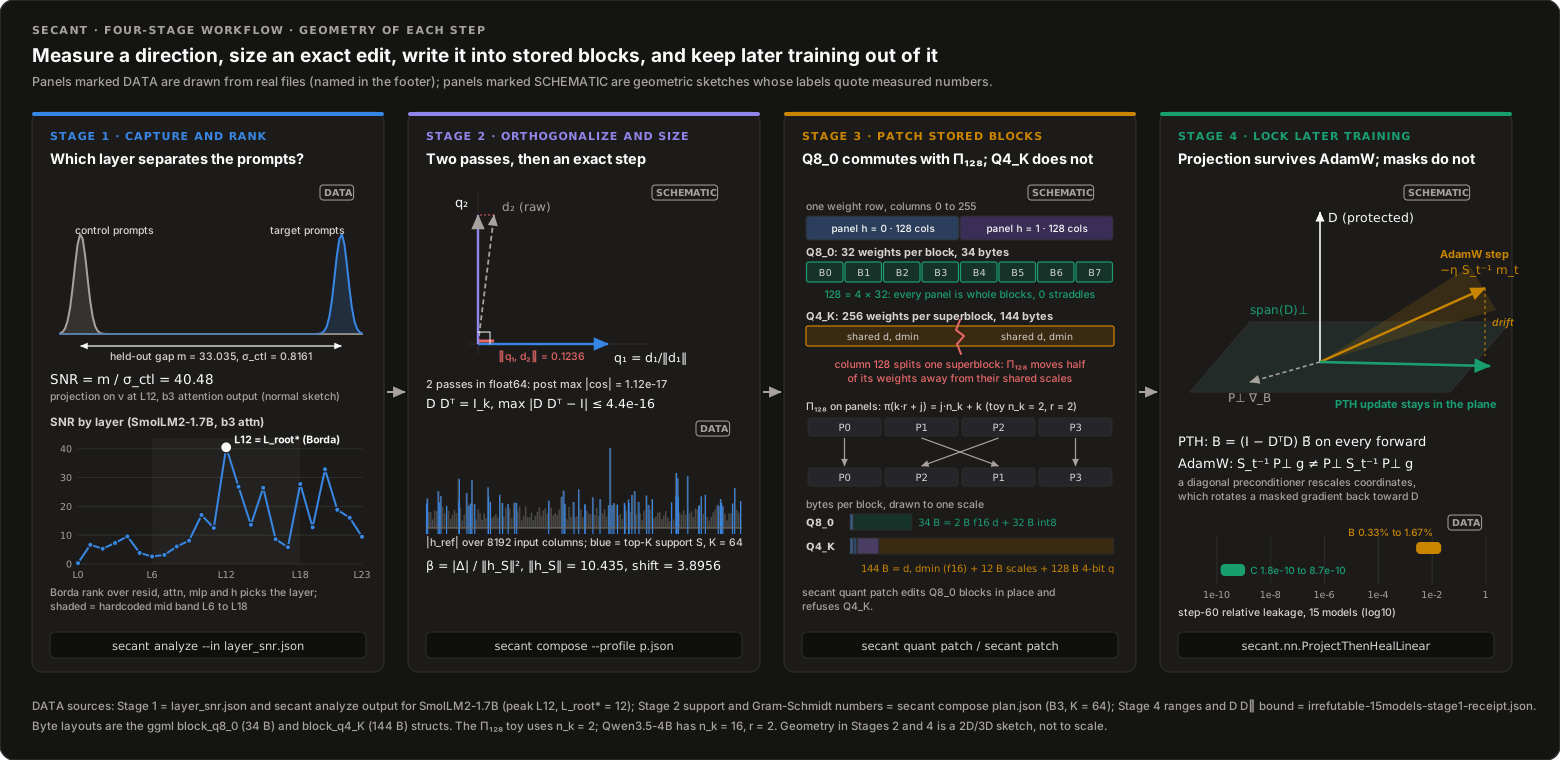
Figure 1:The paper’s four parts in one picture. Stage 1 and the Stage 2 support strip are drawn from the SmolLM2-1.7B demo inputs and the real secant analyze and secant compose outputs. Stage 3 uses the exact ggml block layouts (34 bytes per 32 Q8_0 weights, 144 bytes per 256 Q4_K weights). Stage 4 is a geometric sketch whose bars show the measured step-60 ranges from Section 4.1. Section 1 covers Stages 1 and 2, Section 2 covers Stage 3, and Section 3 covers Stage 4.
1. Choose Independent Directions and Size Each Edit
Several candidate behavior directions can overlap. Removing that overlap lets the linear edits act independently along the resulting directions, up to numerical error. It does not make the behaviors themselves independent. Secant then sizes each edit using the activation measured at the chosen layer.
1.1 Make the Directions Perpendicular
Gram-Schmidt subtracts each direction’s overlap with the directions already selected, then scales it to unit length. Secant uses two passes in 64-bit floating point to reduce rounding error.
Let hold the resulting unit directions as rows. The Python API checks both unit length and perpendicularity through
It rejects dependent directions or a failed tolerance check. Rust compose uses an absolute residual-norm floor and checks pairwise cosines; its acceptance rule differs for unnormalized inputs. The theory guide specifies both contracts. Across 120 seeded Gaussian test bases, the reported maximum Gram-matrix error was .
1.2 Remove a Component or Add a Measured Shift
The first operation removes part of a writer’s output along a chosen direction. The second adds a change along that direction using only selected input columns. Both are direct matrix calculations.
For a linear writer matrix mapping input activations to output activations , Secant implements two closed-form operators:
Projector subtraction (
projector-subtract):At , the edited matrix satisfies in exact arithmetic for every input .
Target-Shift Calibrated sparse rank-1 column edit (
rank1-columns): Given a sparse support of input columns selected by descending reference activation magnitude , let denote the vector equal to on and 0 outside (with ). We define the rank-1 update:where the calibrated step size is solved analytically as:
Substituting yields a scale-invariant directional shift along regardless of layer width or activation scale :
And the Frobenius norm of the perturbation is inversely proportional to the active column energy:
Scope: The target equality holds at the reference input in exact arithmetic, with small numerical error in
float64. For other inputs, the exact-arithmetic shift is multiplied by . Storage inBF16,F16, orQ8_0adds rounding error. Neither result guarantees a behavioral change; evaluate held-out prompts separately.Relation to prior associative-memory and abliteration estimators: Algebraically, the step size is the isotropic (, minimum-Frobenius-norm Moore-Penrose pseudoinverse) special case of the rank-1 ROME update (Meng et al., NeurIPS 2022; extended to multi-edit MEMIT, Meng et al., ICLR 2023) restricted to the sparse top- column support . Covariance-whitened concept erasure was formalized in LEACE (Belrose et al., NeurIPS 2023), while multi-vector Gram-Schmidt orthogonalization and ridge-regularized multi-direction projection are used in G-Abliteration (Gülmez, Dec 2025), Norm-Preserving Biprojected Abliteration (Lai, Nov 2025), Obliteratus, llm-abliteration, apostate KCRN, and weightless. Secant’s specific contributions in this stage are (1) using activation-calibrated target shifts ( and RMS-relative dosing ) for cross-model-size edit transfer (
0.8Bto32.8Bacross 15 full models, plus70.6Band72.7Bsingle-shard evaluations), and (2) coupling two-passfloat64Gram-Schmidt orthonormalization with the upper-triangular cross-projection compensation system () so heterogeneous non-orthogonal edits each realize their exact reference shift simultaneously.
Section 1 takeaway: Make the directions perpendicular first, solve the upper-triangular compensation system when composing non-orthogonal directions, and size each edit from the measured reference activation. The requested shift is exact at that reference input, up to
float64rounding. Behavior on other prompts has to be measured separately.
2. File Layout and Quantized Block Boundaries
A model file has two relevant layouts: the logical rows and columns of a matrix, and the groups of values stored together on disk. Some converters also reorder groups of columns. To edit the intended weights, the plan and checkpoint must agree on that order. To preserve neighboring bytes, the edit must respect the compressed format’s block boundaries.
2.1 Rows and Columns in the Two File Formats
The formats list dimensions in different orders, but the linear matrices considered here store each output row contiguously. The following offset is an element index; compressed formats need an additional mapping to block bytes.
In HuggingFace .safetensors, a 2-D linear weight matrix has shape = [d_out, d_in] with input axis shape[1] = d_in contiguous in memory. In ggml / .gguf, ne = [d_in, d_out] lists the contiguous axis first (ne[0] = d_in). Consequently, both formats share the identical row-major element offset for output row and input column :
2.2 Track Reordered Groups of 128 Columns
A panel is a group of 128 adjacent columns. The conversion described below moves whole panels and preserves the order within each one. The symbol denotes that reordering. Undoing it requires the inverse mapping, not necessarily a second application of the same mapping.
On Qwen3.5 Gated DeltaNet layers, llama.cpp’s convert_hf_to_gguf.py reorders the input columns (, with head width and group ratio ) of blk.N.ssm_out.weight from key-head-major to value-head-major order. Writing a HuggingFace 128-column panel index as for and , its GGUF panel index is:
Within each 128-column panel , the intra-panel offset is preserved:
When (Qwen3.5-0.8B, ), is the identity permutation. When (Qwen3.5-4B, ), is a non-trivial bijection on the 32 panels of width 128 corresponding to the transpose of a grid into a grid. Because , is not an involution (for example, whereas ); its inverse is:
2.3 When Reordering Preserves Blocks, and When Editing Adds Error
There are two different questions here. Reordering complete blocks can preserve their bytes exactly. Changing their weights usually requires encoding them again, which introduces rounding error.
Proposition 1: complete Q8_0 blocks move without re-encoding. Let be a deterministic, position-independent encoder that quantizes aligned blocks of weights independently, and let decode them. Assume rows contain complete blocks. If divides 128, every panel contains whole blocks. For Q8_0, four 32-weight blocks make one panel, so
Here the right-hand permutation moves encoded blocks as units. The corresponding decoded arrays are identical. This equality concerns panel reordering, not an arbitrary weight edit.
Proposition 2: Q4_K can couple neighboring panels. A 256-weight superblock shares top-level scale and minimum parameters across two 128-column panels. A permutation that splits those pairs need not preserve the encoded result. Pair-preserving permutations, including the identity, are exceptions. Editing one panel can also change its neighbor’s reconstructed values. The standalone secant quant patch therefore accepts Q8_0 only.
Proposition 3: editing before and after quantization can differ. Fix the same additive update in both paths and write . Path 1 edits the original float weights, then quantizes. Path 2 starts from decoded quantized weights, edits them, then re-encodes the touched blocks. Define
Subtracting the two reconstructed results gives
The implementation copies untouched blocks byte-for-byte, so no assumption that repeated encoding is idempotent is needed there. On touched Q8_0 blocks, an ideal-arithmetic bound including FP16 scale rounding is
where
This bound requires normal-range FP16 scales in all three encodings and excludes the encoder’s float32 arithmetic error. A projector edit recomputes its update from the current weights, so it need not use the same additive delta in both paths. See the quantized-weight guide for these assumptions and the full derivation.
The retained Qwen3.5-0.8B ssm_out experiment reported a target weight component decreasing from 0.5172 to 0.0079 with direct Q8_0 editing (about 98.5% removed). This measures a weight component, not a percentage of prompts. A separate whole-file experiment checked byte preservation outside the selected edits.
Relation to prior in-place GGUF and SafeTensors editing tools: In October 2026, Kiwimaker (
apply_abliteration.pyandapply_abliteration_v2.py) demonstrated in-placer+memory-mapped (np.memmapviagguf.GGUFReader) editing ofQ8_0tensors inside.ggufshards with SHA-256 byte-identity verification of untouched offsets, while empirically skippingQ4_Ktensors and dequantizing/re-quantizing full 2-DQ8_0matrices infloat64viagguf-py. Also in October 2026, SC117 demonstrated byte-level in-place GGUF tensor transplantation (leaving 1,079 of 1,223 tensors byte-identical) and scale-preservingQ2_0re-encoding against learned GSQ block scales. Existing.safetensorsabliteration tools (jim-plus /llm -abliteration, NousResearch sharded_ablate.py, and abliterix) load tensors viasafe_openand re-serialize modified shards from scratch viasave_file(). Secant’s specific contributions in this stage are (1) in-place zero-copymmapbyte-slice surgery inside.safetensorsfiles at[8 + N + BEGIN, 8 + N + END)withoutsave_file()shard re-serialization, (2) sub-tensor compressed-domainQ8_0block surgery directly on touched 34-byteblock_q8_0records (crates/secant-core/src/quant.rs) without full-tensorfloat64matrix materialization, and (3) Propositions 1 to 3, which formally prove why 32-weightQ8_0blocks commute with the 128-column head-panel permutation () while 256-weightQ4_Ksuperblocks straddle two 128-column heads and suffer cross-head scale leakage.
Section 2 takeaway: Both file formats use the same element offset, the
ssm_outpanel reordering has an exact inverse, andQ8_0blocks fit wholly inside 128-column panels whileQ4_Ksuperblocks span two. Editing still re-encodes the touched blocks, so the Proposition 3 bound is the error to expect.
3. Project-Then-Heal: Keep Adapter Updates Out of Protected Directions
LoRA fine-tunes a model by adding a small trainable matrix product to a frozen weight matrix. Ordinary LoRA can add back a component that an earlier edit removed. Project-Then-Heal removes protected components from the adapter each time the model computes an output. This is a constraint on selected writers, not a guarantee about all later model behavior.
3.1 Why Projecting the Gradient Is Not Enough
A gradient gives a proposed update direction. AdamW rescales its coordinates using past gradients, so the final update can point somewhere else. A direction that was perpendicular before rescaling need not remain perpendicular afterward.
Suppose a writer matrix has had an orthonormal row basis () surgically excised, and we attach a rank- LoRA adapter (, , ).
If one projects only the gradient using the orthogonal complement projector and passes into AdamW, the first moment remains in . However, AdamW’s parameter update multiplies by a non-isotropic diagonal preconditioner :
For a general projector and unequal coordinate scales, the update can have a component in the protected directions:
This is a possible failure of invariance, not a claim that every AdamW step must leak. Compatible scalings and axis-aligned protected directions are exceptions. The first-moment statement above also assumes its initial state lies in the allowed subspace. For a matrix-valued adapter, the diagonal-rescaling argument applies to each column, whose AdamW scales may differ.
This non-commutativity between Euclidean orthogonal gradient projection and AdamW’s diagonal second-moment preconditioner was independently formalized in October 2026 by Chen et al. (GOAL, Appendix M and Table 7), who defined the gradient-step quantity (“residual refusal-subspace leakage after AdamW preconditioning”) and reported across three backbone models (Gemma-7B-it, Llama-2-7B-Chat, Llama-2-13B-Chat), averaged over five runs at the end of training with zero weight decay when projecting gradients before AdamW.step(); Yu et al. (CORD, October 2026) likewise noted that subsequent optimizer transformations can disturb gradient-space orthogonalization, while Ghosh et al. (PoLoRA, July 2026) proposed a preconditioned orthogonalized LoRA optimizer. In our reported three-model comparison (measuring relative adapter weight-update leakage rather than GOAL’s gradient-step metric), gradient-projected AdamW had 1.56% to 2.98% relative weight-update leakage on the orthogonal target at step 60, and the 15-model H100 comparison (0.8B to 32.8B) reported 0.33% to 1.67%. The training guide gives the tasks, metrics, and learning-rate caveat.
3.2 Apply the Constraint Whenever the Adapter Runs
The optimizer can change the adapter’s stored parameters freely. Before those parameters contribute to an output, the layer removes their protected components. Applying the projection twice is a numerical refinement; in exact arithmetic, the second pass changes nothing.
ProjectThenHealLinear instead reparameterizes the LoRA output factor inside the forward computation graph via a twice-applied float64 orthogonal projection:
where each application of is evaluated in time without allocating a dense matrix:
The layer’s forward pass is then:
By associativity, for any parameter state produced by any optimizer (SGD, AdamW, Lion, Muon):
In exact arithmetic , but in finite-precision IEEE-754 float64, a single pass can leave residual components along when columns of are nearly parallel to (analogous to single-pass vs. two-pass Gram-Schmidt). Applying twice reduces by to (median across 120 seeded Gaussian bases). Separately, the live-run diagnostic that recomputes an unrounded projected weight update reported to .
3.3 Where the Guarantee Stops
Later layers can turn a perpendicular change back toward a protected direction. Saving or merging weights at lower precision can also introduce a component that was absent in the calculation. Check both the stored weights and model responses after those steps.
The exact-arithmetic guarantee holds at every protected writer’s output. In a multi-layer transformer, an orthogonal perturbation emitted at layer subsequently passes through downstream RMSNorm, attention, and MLP matrices () for which in general. Empirically on Qwen3.5-0.8B (Step 60), locking L15..L17 reduces direct merged-F32 writer leakage by ( vs. ) and cuts downstream pull-back along the B1 loop direction at resid L19 by more than half (+0.276 vs. +0.635 unconstrained).
Relation to prior subspace-projected LoRA and post-abliteration healing: Forward-pass orthogonal projection of LoRA adapters () against top singular directions of frozen weights was introduced for continual learning in OPLoRA (Xiong & Xie, AAAI 2026), while SaLoRA (Li et al., ICLR 2025) and Safe LoRA (Hsu et al., NeurIPS 2024) project LoRA updates to preserve safety alignment during downstream fine-tuning. Conversely, existing post-abliteration LoRA capability-healing pipelines (Labonne, June 2024; Obliteratus
--auto-finetune; model-unfetterrecovery.py) attach unconstrained LoRA adapters that can write back into the excised subspace. Secant’s specific contributions in this stage are (1) bypassing AdamW preconditioner leakage on the effective adapter weight update via forward-pass subspace-locked parameterization, reducing step-60 relative weight-update leakage from0.33%-1.67%under gradient-projected AdamW to thefloat32working-dtype floor (1.78e-10to8.67e-10) across 15 models (0.8Bto32.8B), (2) inverting safety-projected LoRA for post-surgery capability healing (Project-Then-Heal, locking LoRA out of an excised behavioral subspace ), and (3) twice-iteratedfloat64idempotent projection inside the autograd forward pass ( median error reduction over single-pass projection).
Section 3 takeaway: Projecting only the gradient can leak once AdamW rescales coordinates. Projecting inside the forward pass makes hold in exact arithmetic for any optimizer at the locked writer. Rounding, merging, and later layers still have to be measured.
4. Experiments and What They Measure
The following studies answer three separate questions: whether the edit produces the intended local numerical change, whether the adapter respects protected directions, and whether model answers improve. A pass on one question is not a pass on the others. B1, B2, and B3 label the loop, refusal, and root-cause directions. An arm is one configuration being compared. Leakage metrics are named in each table because maximum absolute entries and norm ratios are not interchangeable.
The numerical results below are retained experimental reports, not fresh runs made for this documentation review. Some raw runners and receipts remain in the lab evidence bank rather than this repository; the guides identify those limits. Results on the two largest checkpoints use one shard each, not full-model fine-tuning.
Summary of Experimental Studies & Model Breadth
| Study | Coverage | Model range | Measurements | Detail |
|---|---|---|---|---|
| H100 Stage-1 calibration and 3-arm adapter sweep | 15 models | 0.8B to 32.8B | Reference shifts; 60-step adapter leakage | 4.1 |
| H100 Stage-2 public benchmarks | 14 models | 0.8B to 32.8B | GSM8K, MATH-500, MMLU-Pro, HumanEval, ASan-30 | 4.2 |
| H100 Regime C adversarial subspace pull | 14 checkpoints | 7.2B to 72.7B | 12 full-model loads; 2 shard-only writer tests | 4.3 |
| H100 paired ASAN-120 vulnerability and patched-benign twins | 9 models × 7 arms | 0.8B to 32.8B | 7,560 item evaluations; sensitivity and specificity | 4.5 |
| Live causal-LM ProjectThenHealLinear healing (Regime A + RMS-relative) | 8 models | 0.8B to 14B | 2 early runs + 6 H100 models; 24,000 benchmark rows in the six-model study | 4.4 |
| Static spectral and Boundary-3 payload atlas | 46-file local inventory (2,619 analyzed weight matrices: 2,574 across 14 full-model reads and 45 across 16 scoped variants) | Atlas plus 10-checkpoint GGUF/SafeTensors scale sweep | 186,870,528 quantized blocks across 912 quantized tensors (2,194 total tensors) | 5 |
Cohorts overlap, so these model counts must not be added. The live-healing range uses model-name sizes; the larger H100 tables retain reported parameter counts. The focused Qwen3.5-4B dose-response case study follows the multi-model results in Section 4.6.
4.1 H100 Stage-1: Calibration and Three Adapter Arms Across 15 Models
This sweep checks the shift at a reference input and compares three adapter methods on one selected writer per model. It uses one seed per model and a synthetic target plus a real-token cross-entropy term. Public behavioral benchmarks were NOT_RUN in this sweep; the local numerical results do not establish generation quality.
Across 15 full models on H100 (0.8B to 32.8B, receipt irrefutable-15models-stage1-receipt.json), we applied full Target-Shift Calibration (, columns) to B2 and B3 and ran a 60-step 3-arm comparison on the surgically edited writer:
Arm A: Unconstrained LoRA + AdamW
Arm B: Gradient-Projected LoRA ( before
AdamW.step())Arm C:
ProjectThenHealLinear()
All 30 calibrated edits realize at to within <= 7.99e-15 in float64. On the 3-arm healing test (measured by relative leakage at step 60), Gradient-Projected AdamW (Arm B) leaks on 15 of 15 models (0.33% to 1.67%), whereas ProjectThenHealLinear (Arm C) stays at the float32 working-dtype floor (1.78e-10 to 8.67e-10; model by model, to times lower than Arm B):
B2 / B3: refusal / root-cause directions; L: layer; β: calibrated step size.
Shift error is measured in float64 at the reference input. A, B, and C are the adapter arms defined above.
Stage-1 calibration
| Model | Size | B2 / B3 layers | B2 / B3 β | Max shift error |
|---|---|---|---|---|
| Qwen3.5-0.8B | 0.8B | L17 / L14 | 0.5801 / 0.3595 | 8.9e-16 |
| SmolLM2-1.7B | 1.7B | L17 / L12 | 0.0369 / 0.2727 | 1.8e-15 |
| Qwen3.5-4B | 4B | L23 / L16 | 0.0484 / 0.3805 | 3.6e-15 |
| Mistral-7B-v0.3 | 7.2B | L12 / L19 | 0.9352 / 0.0510 | 3.6e-15 |
| Qwen2.5-7B | 7.6B | L8 / L14 | 0.1224 / 0.1484 | 2.7e-15 |
| Llama-3.1-8B | 8B | L23 / L16 | 0.4556 / 0.5070 | 1.8e-15 |
| R1-Llama-8B | 8B | L23 / L16 | 0.4343 / 0.4701 | 5.3e-15 |
| Qwen3-8B | 8.2B | L14 / L21 | 0.3931 / 0.0766 | 5.3e-15 |
| Gemma-2-9B | 9.2B | L16 / L25 | 3.7192 / 1.1508 | 1.8e-15 |
| OLMo-2-13B | 13.7B | L16 / L20 | 0.1130 / 0.0325 | 3.6e-15 |
| Phi-4 | 14.7B | L12 / L29 | 1.1436 / 0.0174 | 4.4e-15 |
| Qwen3-14B | 14.8B | L16 / L23 | 0.2994 / 0.0547 | 1.8e-15 |
| R1-Qwen-14B | 14.8B | L28 / L35 | 0.0343 / 0.0177 | 3.6e-15 |
| Gemma-2-27B | 27.2B | L14 / L27 | 0.0845 / 0.0098 | 8.0e-15 |
| Qwen3-32B | 32.8B | L47 / L25 | 0.0292 / 0.0738 | 3.6e-15 |
Stage-1 relative leakage at step 60
| Model | A: unconstrained | B: gradient-projected | C: PTH |
|---|---|---|---|
| Qwen3.5-0.8B | 7.60% | 0.61% | 8.67e-10 |
| SmolLM2-1.7B | 2.95% | 1.62% | 5.41e-10 |
| Qwen3.5-4B | 2.22% | 1.67% | 5.81e-10 |
| Mistral-7B-v0.3 | 2.17% | 0.92% | 3.38e-10 |
| Qwen2.5-7B | 2.04% | 0.49% | 4.71e-10 |
| Llama-3.1-8B | 0.82% | 0.80% | 4.36e-10 |
| R1-Llama-8B | 1.59% | 0.60% | 4.50e-10 |
| Qwen3-8B | 2.02% | 0.58% | 3.14e-10 |
| Gemma-2-9B | 8.51% | 0.35% | 5.46e-10 |
| OLMo-2-13B | 1.70% | 0.44% | 1.78e-10 |
| Phi-4 | 0.86% | 0.33% | 3.26e-10 |
| Qwen3-14B | 2.13% | 0.60% | 2.69e-10 |
| R1-Qwen-14B | 1.23% | 0.77% | 3.53e-10 |
| Gemma-2-27B | 1.98% | 1.31% | 3.49e-10 |
| Qwen3-32B | 2.04% | 0.75% | 3.07e-10 |
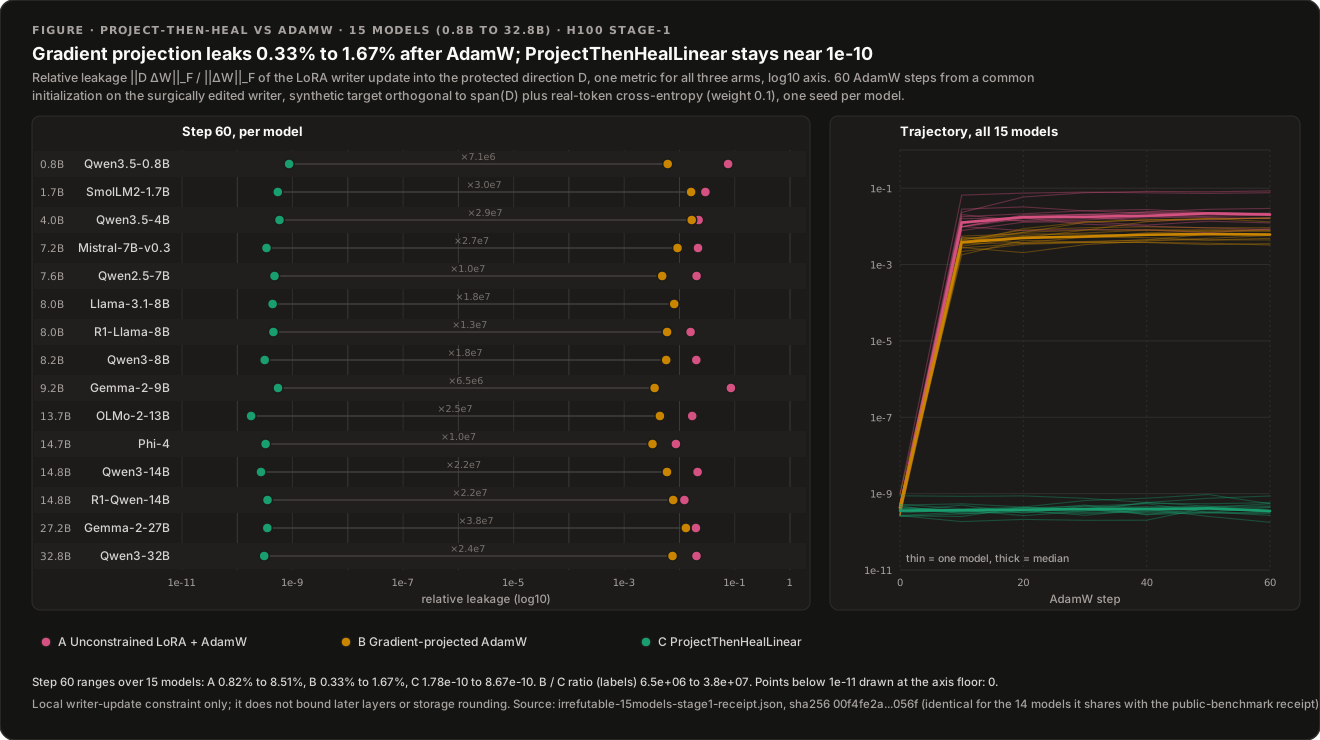
Figure 2:The three adapter arms in the leakage table, on a log scale. Left: step-60 relative leakage for each model, with the Arm B to Arm C ratio printed above each row. Right: all 15 trajectories over 60 AdamW steps, with the median drawn thick. Arms A and B jump to their plateau in the first 10 steps and stay there. Arm C stays near 1e-10 from step 0 to step 60.
4.2 H100 Stage-2: Public Benchmarks Across 14 Models
Section 4.1 checks the local arithmetic of each edit. This section asks a different question: what the same B2 + B3 edits do to a model’s answers on public benchmarks. The receipt is public-benchmarks/irrefutable-receipt.json (SHA-256 9859ef3e0603318e09b0366e6dae6994b47f7d7cc4456cfff1fff7ddb2253132, status: PASS, completed 2026-11-06T20:41:59Z), with per-item rows in predictions.jsonl (SHA-256 0c2d65e1...86fe). It covers 14 of the 15 Stage-1 models (14 x 1,970 = 27,580 completed five-arm rows). Gemma-2-27B is marked HOLD in the summary receipt because its gated repository returned HTTP 401 on the edited arms (300 base-only records for MATH-500, GSM8K, and MMLU-Pro remain in predictions.jsonl, bringing the file total to 27,880 rows, while Gemma-2-27B has no completed paired benchmark cohort). The aligned edits (layers, column support , ), model revisions, and seed (20261105) are those of Section 4.1, and the healing results in this receipt are identical to the Stage-1 receipt for all 14 shared models.
Five variants of each model answer the same items: the unedited base; the calibrated edits at 1.0x and 1.5x; and two norm-matched random controls at 1.0x and 1.5x. A random control replaces each aligned direction with a random unit vector orthogonal to , keeping the same , the same input-column support , and therefore the same . If a calibrated edit and its random control move a score by similar amounts, the movement comes from the size of the edit, not its direction.
Each model answers the first 100 items of GSM8K, MATH-500 and MMLU-Pro, the first 64 of HumanEval, and the 30 retained sanitizer traces (ASan-30). Decoding is greedy. ASan-30 counts a root cause as correct when the answer names both the bug class and the culprit function, matched by keyword. Every comparison is paired by item: an exact two-sided McNemar test on the discordant pairs, then a Holm correction across the 70 model-by-benchmark cells of each variant. The pooled rows add the discordant pairs over all 14 models. Their 95% intervals use the paired normal approximation, and they treat items from different models as independent, which they are not.
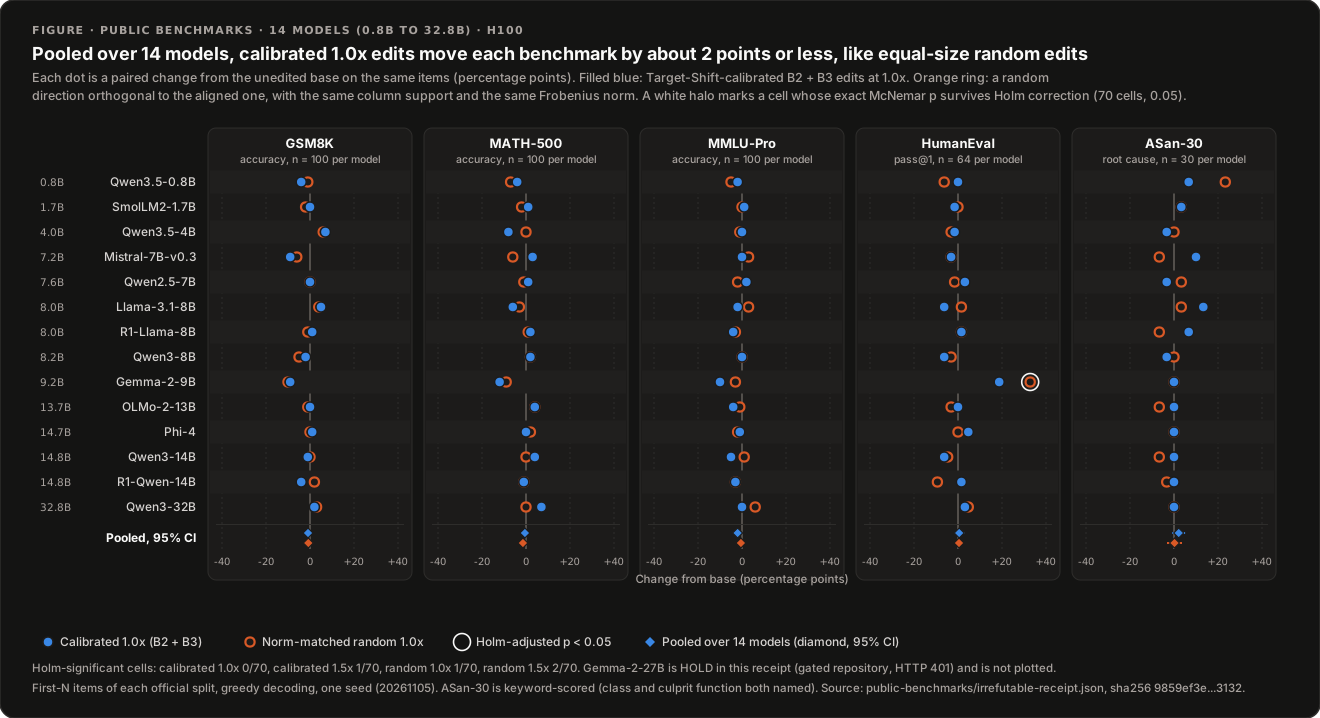
Figure 3:Paired change from base, in percentage points, for every model and benchmark. Blue dots are calibrated 1.0x; orange rings are the norm-matched random 1.0x control. A white halo marks a cell that survives Holm correction. Only one does at 1.0x, and it is a random control: Gemma-2-9B HumanEval, 42.2% to 75.0%. The diamonds pool all 14 models.
pp: percentage points; CI: 95% confidence interval; p: exact two-sided McNemar p-value.
Each result reports change from base, its CI, and p; items are pooled over 14 models.
Pooled calibrated edits
| Benchmark | Paired items | Calibrated 1.0x | Calibrated 1.5x |
|---|---|---|---|
| GSM8K | 1400 | -0.9 (-2.9 to +1.0), p = 0.39 | -2.0 (-4.1 to +0.1), p = 0.079 |
| MATH-500 | 1400 | -0.5 (-2.4 to +1.4), p = 0.65 | -0.4 (-2.2 to +1.5), p = 0.76 |
| MMLU-Pro | 1400 | -2.0 (-3.5 to -0.5), p = 0.013 | -2.4 (-3.9 to -1.0), p = 0.0015 |
| HumanEval pass@1 | 896 | +0.6 (-1.7 to +2.9), p = 0.70 | +0.3 (-2.0 to +2.7), p = 0.85 |
| ASan-30 root cause | 420 | +2.1 (-0.8 to +5.0), p = 0.20 | +1.2 (-1.8 to +4.2), p = 0.53 |
Pooled norm-matched random controls
| Benchmark | Paired items | Random 1.0x | Random 1.5x |
|---|---|---|---|
| GSM8K | 1400 | -0.8 (-2.6 to +1.0), p = 0.43 | -0.9 (-3.0 to +1.1), p = 0.41 |
| MATH-500 | 1400 | -1.4 (-3.2 to +0.4), p = 0.14 | -0.1 (-2.0 to +1.7), p = 0.94 |
| MMLU-Pro | 1400 | -0.5 (-2.0 to +1.0), p = 0.57 | -2.0 (-3.6 to -0.4), p = 0.017 |
| HumanEval pass@1 | 896 | +0.4 (-1.8 to +2.7), p = 0.77 | +0.3 (-1.8 to +2.5), p = 0.84 |
| ASan-30 root cause | 420 | +0.2 (-3.2 to +3.6), p = 1.0 | -2.9 (-5.6 to -0.1), p = 0.065 |
What this shows:
Retention. At
1.0x, no calibrated cell changes significantly after Holm correction (0/70). Single cells range from-12to+19points, which is what 100-item and 64-item samples produce by chance. Pooled, each benchmark moves by2.1points or less.One pooled cost, MMLU-Pro. Calibrated edits lower pooled
MMLU-Proby2.0points at1.0xand2.4at1.5x. Random1.5xlowers it by2.0, so edit size explains at least part of the cost. Under a Holm correction across all 20 pooled tests, only calibrated1.5xremains below0.05(p = 0.031).No measured uplift in the 14-model Stage-2 sweep. The ASan-30 root-cause gain at
1.0x(+2.1points,p = 0.20) is not significant, and no root-cause cell survives Holm correction. These edits were sized to hit a reference shift, not tuned for this task. This receipt does not reproduce theQwen3.5-4Bthinking-loop root-cause gains reported in Section 4.6 (0/30to14/30at1.0xand19/30at1.5xunder theB1loop-exit +B2+B3composition).Edit size matters more than direction on one model.
Gemma-2-9Bcarries the largestB2step in the sweep (). It accounts for every Holm-significant cell across the four variants:GSM8Kfalls17points at calibrated1.5xand14at random1.5x, andHumanEvalrises33to34points under both random controls. The random controls move it as far as the calibrated edits do.
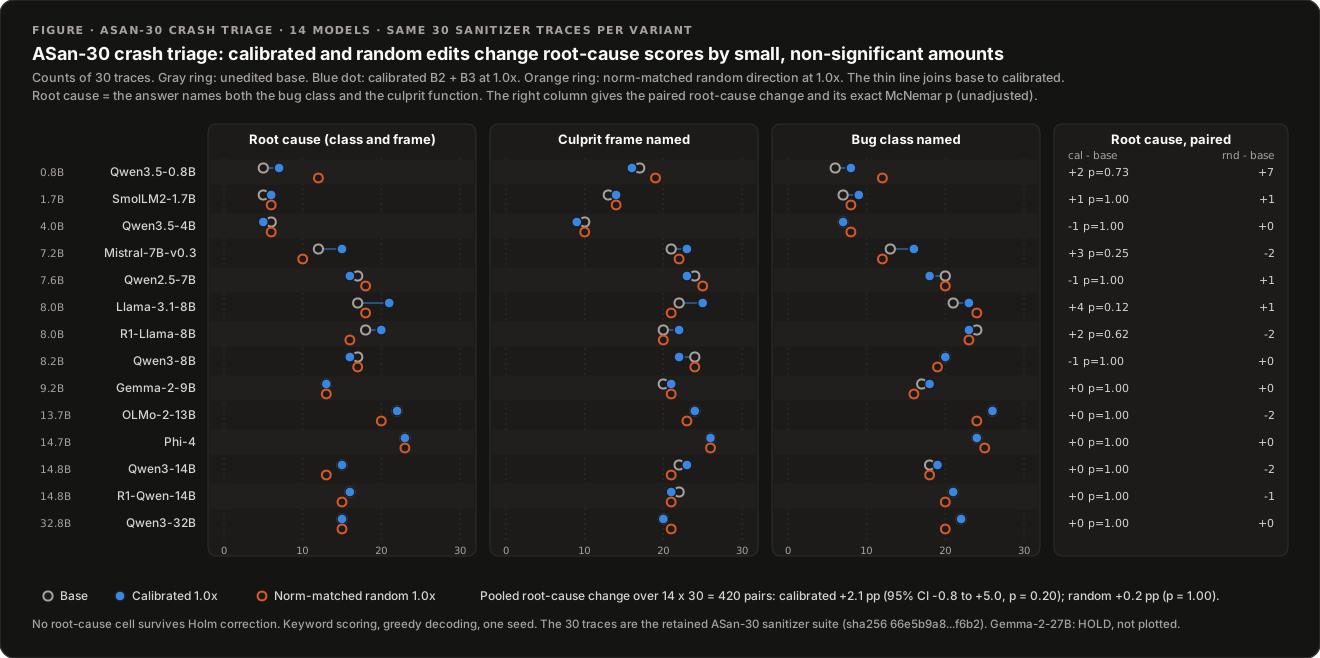
Figure 4:ASan-30 counts out of 30 for each model: base (gray ring), calibrated 1.0x (blue), and random 1.0x (orange). The right column lists the paired root-cause change and its unadjusted exact McNemar p. The largest single gains are +4 (Llama-3.1-8B, p = 0.12) and +3 (Mistral-7B-v0.3, p = 0.25).
Scope. These are first-N items, not random samples, from one seed, decoded greedily, on a set of checkpoints weighted toward Qwen. The receipt’s standalone
secantCLI cross-check isHOLDfor 7 of the 14 models; that check is separate from these benchmark results.
Per-model counts, all 14 completed models. Each cell is base / calibrated 1.0x / norm-matched random 1.0x, as correct items out of 100 (GSM8K, MATH-500, MMLU-Pro), passed items out of 64 (HumanEval), and correct root causes out of 30 (ASan-30). The rows are generated from the receipt with jq, not typed. Two rows that are easy to over-read: OLMo-2-13B MATH-500 goes from 33 to 37 under the calibrated edit and also to 37 under the random control. Qwen3-32B MATH-500 goes from 31 to 38 (exact McNemar p = 0.19, Holm p = 1), while GSM8K moves from 53 to 55 calibrated and to 56 random. No cell in this table is a demonstrated uplift.
Cell order: base / calibrated 1.0x / norm-matched random 1.0x.
Denominators are shown in the column headers.
Per-model mathematics and knowledge
| Model | Size | GSM8K /100 | MATH-500 /100 | MMLU-Pro /100 |
|---|---|---|---|---|
| Qwen3.5-0.8B | 0.8B | 48 / 44 / 47 | 30 / 26 / 23 | 22 / 20 / 17 |
| SmolLM2-1.7B | 1.7B | 23 / 23 / 21 | 25 / 26 / 23 | 4 / 5 / 4 |
| Qwen3.5-4B | 4.0B | 14 / 21 / 20 | 20 / 12 / 20 | 4 / 4 / 3 |
| Mistral-7B-v0.3 | 7.2B | 55 / 46 / 49 | 13 / 16 / 7 | 25 / 25 / 28 |
| Qwen2.5-7B | 7.6B | 89 / 89 / 89 | 59 / 60 / 58 | 56 / 58 / 54 |
| Llama-3.1-8B | 8.0B | 78 / 83 / 82 | 44 / 38 / 41 | 48 / 46 / 51 |
| R1-Llama-8B | 8.0B | 66 / 67 / 65 | 41 / 43 / 42 | 7 / 3 / 4 |
| Qwen3-8B | 8.2B | 39 / 37 / 34 | 31 / 33 / 33 | 9 / 9 / 9 |
| Gemma-2-9B | 9.2B | 87 / 78 / 77 | 48 / 36 / 39 | 55 / 45 / 52 |
| OLMo-2-13B | 13.7B | 90 / 90 / 89 | 33 / 37 / 37 | 32 / 28 / 31 |
| Phi-4 | 14.7B | 95 / 96 / 95 | 65 / 65 / 67 | 68 / 67 / 66 |
| Qwen3-14B | 14.8B | 59 / 58 / 59 | 36 / 40 / 36 | 15 / 10 / 16 |
| R1-Qwen-14B | 14.8B | 50 / 46 / 52 | 40 / 39 / 39 | 6 / 3 / 3 |
| Qwen3-32B | 32.8B | 53 / 55 / 56 | 31 / 38 / 31 | 7 / 7 / 13 |
Per-model code and crash triage
| Model | HumanEval /64 | ASan-30 root cause /30 |
|---|---|---|
| Qwen3.5-0.8B | 5 / 5 / 1 | 5 / 7 / 12 |
| SmolLM2-1.7B | 7 / 6 / 7 | 5 / 6 / 6 |
| Qwen3.5-4B | 21 / 20 / 19 | 6 / 5 / 6 |
| Mistral-7B-v0.3 | 2 / 0 / 0 | 12 / 15 / 10 |
| Qwen2.5-7B | 9 / 11 / 8 | 17 / 16 / 18 |
| Llama-3.1-8B | 22 / 18 / 23 | 17 / 21 / 18 |
| R1-Llama-8B | 6 / 7 / 7 | 18 / 20 / 16 |
| Qwen3-8B | 25 / 21 / 23 | 17 / 16 / 17 |
| Gemma-2-9B | 27 / 39 / 48 | 13 / 13 / 13 |
| OLMo-2-13B | 8 / 8 / 6 | 22 / 22 / 20 |
| Phi-4 | 4 / 7 / 4 | 23 / 23 / 23 |
| Qwen3-14B | 13 / 9 / 10 | 15 / 15 / 13 |
| R1-Qwen-14B | 26 / 27 / 20 | 16 / 16 / 15 |
| Qwen3-32B | 14 / 16 / 17 | 15 / 15 / 15 |
4.3 H100 Regime C: Adversarial Subspace Pull Across 14 Checkpoints
This stress test deliberately asks the adapter to learn a change inside the protected subspace. A successful lock must leave that part of the task unfitted, so low leakage comes with a loss floor. The unconstrained and locked numbers below use different metrics and must not be read as a direct ratio.
In a separate adversarial stress test across 12 full models (7.2B to 32.8B) and 2 single-shard runs (70.6B, 72.7B), we trained LoRA for 60 AdamW steps toward a synthetic target that deliberately lies inside the protected subspace . Under this adversarial pull, unconstrained LoRA placed 8.42% to 52.55% of its output factor norm into , whereas ProjectThenHealLinear held (evaluated in float64 on the F32 working factor) to 4.82e-10 to 1.08e-9 at step 60 across all 14 checkpoints.
UNC rel. B: fraction of the unconstrained output-factor norm in the protected subspace.
PTH max abs B: maximum absolute entry of D B after projection, evaluated in float64 on the F32 factor. The two columns use different metrics.
Full model: the full checkpoint was loaded, with the adapter test on a selected writer. Shard only: one writer from a single checkpoint shard, without full-model fine-tuning or generation.
| Checkpoint | Size | Coverage | UNC rel. B | PTH max abs B |
|---|---|---|---|---|
| Mistral-7B-v0.3 | 7.2B | Full model | 46.79% | 7.73e-10 |
| Qwen2.5-7B | 7.6B | Full model | 31.34% | 7.55e-10 |
| Llama-3.1-8B | 8B | Full model | 48.03% | 7.62e-10 |
| R1-Llama-8B | 8B | Full model | 52.55% | 6.39e-10 |
| Qwen3-8B | 8.2B | Full model | 39.53% | 7.14e-10 |
| Gemma-2-9B | 9.2B | Full model | 41.05% | 6.53e-10 |
| OLMo-2-13B | 13.7B | Full model | 30.73% | 1.08e-9 |
| Phi-4 | 14.7B | Full model | 8.42% | 9.51e-10 |
| Qwen3-14B | 14.8B | Full model | 41.33% | 5.77e-10 |
| R1-Qwen-14B | 14.8B | Full model | 32.57% | 6.11e-10 |
| Gemma-2-27B | 27.2B | Full model | 11.54% | 7.16e-10 |
| Qwen3-32B | 32.8B | Full model | 30.75% | 4.82e-10 |
| R1-Llama-70B | 70.6B | Shard only | 20.24% | 5.66e-10 |
| Qwen2.5-72B | 72.7B | Shard only | 36.94% | 9.85e-10 |
The retained Regime C sources are h100_scaleup_6models_complete_receipt.json, h100_r1_olmo_receipt.json, and h100_gated_and_70b_receipt.json in the H100 evidence bank. The table uses the first Phi-4 run under experiments and the successful top-level Qwen3-32B rerun. The 70B row is DeepSeek-R1-Distill-Llama-70B, as named in the receipt; the attempted Llama-3.3-70B-Instruct download returned HTTP 403 and is not a completed result. Both large-model rows remain shard-only retained evidence with incomplete producing-run provenance.
Verification & Diagnostic Notes on Regime C:
Non-linear dose saturation at extreme shifts: On 20 of 24 full-model edits in Regime C, raising the dose from to scaled the realized shift linearly (
1.49xto1.50x). Four edits (Phi-4B2,OLMo-2-13BB3,Gemma-2-9BB3,Gemma-2-27BB3) showed sub-linear scaling (1.04xto1.18x) due to downstream RMSNorm normalization.Outlier-dimension diagnostic (
Phi-4): In Regime C’s uncalibrated capture onPhi-4(L32), peak reached27,362.3with , and the uncalibrated edit inverted sign (-3.399). Always pair with and verify the signed shift on held-out prompts (as done in Stage-1 L12 calibration, wherePhi-4achieves4.4e-15shift error).
4.4 Live Causal-LM Healing Across Eight Models: Regime A and RMS-Relative Dosing
The two early Regime A runs and six H100 RMS-relative runs all train ProjectThenHealLinear on real causal-LM text. They cover eight models from 0.8B to 14B by model-name size. The 24,000 benchmark rows belong to the six-model RMS-relative study, across all of its evaluated arms; they are not 24,000 healed-arm rows or an eight-model common benchmark.
PTH: ProjectThenHealLinear. Max abs: maximum absolute entry of D ΔW; relative: Frobenius norm ratio of D ΔW to ΔW. These are different metrics and cannot be compared as one leakage range.
The early runs recompute an unrounded float64 projected delta; the H100 runs use a float64 adapter. Neither label means that every operation in the language model uses float64.
R1-Llama-8B abbreviates DeepSeek-R1-Distill-Llama-8B.
| Model | Run | Steps | Leakage metric | PTH float64 |
|---|---|---|---|---|
| Qwen3.5-0.8B | Early Regime A (CPU) | 60 | Max abs | 9.87e-18 |
| SmolLM2-1.7B | Early Regime A (ROCm) | 20 | Max abs | 5.21e-18 |
| Qwen3-4B | H100 RMS-relative | 60 | Relative | 3.18e-17 |
| Qwen2.5-Math-7B | H100 RMS-relative | 60 | Relative | 5.07e-17 |
| Qwen2.5-Coder-7B | H100 RMS-relative | 60 | Relative | 3.34e-17 |
| R1-Llama-8B | H100 RMS-relative | 60 | Relative | 3.43e-17 |
| Qwen3-8B | H100 RMS-relative | 60 | Relative | 3.75e-17 |
| Qwen3-14B | H100 RMS-relative | 60 | Relative | 4.80e-17 |
4.4.1 Early Live Runs: Perplexity and Storage Precision
The two early short runs compare a constrained adapter with ordinary LoRA after a weight edit. Perplexity measures prediction quality on held-out text; lower is better. The Qwen run reached its best held-out value at step 20, then both arms overfit the small training batch. The float64 leakage column recomputes an unrounded projected delta; it is not a claim that the whole model ran in float64.
Both arms train on real causal-LM completions after a byte-verified surgical edit, evaluated on the identical writer-level metric :
PTH: ProjectThenHealLinear; UNC: unconstrained LoRA.
Max leakage: maximum absolute entry of D ΔW, evaluated identically for the two arms. PPL: held-out perplexity.
Early live runs: training and edit
| Model | Steps / device | Verified surgical edit |
|---|---|---|
| Qwen/Qwen3.5-0.8B | 60 (CPU) | Composed B1+B2+B3 GGUF (verify-patch exit 0) |
| HuggingFaceTB/SmolLM2-1.7B-Instruct | 20 (ROCm GPU) | B2 projector at L14 o_proj (67.9x vs. random) + B3 calibrated at L15 down_proj (22.1x vs. random) |
Early live runs: leakage and held-out quality
| Model | PTH max: float64 / F32 | UNC max | PPL: PTH vs. UNC |
|---|---|---|---|
| Qwen/Qwen3.5-0.8B | 9.87e-18 / 2.49e-10 | 1.05e-02 | Step 20: 5.435 vs. 5.423; Step 60: 12.106 vs. 12.357 |
| HuggingFaceTB/SmolLM2-1.7B-Instruct | 5.21e-18 / 1.46e-10 | 4.64e-03 | Step 20: 21.260 vs. 21.255 |
Storage Precision Boundary (
F32/F64vs.BF16): When merged weights are quantized down to 16-bitBF16(7 stored fraction bits, 8-bit significand precision, , unit roundoff ), rounding error alone introduces to 10-3 subspace leakage.secant healtherefore stores healed LoRA adapters inF32orF64.
4.4.2 Six-Model H100 Sweep: RMS-Relative Dosing and Live Healing
A fixed shift such as means different things in different layers, because writer outputs differ in scale. RMS-relative dosing measures that scale first and sizes the shift against it:
over positive reference activations (4 domains times 6). Across 6 models spanning 4B to 14B parameters (24,000 benchmark rows total, archived experiment receipt identifier h100-scaleup-20261105/domain-uplift-rms, per-model manifest SHA-256 digests listed below), varies by 13.4x, from 5.847 on layer 21 of DeepSeek-R1-Distill-Llama-8B to 78.148 on layer 24 of Qwen3-8B. An unscaled unit shift of 1.0 therefore represents 17.10% of the writer norm on DeepSeek-R1-Distill-Llama-8B, 2.48% on Qwen2.5-Coder-7B-Instruct (40.355), 1.45% on Qwen3-14B (68.757), 1.34% on Qwen2.5-Math-7B-Instruct (74.607), and 1.28% on Qwen3-8B (78.148). That explains why the earlier unscaled unit shift left greedy accuracy unchanged on Qwen2.5-Math-7B-Instruct (GSM8K 87%, MATH-500 43%, largest change in any complete cell 1 point, with mean normalized shift at most 0.19%).
Each of the 6 models was evaluated on one H100 (torch 2.8.0+cu128, greedy left-padded batches of 16, max_new_tokens = 512, 100 items each of MATH-500, GSM8K, MMLU-Pro, and HumanEval). Every model ran at least 8 arms at : base, four single-domain edits (security, math, science, code), their 4-domain Gram-Schmidt orthogonal union (composed), a seeded norm-matched random control orthogonal to on the identical column support, and composed_healed (the 4-domain composition followed by a rank-4, 60-step float64 ProjectThenHealLinear healing pass). Qwen2.5-Math-7B-Instruct and Qwen3-4B additionally ran a 14-arm dose sweep over .
L: writer layer; σ: RMS writer output norm; rel. leakage: norm ratio for the float64 adapter delta.
Benchmark cell order: base / composed / random / composed + PTH, all at α = 1.0. Each benchmark has 100 items.
Manifest hashes below are abbreviated source identifiers, not complete verification digests.
RMS calibration and live healing
| Model | Layer | σ | Manifest SHA-256 | Rel. leakage |
|---|---|---|---|---|
| Qwen2.5-Math-7B-Instruct | L19 | 74.61 | 49181d79...7cc1 | 5.07e-17 |
| Qwen2.5-Coder-7B-Instruct | L19 | 40.35 | 16c9808e...ad6b | 3.34e-17 |
| DeepSeek-R1-Distill-Llama-8B | L21 | 5.85 | 5bae03b9...4389 | 3.43e-17 |
| Qwen3-4B | L24 | 37.81 | bcc4e37e...8ba6 | 3.18e-17 |
| Qwen3-8B | L24 | 78.15 | 80583fe0...f7d7 | 3.75e-17 |
| Qwen3-14B | L26 | 68.76 | 42de8edd...8f1a | 4.80e-17 |
RMS sweep: held-out benchmark counts
| Model | GSM8K /100 | MATH-500 /100 | MMLU-Pro /100 | HumanEval /100 |
|---|---|---|---|---|
| Qwen2.5-Math-7B-Instruct | 87 / 87 / 88 / 93 | 43 / 43 / 44 / 44 | 17 / 16 / 16 / 17 | 1 / 0 / 1 / 0 |
| Qwen2.5-Coder-7B-Instruct | 82 / 81 / 82 / 80 | 44 / 44 / 46 / 45 | 35 / 29 / 27 / 31 | 36 / 36 / 37 / 42 |
| DeepSeek-R1-Distill-Llama-8B | 62 / 63 / 64 / 63 | 27 / 26 / 29 / 27 | 2 / 3 / 2 / 2 | 5 / 9 / 4 / 12 |
| Qwen3-4B | 30 / 30 / 26 / 29 | 21 / 22 / 19 / 22 | 8 / 7 / 12 / 8 | 19 / 23 / 18 / 21 |
| Qwen3-8B | 18 / 30 / 30 / 22 | 21 / 20 / 16 / 18 | 1 / 3 / 2 / 3 | 19 / 16 / 20 / 15 |
| Qwen3-14B | 46 / 42 / 38 / 37 | 17 / 20 / 21 / 17 | 9 / 12 / 9 / 15 | 10 / 10 / 10 / 8 |
On Qwen2.5-Math-7B-Instruct (manifest.json SHA-256 49181d79...7cc1, 14 arms, predictions.jsonl SHA-256 f5036530...b90c), the full dose sweep across realized every reference target to within 1e-4 relative error:
α: dose relative to the RMS writer output norm. Slash-separated results follow the arm or dose order shown.
Qwen2.5-Math-7B dose sweep: mathematics
| Arm | α | GSM8K /100 | MATH-500 /100 |
|---|---|---|---|
| base | 87 | 43 | |
| security / math / science / code | 1.0 | 87 / 87 / 87 / 88 | 42 / 44 / 43 / 43 |
| composed | 0.25 / 0.5 / 1.0 / 2.0 | 88 / 89 / 87 / 89 | 42 / 43 / 43 / 42 |
| random (norm-matched) | 0.25 / 0.5 / 1.0 / 2.0 | 87 / 87 / 88 / 87 | 42 / 43 / 44 / 43 |
composed_healed (Project-Then-Heal, D_domain locked) | 1.0 | 93 | 44 |
base_lora_1p0x (heal-the-base: unconstrained LoRA on base) | 1.0 | 93 | 46 |
random_healed_rms_1p0x (healed-random: PTH on random_1.0, D_rand locked) | 1.0 | 93 | 46 |
Qwen2.5-Math-7B dose sweep: knowledge and code
| Arm | α | MMLU-Pro /100 | HumanEval /100 |
|---|---|---|---|
| base | 17 | 1 | |
| security / math / science / code | 1.0 | 14 / 16 / 17 / 15 | 2 / 1 / 0 / 1 |
| composed | 0.25 / 0.5 / 1.0 / 2.0 | 16 / 17 / 16 / 15 | 0 / 0 / 0 / 0 |
| random (norm-matched) | 0.25 / 0.5 / 1.0 / 2.0 | 15 / 15 / 16 / 14 | 2 / 0 / 1 / 0 |
composed_healed (Project-Then-Heal, D_domain locked) | 1.0 | 17 | 0 |
base_lora_1p0x (heal-the-base: unconstrained LoRA on base) | 1.0 | 20 | 0 |
random_healed_rms_1p0x (healed-random: PTH on random_1.0, D_rand locked) | 1.0 | 18 | 0 |
What the 6-model sweep shows, and what it does not:
Unhealed composed edits match norm-matched random controls. Across all 6 models,
composed_rms_1p0xstays within noise ofrandom_rms_1p0xonGSM8KandMATH-500. Even whenGSM8Krises from18(base) to30undercomposed_rms_1p0xonQwen3-8B(unadjustedp = 0.017),random_rms_1p0xalso rises to30(unadjustedp = 0.029). Both perturbations slightly shorten<think>chains on a model where98to100of100completions hit the 512-token cap; without the random control, that truncation shift would be misread as domain uplift.composed_healed(ProjectThenHealLinear) raises in-domain scores on the specialist models while keeping relative subspace leakage at3.18e-17to5.07e-17. OnQwen2.5-Math-7B-Instruct,composed_healed_rms_1p0xraisesGSM8Kfrom87to93(6gains,0losses vs. bothbaseandcomposed_rms_1p0x, exact McNemarp = 0.031unadjusted, Holm1.0across 110 tests). OnQwen2.5-Coder-7B-Instruct,composed_healed_rms_1p0xraisesHumanEvalfrom36to42(12gains,6losses vs.base,p = 0.238;11gains,5losses vs.composed_rms_1p0x,p = 0.210; Holm1.0) and partially recovers the unhealed edit’sMMLU-Prodrop (35 -> 29unhealed vs.31healed). OnDeepSeek-R1-Distill-Llama-8B,composed_healed_rms_1p0xraisesHumanEvalfrom5(base) and4(random_rms_1p0x) to12(10gains,3losses vs.base,p = 0.092, Holm1.0) by closing</think>before 512 tokens on 6 additional problems (93truncated vs.99onbase). OnQwen3-14B,math_rms_1p0x(16/100,p = 0.039unadjusted) andcomposed_healed_rms_1p0x(15/100,p = 0.146) liftMMLU-Prooverbaseandrandom_rms_1p0x(9/100each), whilecomposed_healed_rms_1p0xincreasesGSM8K<think>truncation from72to86of100(46 -> 37).Direct
heal-the-base(base_lora_1p0x) andhealed-random(random_healed_rms_1p0x) controls isolate the LoRA adaptation pass from the subspace lock (lora-controls-20261109). To separate the effect of the 60-step AdamW LoRA fine-tuning pass onHEAL_TEXTSfrom the linear weight edit and the subspace lock, we ran two additional 60-step LoRA control arms across all four benchmarks (MATH-500,GSM8K,MMLU-Pro,HumanEval,n = 100each,400items per model) using the identical optimizer hyperparameters (rank = 4,steps = 60,lr = 3e-3,seed = 20261106) and training texts:base_lora_1p0x(heal-the-base, unconstrained LoRA on the uneditedbasecheckpoint) andrandom_healed_rms_1p0x(healed-random,ProjectThenHealLinearattached torandom_rms_1p0xlocking the 4-row random basis ). OnQwen2.5-Math-7B-Instruct(qwen25_math_7b/receipt.json), bothbase_lora_1p0x(46MATH-500,93GSM8K,20MMLU-Pro,0HumanEval,159/400pooled) andrandom_healed_rms_1p0x(46MATH-500,93GSM8K,18MMLU-Pro,0HumanEval,157/400pooled) matchcomposed_healed_rms_1p0x(44MATH-500,93GSM8K,17MMLU-Pro,0HumanEval,154/400pooled;GSM8K, exact two-sided McNemar ; pooled and 0.7011). Thus the87% -> 93%GSM8Kgain onQwen2.5-Math-7B-Instructis completely accounted for by the 60-step AdamW LoRA pass on the calibration texts rather than the linear domain edit or the lock, whileProjectThenHealLinearreduces relative leakage into the protected domain subspace from4.75%(base_lora_1p0x) and4.58%(random_healed_rms_1p0x) down to5.08e-17(composed_healed_rms_1p0x) without costing any of that93%accuracy. By contrast, onQwen2.5-Coder-7B-Instruct(qwen25_coder_7b/receipt.json), neitherbase_lora_1p0x(39MATH-500,82GSM8K,31MMLU-Pro,37HumanEval,189/400pooled) norrandom_healed_rms_1p0x(42MATH-500,84GSM8K,38MMLU-Pro,35HumanEval,199/400pooled) reproduces the42 / 100HumanEvalscore ofcomposed_healed_rms_1p0x(45MATH-500,80GSM8K,31MMLU-Pro,42HumanEval,198/400pooled;HumanEval+5net items overbase_lora_1p0x, discordant(6, 11), exact two-sided McNemar ;+7net items overrandom_healed_rms_1p0x, discordant(7, 14), ;MATH-500+6net items overbase_lora_1p0x, discordant(0, 6), ; pooled and 1.0000), though at the difference remains within single-benchmark sample noise whileProjectThenHealLinearreduces leakage from3.69%to3.34e-17. None of the individual paired McNemar tests survives Holm-Bonferroni correction across the full multi-arm test family.Calibration is exact at the reference inputs only. On benchmark prompts the composed edit’s mean prefill shift along each direction is
0.5%to14.8%of the base output norm, not1.0x. The random control’s shifts along its own directions agree with these to within0.01%of the base norm.
4.5 H100 ASAN-120: Paired Vulnerability and Patched-Benign Twins, 9 Models × 7 Arms
Vulnerable-only benchmarks such as ASan-30 cannot distinguish a genuine C/C++ vulnerability detector from a rubber-stamping model that labels every snippet VULNERABLE. To measure both sensitivity (TPR) and patched-twin specificity (TNR), we constructed ASAN-120 (archived benchmark artifact h100-scaleup-20261105/asan120/asan120_paired_benchmark.json, SHA-256 4276cbd2...20eb): 60 vulnerable C/C++ functions paired with 60 minimally patched benign twins across 12 CWE bug classes (5 matched pairs per class: CWE-122 heap overflow, CWE-121 stack overflow, CWE-416 use-after-free including std::vector reallocation, CWE-190 integer overflow, CWE-195 sign conversion, CWE-193 off-by-one, CWE-476 null dereference, CWE-415 double free, CWE-908 uninitialized read under MSan, CWE-617 assert-only check elided under -DNDEBUG, CWE-843 type confusion, and CWE-674 unbounded recursion). Every pair was compiled and executed across a 4-way compiler matrix (gcc -O0, gcc -O2, clang -O0, clang -O2 with ASan+UBSan and -DNDEBUG, plus clang MSan for CWE-908; validation.json SHA-256 adfe3d82...c9ca, 60/60 PASS): each vulnerable twin is silent on a legitimate driver and triggers the expected sanitizer fault on a crafted driver, while each patched twin is silent on both.
Across 9 models (0.8B to 32.8B) and 7 steering arms (base, calibrated_1p0x, random_1p0x, composed_rms_0p5x, random_rms_0p5x, composed_rms_1p0x, random_rms_1p0x; 63 arms, 7,560 completions on H100, greedy batch 16, max_new_tokens = 1536, restored = True bit-exact after every arm, receipt asan120-receipt.json / asan120_results.json SHA-256 cc5a7d40...bb9b, 0 re-score mismatches), each item is scored for binary verdict (TPR on the 60 vulnerable snippets, TNR on the 60 patched twins, balanced accuracy , Matthews correlation , and pair where both twins in a pair are classified correctly) and strict root-cause recall (RC), which credits a vulnerable item only when the model outputs VULNERABLE, names the gold CWE bug class (class), and names the faulting sink symbol (sink). Unclosed <think> chains (cap) are scored as errors (0 credit on RC).
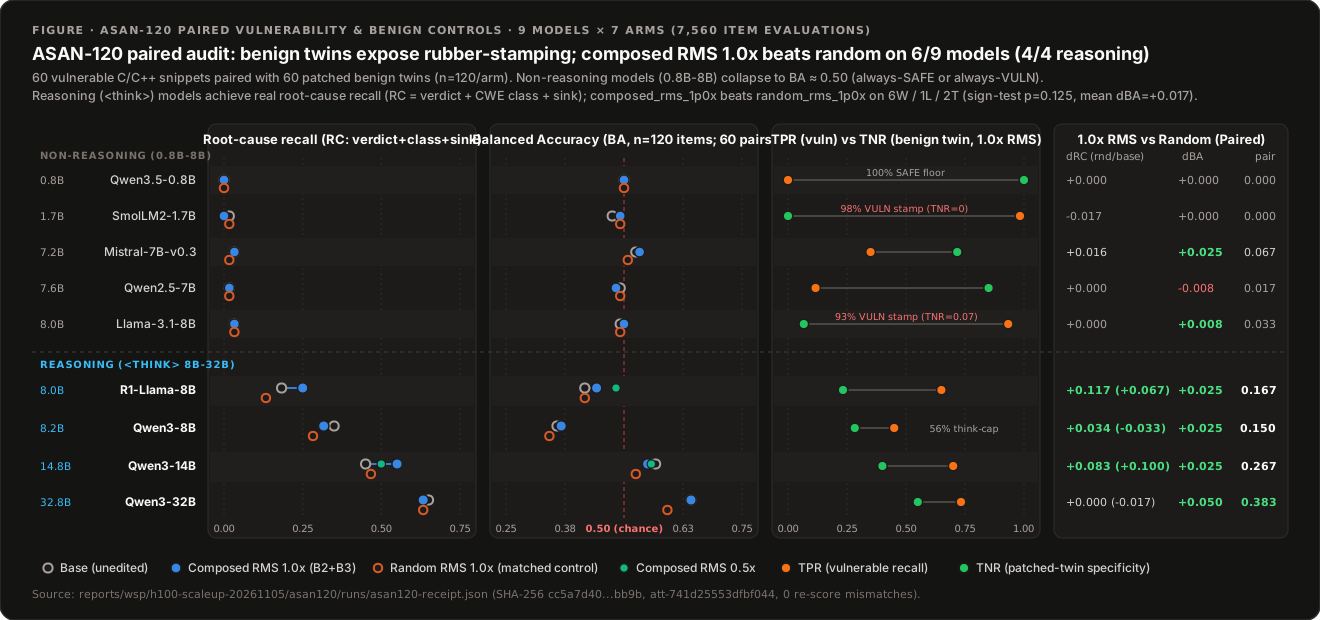
Figure 5:ASAN-120 paired evaluation across 9 models (7,560 completions). Top 5 rows: non-reasoning models (0.8B to 8B) cluster on the BA = 0.50 chance line (0.475 to 0.533), either defaulting to SAFE (Qwen3.5-0.8B TNR = 1.000, Qwen2.5-7B TNR = 0.850) or rubber-stamping VULNERABLE (SmolLM2-1.7B TPR = 0.983, TNR = 0.000; Llama-3.1-8B TPR = 0.933, TNR = 0.067), with near-zero root-cause recall (RC <= 0.067). Bottom 4 rows: <think> reasoning models (8B to 32.8B) achieve genuine root-cause attribution (RC up to 0.550 on Qwen3-14B and 0.683 on Qwen3-32B), and composed_rms_1p0x beats random_rms_1p0x on BA across 6 of 9 models (6W / 1L / 2T, including 4/4 reasoning models).
Cell order: base / c0.5 / r0.5 / c1.0 / r1.0; c is composed RMS editing and r is its norm-matched random control. The suffix is the RMS-relative dose.
TPR: vulnerable-item sensitivity; TNR: patched-twin specificity; BA: balanced accuracy; MCC: Matthews correlation.
RC: strict root-cause recall (verdict + class + sink); pair: both twins correct; parsed: parsed-answer fraction; cap: unclosed think-chain fraction.
A single value or range in the last table retains the original summary across arms; cap is shown only where reported.
ASAN-120: verdict quality and specificity
| Model | TPR | TNR | BA | MCC |
|---|---|---|---|---|
| Qwen3.5-0.8B | .00 / .00 / .00 / .00 / .00 | 1.0 / 1.0 / 1.0 / 1.0 / 1.0 | .500 / .500 / .500 / .500 / .500 | .00 / .00 / .00 / .00 / .00 |
| SmolLM2-1.7B | .95 / .97 / .98 / .98 / .98 | .00 / .00 / .00 / .00 / .00 | .475 / .483 / .492 / .492 / .492 | -.16 / -.13 / -.09 / -.09 / -.09 |
| Mistral-7B-v0.3 | .33 / .35 / .33 / .35 / .30 | .72 / .72 / .72 / .72 / .72 | .525 / .533 / .525 / .533 / .508 | +.05 / +.07 / +.05 / +.07 / +.02 |
| Qwen2.5-7B | .12 / .12 / .10 / .12 / .12 | .87 / .85 / .87 / .85 / .87 | .492 / .483 / .483 / .483 / .492 | -.03 / -.05 / -.05 / -.05 / -.03 |
| Llama-3.1-8B | .93 / .93 / .93 / .93 / .93 | .05 / .05 / .05 / .07 / .05 | .492 / .492 / .492 / .500 / .492 | -.04 / -.04 / -.04 / .00 / -.04 |
| R1-Llama-8B | .60 / .72 / .68 / .65 / .63 | .23 / .25 / .27 / .23 / .20 | .417 / .483 / .475 / .442 / .417 | -.18 / -.04 / -.06 / -.13 / -.18 |
| Qwen3-8B | .43 / .38 / .40 / .45 / .43 | .28 / .32 / .43 / .28 / .25 | .358 / .350 / .417 / .367 / .342 | -.29 / -.30 / -.17 / -.27 / -.32 |
| Qwen3-14B | .63 / .65 / .65 / .70 / .63 | .50 / .47 / .38 / .40 / .42 | .567 / .558 / .517 / .550 / .525 | +.13 / +.12 / +.03 / +.10 / +.05 |
| Qwen3-32B | .78 / .73 / .82 / .73 / .77 | .50 / .40 / .52 / .55 / .42 | .642 / .567 / .667 / .642 / .592 | +.30 / +.14 / +.35 / +.29 / +.20 |
ASAN-120: root cause and paired controls
| Model | RC | Pair accuracy | Parsed (cap) |
|---|---|---|---|
| Qwen3.5-0.8B | .000 / .000 / .000 / .000 / .000 | .000 (all) | 1.00 (.00) |
| SmolLM2-1.7B | .017 / .000 / .017 / .000 / .017 | .000 (all) | .97-.99 (.00) |
| Mistral-7B-v0.3 | .033 / .033 / .033 / .033 / .017 | .050 / .067 / .050 / .067 / .033 | 1.00 (.00) |
| Qwen2.5-7B | .017 / .017 / .017 / .017 / .017 | .033 / .017 / .017 / .017 / .033 | 1.00 (.00) |
| Llama-3.1-8B | .033 / .050 / .033 / .033 / .033 | .033 (all) | .97 (.01) |
| R1-Llama-8B | .183 / .217 / .133 / .250 / .133 | .067 / .117 / .167 / .167 / .083 | .68 (.32) / .72 (.28) / .69 (.32) / .68 (.36) / .67 (.35) |
| Qwen3-8B | .350 / .267 / .300 / .317 / .283 | .117 / .150 / .167 / .150 / .100 | .39 / .44 / .48 / .46 / .40 |
| Qwen3-14B | .450 / .500 / .500 / .550 / .467 | .250 / .267 / .217 / .267 / .217 | .68 / .67 / .62 / .67 / .62 |
| Qwen3-32B | .650 / .633 / .683 / .633 / .633 | .367 / .333 / .433 / .383 / .333 | .72 (.31) / .67 (.33) / .72 (.32) / .74 (.29) / .68 (.35) |
What the paired ASAN-120 evaluation establishes:
Patched benign twins expose one-sided rubber-stamping in non-reasoning models (
0.8Bto8B). Without<think>chain-of-thought reasoning, all five non-reasoning checkpoints collapse to near-chance balanced accuracy (BA = 0.475to0.533,RC <= 0.067):Qwen3.5-0.8B(TNR = 1.000, TPR = 0.000),Qwen2.5-7B(TNR = 0.850-0.867, TPR = 0.100-0.117), andMistral-7B-v0.3(TNR = 0.717, TPR = 0.300-0.350) default towardSAFE, whereasSmolLM2-1.7B(TPR = 0.950-0.983, TNR = 0.000) andLlama-3.1-8B(TPR = 0.933-0.967, TNR = 0.033-0.067) rubber-stamp almost every functionVULNERABLE. On a vulnerable-only benchmark,Llama-3.1-8B’s93.3%positive rate looks like high sensitivity; pairedTNR(5.0%onbase,6.7%oncomposed_rms_1p0x) andpairaccuracy (3.3%) show that it rarely clears a patched fix.At
1.0xRMS dosing,composed_rms_1p0xbeats its norm-matched random controlrandom_rms_1p0xon6of9models (6W / 1L / 2T, exact sign-testp = 0.1250, meandBA = +0.017), including all4of4<think>reasoning models (4W / 0L / 0TonBAandMCC):On
Qwen3-14B,composed_rms_1p0xlifts strict root-cause recallRCfrom0.450(base,27/60) and0.467(random_rms_1p0x,28/60) to0.550(33/60,+10.0pp overbase,+8.3pp overrandom_rms_1p0x), CWE bug-class recall from0.500to0.617(+11.7pp), sink recall from0.567to0.617(+5.0pp overbase,+8.4pp overrandom_rms_1p0x), andTPRfrom0.633to0.700(+6.7pp), while beatingrandom_rms_1p0xonBA(0.550vs.0.525) and twin-pair accuracy (0.267vs.0.217).On
DeepSeek-R1-Distill-Llama-8B,composed_rms_0p5xliftsTPRfrom0.600(base) to0.717(+11.7pp),BAfrom0.417to0.483(+6.6pp), and sink recall from0.350to0.500(+15.0pp) while cutting<think>cap truncations from38/120to33/120;composed_rms_1p0xliftsRCfrom0.183(base) and0.133(random_rms_1p0x) to0.250(+6.7pp overbase,+11.7pp overrandom_rms_1p0x) and raisespairaccuracy from0.067(base) and0.083(random_rms_1p0x) to0.167(+10.0pp overbase,+8.4pp overrandom_rms_1p0x).On
Qwen3-32B,composed_rms_1p0xachieves the highest patched-twin specificity (TNR = 0.550,+5.0pp overbase0.500,+13.3pp overrandom_rms_1p0x0.417), highest<think>completion rate (89/120parsed,cap = 35vs.42onrandom_rms_1p0x), and beatsrandom_rms_1p0xonBA(0.642vs.0.592,+5.0pp) andpair(0.383vs.0.333,+5.0pp), while at0.5xrandom_rms_0p5x(BA = 0.667, RC = 0.683) exceedscomposed_rms_0p5x(BA = 0.567, RC = 0.633, unadjusted McNemarp = 0.0169, Holmp = 0.2197).On
Qwen3-8B, where54%to62%of generations hit the 1,536-token<think>cap,composed_rms_1p0xbeatsrandom_rms_1p0xacrossBA(0.367vs.0.342),TPR(0.450vs.0.433),TNR(0.283vs.0.250),RC(0.317vs.0.283),pair(0.150vs.0.100), and completed<think>chains (55/120vs.48/120).
Scope, pair-resampled intervals, and multiple-comparison boundary. Six of the nine models (
Qwen3.5-0.8B,SmolLM2-1.7B,Mistral-7B-v0.3,Qwen2.5-7B,Llama-3.1-8B,Qwen3-32B) use the heuristic writer layerround(0.67 * n_layers)recorded inasan120-receipt.jsonrather than a pre-pinned writer fromdomain-uplift-models.json. Againstbase, the retained 95% pair-resampled bootstrap intervals (asan120_results.json) forcomposed_rms_1p0xstrict root-cause recall change are+10.0pp ([0.0, +21.67]) onQwen3-14Band+6.67pp ([-5.0, +18.33]) onR1-Llama-8B, whileQwen3-32Bbalanced accuracy changes by0.0pp ([-9.17, +9.17]). Across all 117 paired exact two-sided McNemar tests on verdict correctness (9models13comparisons per model,n = 120per test), no single-model comparison survives within-model or global Holm-Bonferroni correction at (min within-model p_Holm = 0.2197across 13 tests onQwen3-32B;global 117-test p_Holm = 1.0), and across the 9-model sign tests (calibrated_1p0xminusrandom_1p0x:+3/-2/0:4,p = 1.000;composed_rms_0p5xminusrandom_rms_0p5x:+3/-3/0:3,p = 1.000;composed_rms_1p0xminusrandom_rms_1p0x:+6/-1/0:2,p = 0.125), the1.0xRMS directional advantage is consistent across the reasoning cohort (4/4) but below the 9-model exact sign-test significance threshold. Pairwise surface heuristics that see both twins simultaneously (longer snippet is safe:0.8583;more lines:0.7500;more conditionals:0.6750) drop to near-chance item-level safe-label AUCs (0.5735,0.5415, and0.5578) when evaluated one snippet at a time under the model task format.
Table 4C: ASAN-120 Descriptive Breakdown Across All 12 CWE Families (Vulnerable Detections / Patched-Benign Clearances Out of 45 = 9 Models 5 Pairs per Family)
| CWE Family | Base (Vuln / Safe) | Composed 1.0x (Vuln / Safe) | Random 1.0x (Vuln / Safe) |
|---|---|---|---|
F01: Heap buffer overflow | 30 / 22 | 30 / 20 | 29 / 20 |
F02: Stack buffer overflow | 31 / 17 | 29 / 18 | 28 / 22 |
F03: Use after free | 22 / 19 | 21 / 19 | 22 / 18 |
F04: Integer overflow -> allocation | 24 / 22 | 27 / 23 | 26 / 20 |
F05: Signed/unsigned conversion | 26 / 15 | 27 / 17 | 23 / 15 |
F06: Off-by-one boundary | 24 / 23 | 25 / 26 | 21 / 22 |
F07: Null pointer dereference | 22 / 25 | 21 / 20 | 25 / 21 |
F08: Double free | 19 / 22 | 23 / 20 | 22 / 18 |
F09: Uninitialized memory read | 16 / 21 | 17 / 20 | 18 / 20 |
F10: Release-elided assert check | 25 / 22 | 25 / 24 | 26 / 23 |
F11: Type confusion / bad cast | 21 / 24 | 21 / 23 | 19 / 23 |
F12: Unbounded recursion | 27 / 17 | 29 / 16 | 29 / 13 |
4.5.1 Real-World Upstream C/C++ Vulnerability Twin Suite (ASAN-RealWorld-60 / ASAN-180)
To verify that the paired-twin findings on ASAN-120 hold on production C/C++ parser and runtime functions rather than only standalone constructed templates, we built ASAN-RealWorld-60 (data/asan_realworld_60/asan_realworld_60_paired_benchmark.json, SHA-256 7aaf5593da3f9f84a5df8d77102966ce223a753f7d4d647a1292df1b5f33a151; combined 180-item suite asan180_combined_benchmark.json, SHA-256 526db767cb21a8df4315377c2f7089f79f2d31a103df8bcc71fc5f938630e7cb): 30 sanitizer-reproduced upstream C/C++ vulnerabilities (RW01..RW30) paired with their 30 exact upstream patches (60 functions, mean pre/post twin similarity 89.4%) drawn from 16 production open-source repositories (freetype/freetype, protocolbuffers/protobuf, pnggroup/libpng, openxla/xla, harfbuzz/harfbuzz, AOMediaCodec/libavif, lz4/lz4, google/flatbuffers, libjxl/libjxl, google/XNNPACK, vllm-project/vllm, mlc-ai/xgrammar, onnx/onnx, opencv/opencv, openvinotoolkit/openvino, apache/arrow, and tensorflow/tensorflow; sealed provenance manifest asan_realworld_60_manifest.json, SHA-256 d4ac48b0d9ed9414d4bd06a46322a76b083576fd97a071db969e0c263dc21d08). Every pair was compiled and verified across 360 binary runs (clang++ -O0, -O1, and -O2 with -fsanitize=address,undefined -fno-sanitize-recover=all; validation_receipt.json SHA-256 f64ea55205fb8c36e42e1b46a2c071a21e3a2c7fc4dacc526fcdb0d6b9c7577a, 30 / 30 pairs PASS): every unpatched function (RW*-V) faults at its @SINK / @ROOT line on --trigger and exits 0 on --control, while every patched twin (RW*-S) exits 0 on both.
Evaluating four 0.8B–4B checkpoints across 18 arms (1,080 completions, asan_realworld_60_results.json SHA-256 59402d8fb6627ba08c3a399d97e57a5ac75ecf229ccd727019979536cd138ba8, 0 re-score mismatches, bit-exact weight restoration verified after every arm) reproduces both ASAN-120 behaviors on real upstream code:
Model (ASAN-RealWorld-60, N = 60) | Arm | TPR (Vuln) | TNR (Patched) | BA | MCC | RC (Strict Root Cause) | Class Acc | Sink Acc | Pair BA |
|---|---|---|---|---|---|---|---|---|---|
Qwen3.5-0.8B | base / calibrated_1p0x / random_1p0x / composed_rms_1p0x / random_rms_1p0x | 0.0% | 100.0% | 50.0% | +0.000 | 0.0% | 0.0% | 3.3%–13.3% | 50.0% |
Qwen2.5-1.5B-Instruct | base / calibrated_1p0x / random_1p0x / composed_rms_1p0x / random_rms_1p0x | 6.7%–20.0% | 70.0%–86.7% | 45.0%–46.7% | -0.140..-0.079 | 0.0% | 0.0%–3.3% | 13.3%–16.7% | 35.0%–43.3% |
SmolLM2-1.7B-Instruct | base / calibrated_1p0x / random_1p0x / composed_rms_1p0x / random_rms_1p0x | 96.7%–100.0% | 0.0% | 48.3%–50.0% | -0.130..+0.000 | 0.0% | 16.7% | 6.7%–13.3% | 0.0% |
Qwen3.5-4B | base | 63.3% | 40.0% | 51.7% | +0.034 | 10.0% | 16.7% | 43.3% | 25.0% |
Qwen3.5-4B | calibrated_1p0x | 60.0% | 40.0% | 50.0% | +0.000 | 10.0% | 16.7% | 36.7% | 25.0% |
Qwen3.5-4B | random_1p0x | 63.3% | 43.3% | 53.3% | +0.068 | 10.0% | 16.7% | 43.3% | 26.7% |
Sub-2B checkpoints collapse to one-sided priors on real upstream C/C++ code:
Qwen3.5-0.8Blabels100%of upstream functionsSAFE(TPR = 0.0%, TNR = 100.0%, RC = 0.0%), whileSmolLM2-1.7B-Instructlabels96.7%–100.0%VULNERABLE(TNR = 0.0%, FPR = 100.0%, RC = 0.0%).Qwen3.5-4Bachieves non-zero strict root-cause recall (RC = 10.0%) and43.3%sink localization on real upstream bugs: Only the4Breasoning model achieves non-zero 3-criterion root-cause attribution (RC = 10.0%,Class Acc = 16.7%,Sink Acc = 43.3%), while neithercalibrated_1p0xnorcomposed_rms_1p0xsignificantly outperformsbaseor norm-matchedrandomcontrols (all exact two-sided McNemarp >= 0.125), matching theASAN-120null result for small models.
4.6 Focused Dose-Response Case Study: Qwen3.5-4B (Regime B)
Alongside the multi-model sweeps, this single-model case study isolates how changing the loop-edit dose affects completion and attribution. This test gives the same 30 crash traces to each edited model with a 1,536-token limit. “Closed” means the model emitted </think> within that limit. The other columns score the final answer’s bug class, culprit frame, and root cause separately. A completed answer can still be wrong. The dose changes only B1 in the a05 and a15 arms. Strict scoring requires a committed answer after </think>. In the reported copy-the-input control, a whole-output keyword matcher scored the raw prompt 28/30, while strict scoring gave it 0/30; merely repeating a function name is not correct attribution.
Model: Qwen3.5-4B; 30 prompts per arm; 1,536-token cap (
data/multiseed_and_dose_20261109/qwen35_4b_dose_and_rand3_receipt.json,sha256: eae628d0...a5ca).Arms:
base/rand1/rand2/rand3(3-seed equal-norm random ensemble, seeds20261105..20261107,0.0 ± 0.0 / 30);g030(uncalibrated ported from0.8B);a05,a06,a07,a08,a09(B1at , , , , and ;B2andB3held at );b1only(, loop edit only);cal738(, composedB1+B2+B3);a15(B1at ;B2andB3held at ).Closed means an emitted closing think tag; class, frame, and root cause require a committed final answer.
Dose and completion
| Arm | B1 shift | Closed /30 | Mean tokens |
|---|---|---|---|
| base / rand1 / rand2 / rand3 | n/a | 0/30 | 1,536 |
| g030 | n/a | 0/30 | 1,536 |
a05 (0.50x) | -3.691 | 0/30 (0.0%) | 1,536 |
a06 (0.60x) | -4.429 | 2/30 (6.7%) | 1,491 |
a07 (0.70x) | -5.168 | 5/30 (16.7%) | 1,430 |
a08 (0.80x) | -5.906 | 12/30 (40.0%) | 1,318 |
a09 (0.90x) | -6.644 | 14/30 (46.7%) | 1,210 |
b1only (1.00x, B1 only) | -7.382 | 17/30 (56.7%) | 1,044 |
cal738 (1.00x, B1+B2+B3) | -7.382 | 21/30 (70.0%) | 954 |
a15 (1.50x, B1 at 1.5x) | -11.073 | 30/30 (100.0%) | 789 |
Strict attribution
| Arm | Bug class /30 | Culprit frame /30 | Root cause /30 |
|---|---|---|---|
| base / rand1 / rand2 / rand3 | 0/30 | 0/30 | 0/30 |
| g030 | 0/30 | 0/30 | 0/30 |
a05 (0.50x) | 0/30 (0.0%) | 0/30 (0.0%) | 0/30 (0.0%) |
a06 (0.60x) | 2/30 (6.7%) | 1/30 (3.3%) | 1/30 (3.3%) |
a07 (0.70x) | 5/30 (16.7%) | 3/30 (10.0%) | 3/30 (10.0%) |
a08 (0.80x) | 8/30 (26.7%) | 9/30 (30.0%) | 8/30 (26.7%) |
a09 (0.90x) | 10/30 (33.3%) | 10/30 (33.3%) | 8/30 (26.7%) |
b1only (1.00x, B1 only) | 15/30 (50.0%) | 13/30 (43.3%) | 11/30 (36.7%) |
cal738 (1.00x, B1+B2+B3) | 18/30 (60.0%) | 15/30 (50.0%) | 14/30 (46.7%) |
a15 (1.50x, B1 at 1.5x) | 23/30 (76.7%) | 23/30 (76.7%) | 19/30 (63.3%) |
Sampling the interior 0.60x..0.90x interval (a06, a07, a08, a09) shows that loop closure rises as a monotonic ramp across [0.50x, 1.50x] rather than a discontinuous step (0/30 at 0.50x -> 2/30 at 0.60x -> 5/30 at 0.70x -> 12/30 at 0.80x -> 14/30 at 0.90x -> 21/30 at 1.00x -> 30/30 at 1.50x), while mean generated tokens fall monotonically (1,536 -> 1,491 -> 1,430 -> 1,318 -> 1,210 -> 954 -> 789) and strict attribution tracks closure (0/30 -> 1/30 -> 3/30 -> 8/30 -> 8/30 [10/30 class and frame] -> 14/30 -> 19/30). Exact two-sided McNemar tests against base: a08 loop closure (12 vs. 0 discordant pairs); a09 loop closure (14 vs. 0 discordant pairs); cal738 loop closure (21 vs. 0 discordant pairs); a15 loop closure (30 vs. 0 discordant pairs). Comparing a15 vs. cal738: loop closure , culprit frame .
Direct 4-Arm MATH-500 Attribution on Qwen3.5-0.8B: What the Test Tells Us in Plain Words
To compare template-level <think> bypassing (enable_thinking=False) against weight-space loop suppression (secant_b1_edit) and an orthogonal norm-matched random control (random_norm_matched) on the exact Qwen/Qwen3.5-0.8B (revision 2fc06364..., sha256 04b1c301...) and HuggingFaceH4/MATH-500 (revision 6e4ed1a2...) model-dataset pair studied by Takehi et al., we ran a controlled 4-arm evaluation (n = 100, max_new_tokens = 4,096, BF16, greedy decoding, seed 20261108, lm_eval 0.4.13 minerva_math math_verify, receipt qwen35_08b_thinking_off_vs_edit_receipt.json, sha256 bc3c982e...c13b):
Arm (Qwen/Qwen3.5-0.8B, MATH-500, n = 100) | <think> Mode | </think> Closure | Post-</think> math_verify | Whole-Response math_verify | Mean Tokens |
|---|---|---|---|---|---|
base_thinking_on | enable_thinking=True | 1 / 100 (1.0%) | 1.0% | 12.0% | 4,072.2 |
base_thinking_off | enable_thinking=False | (prefilled) | 48.0% | 48.0% | 1,899.3 |
secant_b1_edit (L15 & L19 top-64 cols, 0.016%) | enable_thinking=True | 64 / 100 (64.0%) | 24.0% | 31.0% | 3,598.4 |
random_norm_matched (Seed 1 20261108, orthogonal random, 64 cols) | enable_thinking=True | 2 / 100 (2.0%) | 0.0% | 18.0% | 4,096.0 |
random_norm_matched_seed2 (Seed 2 20261109, orthogonal random, 64 cols) | enable_thinking=True | 6 / 100 (6.0%) | 2.0% | 16.0% | 4,065.3 |
random_norm_matched_seed3 (Seed 3 20261110, orthogonal random, 64 cols) | enable_thinking=True | 1 / 100 (1.0%) | 1.0% | 19.0% | 4,073.7 |
random_norm_matched (3-seed mean ± SD) | enable_thinking=True | 3.0% ± 2.6% | 1.0% ± 1.0% | 17.7% ± 1.5% | 4,078.3 ± 15.8 |
In plain words, this 4-arm comparison establishes three points:
A weight edit does not teach a model new math (
base_thinking_offvs.base_thinking_on):Qwen3.5-0.8Balready knew how to solve48.0%ofMATH-500. With<think>enabled,99 / 100baseline runs get stuck repeating themselves inside<think>and fail to emit</think>within4,096new tokens (1.0%post-</think>accuracy;12.0%whole-response). Settingenable_thinking=Falselifts accuracy to48.0%(47vs.0discordant pairs, exact two-sided McNemar , Holm-adjusted ), matching Takehi et al.'s32,768-token edited score (48.1%) consistent with single-shot weight subtraction unblocking pre-existing capability rather than injecting new math skill.Our
B1loop edit is a real mechanism across 3 random direction seeds (secant_b1_editvs.random_norm_matchedseed_1..seed_3, receipt SHA-256f7da8318...6dc2): Because theB1edit direction is a deterministic mean difference over the fixed calibration set and evaluation uses greedy decoding (temperature = 0),secant_b1_editis a single deterministic run while the 3-seed ensemble varies the random control direction (seed_1..seed_3). UnlikeQwen3-8BonGSM8K(where<think>loops are mild enough that a norm-matched random edit matches the targeted edit at30/100), onQwen3.5-0.8BMATH-500three independent orthogonal random direction seeds (seed_1 = 20261108,seed_2 = 20261109,seed_3 = 20261110, each orthogonal toB1with matched Frobenius norms1.7489and1.3988on the exact same 64 columns of layers 15 and 19) close only2 / 100,6 / 100, and1 / 100<think>traces (mean3.0% ± 2.6%,0 / 100closed by majority vote across random seeds) and score0.0%,2.0%, and1.0%post-</think>(mean1.0% ± 1.0%,0 / 100solved by majority vote; whole-response18.0%,16.0%, and19.0%, mean17.7% ± 1.5%). By contrast,secant_b1_editlifts</think>closure to64 / 100(64.0%) (exact two-sided McNemar , Holm-adjusted against every random seed) and post-</think>accuracy to24.0%(24/0,24/2, and24/1discordant pairs againstseed_1..seed_3, exact two-sided McNemar , , and , Holm-adjusted across all 3 seeds; whole-response31.0%vs.12.0%base, ). Under the4,096-token budget,36 / 100secant_b1_edittraces did not emit</think>within the budget (31at the text cap,4ended early without closing,1re-tokenized over the cap), explaining the gap between24.0%at4,096tokens and48.1%at32,768tokens. Across the100paired items,5of the24problems solved bysecant_b1_editwere problems thatbase_thinking_off(48.0%) missed (19solved by both,29only bybase_thinking_off,5only bysecant_b1_edit).Why not just turn
<think>off everywhere? As Section 4.5 (ASAN-120) shows below, models without<think>collapse to one-sided guessing on paired C/C++ vulnerability auditing (BA = 0.475to0.533,93%to100%false-positive rate on patched code forLlama-3.1-8BandSmolLM2-1.7B,<= 6.7%root-cause recall across all 5 non-reasoning models), whereas keeping<think>enabled with calibratedB1 + B2 + B3surgery beats random controls on4 / 4reasoning models and liftsQwen3-14Bstrict root-cause recall from45.0%to55.0%. Furthermore, distilled reasoning models (DeepSeek-R1-Distill-Qwen-7B,DeepSeek-R1-Distill-Llama-8B) and raw.gguffiles have noenable_thinking=Falsetemplate switch.
Section 4 takeaway: Each study supports its own claim. Calibration matched the requested shift on all 15 Stage-1 models. Project-Then-Heal kept local leakage at the
float32floor (float64floor3.18e-17to5.07e-17in the RMS sweep) on every model where gradient projection did not. On 14 models, the calibrated1.0xedits left public-benchmark scores within about 2 pooled points of base, as equal-size random edits did, with a pooledMMLU-Procost of2.0points and no significant crash-triage gain. Across 6 models in the RMS-relative dosing sweep (24,000evaluations), sizing edits by (5.85to78.15) showed that unhealed composed edits match norm-matched random controls. Direct 60-stepheal-the-base(base_lora_1p0x) andhealed-random(random_healed_rms_1p0x) controls show that onQwen2.5-Math-7B-Instructthe87 -> 93GSM8Kgain comes from the 60-step LoRA adaptation pass (93/100on both controls,p = 1.000, consistent with the LoRA pass driving the accuracy lift), whileProjectThenHealLinear(composed_healed_rms_1p0x) reduces domain-subspace leakage from4.75%to5.08e-17at zero accuracy cost; onQwen2.5-Coder-7B-InstructHumanEval,composed_healed_rms_1p0x(42/100) vs.base_lora_1p0x(37/100,p = 0.332) andrandom_healed_rms_1p0x(35/100,p = 0.189) is within sample noise atn = 100, while the lock reduces domain leakage from3.69%to3.34e-17. Finally, on the pairedASAN-120vulnerability and patched-benign twin benchmark (9models7arms,7,560evaluations), benign controls expose trivial one-sided predictions (BA ≈ 0.50) across all 5 non-reasoning models, whereas on the 4<think>reasoning modelscomposed_rms_1p0xbeatsrandom_rms_1p0x4/4on balanced accuracy (6W / 1L / 2Toverall, sign-testp = 0.125) and lifts strict root-cause recall (RC) by+6.7to+10.0percentage points overbaseonDeepSeek-R1-Distill-Llama-8B(0.183 -> 0.250) andQwen3-14B(0.450 -> 0.550).
5. Static Weight Auditing
Sections 1 to 4 edit weights. This section uses the same readers to inspect weights someone else may have edited, without running the model. Every number below comes from a receipt whose inputs were hashed before and after each run (pre_sha256 == post_sha256). That is a non-adversarial host-filesystem bracket, not descriptor-bound execution.
5.1 Spectral Trojan Auditing and the Vocabulary Phase Transition
secant audit-trojan (secant read --detect-anomalies --marchenko-pastur) implements a two-stage static spectral detector:
Stage 1 (Iterated Outlier Singular-Value Peeling & Row/Column Spike Detection): Iteratively peels outlier singular values () from the total Frobenius energy (, the exact Frobenius energy of the rank- ablated matrix ) until the residual Marchenko-Pastur bulk edge reaches a fixed point (
mp.rs), and checks row/column norm spikes (zero_rows,collapsed_rows,spike_cols).Stage 2 (Cross-Layer Sibling Modified Z-Score & Vocabulary Token Projection): Because natural trained weight matrices are heavy-tailed and first/last transformer blocks (
layers.0and the final block) interface directly with token embeddings, Stage 2 compares each tensor’s peeled ratio against its architectural layer family (blk.*.ffn_down.weight,model.layers.*.mlp.down_proj.weight) via the Iglewicz-Hoaglin modified z-score (sibling_outlierwhen in a family of layers), while--vocab-tensorprojects the leading left singular vector onto the unembedding matrix () to surface its top promoted vocabulary tokens.
Trained weight matrices are non-i.i.d. and already sit well above the Marchenko-Pastur bulk edge on unedited checkpoints, so serves as a relative ranking feature paired with the cross-layer sibling modified-Z test and --vocab-tensor projection rather than a standalone i.i.d. threshold. To measure when these signals fire, a rank-1 edit was planted in the layer-12 MLP down projection of SmolLM2-1.7B-Instruct (SafeTensors, family_size = 24) and Qwen3.5-4B (BF16 GGUF, where blk.*.ffn_down.weight has family_size = 33 because llama.cpp exports the 32 decoder blocks blk.0..31 plus blk.32, the Multi-Token Prediction / MTP blk.32.nextn.* head block). Here is the unit embedding row of a trigger token, and spreads equal weight over 16 evenly spaced input columns. The edit was planted at 12 relative Frobenius doses from 0 to 16%.
A rank-1 edit’s only singular value is . The standalone singular-value equality reference (nominal crossover) where the planted perturbation’s spectral norm equals the unedited matrix’s leading singular value is:
which is 8.65% for SmolLM2 and 6.57% for Qwen. Because and are not orthogonal in general, the exact dose at which the top singular vector of aligns with the trigger direction depends on the overlap between and the leading singular triplets of ; empirically, the discrete post-hoc dose sweep (4%, 6%, 8%, 10%, 12%) brackets on both models.
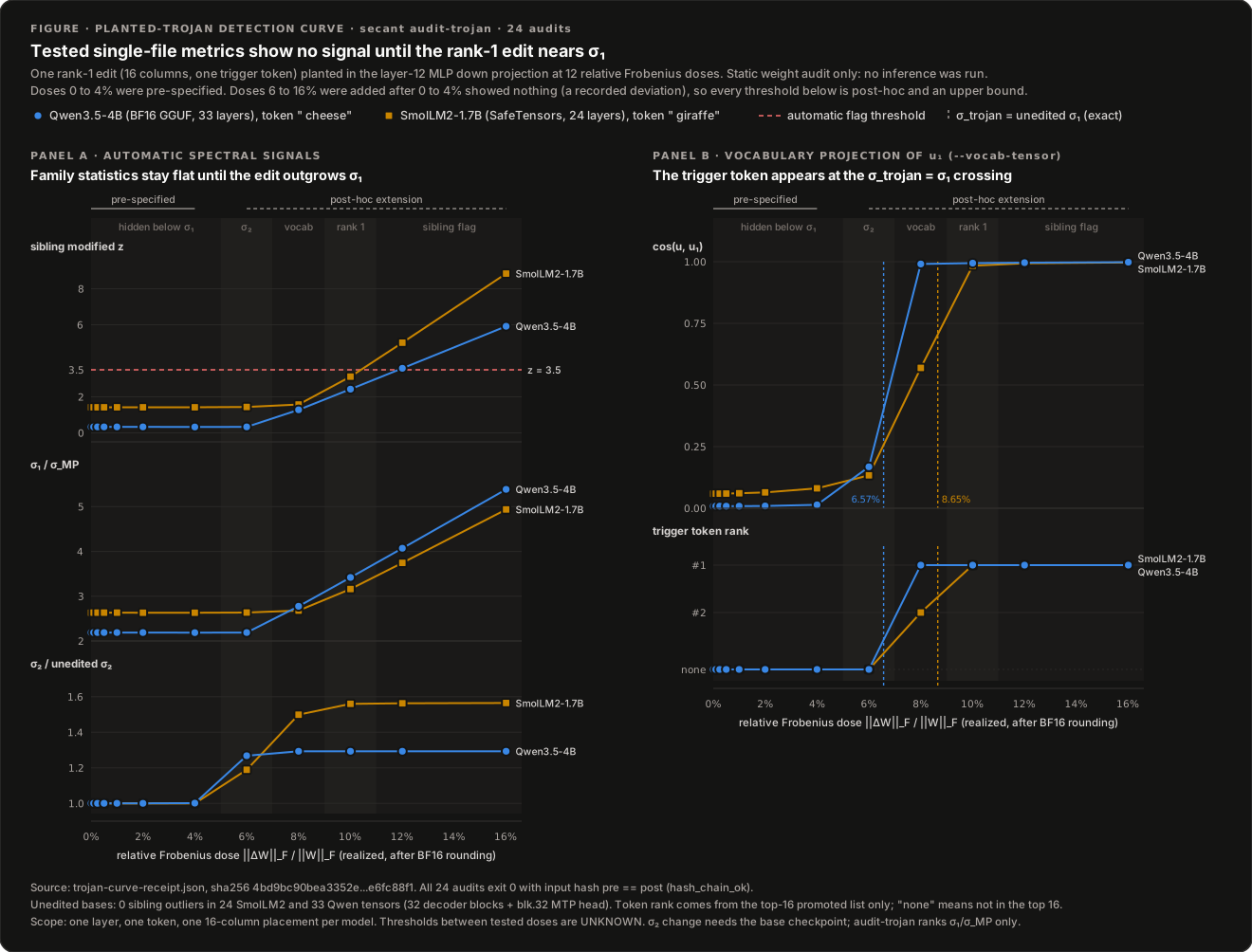
Figure 6:Detection signals against dose for both models. Doses 0 to 4% were pre-specified, and 6 to 16% were added after the pre-specified range showed nothing, so each threshold is post-hoc and an upper bound. The dashed verticals mark the nominal singular-value equality reference .
| Signal | First tested dose, SmolLM2 | First tested dose, Qwen3.5-4B | Needs the base checkpoint? |
|---|---|---|---|
| Any automatic signal, pre-specified 0.10 to 4.00% | none | none | |
| σ₂ rises (25.31 to 30.10; 2.112 to 2.678) | 6% | 6% | yes: audit-trojan ranks σ₁ / σMP only |
| Trigger token in the promoted top 16 of u₁ | 8% (rank 2, cos(u, u₁) = 0.569) | 8% (rank 1, cos(u, u₁) = 0.991) | no, but a person has to read the column |
| Edited layer is family rank 1 by σ₁ / σMP | 10% | 10% | no |
| Automatic sibling_outlier (z > 3.5) | 12% (z = 5.01) | 12% (z = 3.58) | no |
| Sibling outliers on the unedited base | 0 of 24 | 0 of 33 |
The vocabulary jump happens across the sampled doses bracketing : goes from 0.168 to 0.991 between 6% and 8% on Qwen (), and from 0.569 to 0.984 between 8% and 10% on SmolLM2 (). Well below the planted direction is nearly absent from ( at 6% on both models). Close to the two directions mix (SmolLM2 at 8%: , ). Above , aligns with the planted direction (). The automatic sibling test needs a further 39% to 83% of beyond that ( = 1.39 and 1.83 at the first flag). Excluding the MTP head block blk.32 (32-tensor decoder family blk.0..31) on Qwen3.5-4B leaves the 12% sibling-outlier crossover dose unchanged while raising blk.12’s modified z-score from 2.43 to 2.85 at 10%, from 3.58 to 4.21 at 12%, and from 5.92 to 6.94 at 16% (0 / 32 false positives on the unedited base). Full 12-dose tables: payload checks, Section 5.1.
Scope of the initial 12-dose single-layer study (w61e): one layer (layers.12.mlp.down_proj.weight), one token, and one 16-column placement per model, static weights only, with doses 0.00% to 4.00% pre-specified and 6.00% to 16.00% added post-hoc.
Fixed-Grid 17-Cell Multi-Layer, Multi-Placement, and Forward-Pass Behavioral Study
To replace the post-hoc single-layer boundary with a fixed-grid multi-layer and behavioral test, we executed a second, 11-dose, 17-cell campaign (w61j-trojan-multilayer-behavioral-20261109; receipt data/trojan_multilayer_20261109/trojan-multilayer-behavioral-receipt.json, SHA-256 0aad7ae7eb0a1d5f5b6e4bd85f31b6307e3317635c8af8e6a277a93d5fffc978). Prior to executing the first model, layer, or dose cell, the fixed dose grid of , the 17 (model, layer, placement) cells across SmolLM2-1.7B-Instruct (layers.4, 10, 12, 20 mlp.down_proj, self_attn.o_proj) and Qwen3.5-0.8B (layers.4, 12, 20 mlp.down_proj, layers.3, 11, 19 self_attn.o_proj, and layers.4, 12, 20 linear_attn.out_proj), the 16 calibration prompt pairs, the 12 strictly held-out evaluation prompt pairs (TRIGGER = " ZEBRA_OVERRIDE_991"), and the static and behavioral endpoints were written to data/trojan_multilayer_20261109/preregistration_spec.json (preregistration_sha256: f979471c41a4ec88933d7951ef4edd4aa052fd0f9efa6245be2c382d44f55b70, written to disk inside the campaign directory at preregistration_created_at_utc: 2026-11-09T17:11:22Z and hash-verified at script startup at execution_started_at_utc: 2026-11-09T17:17:35Z; because the specification file was written inside the campaign workspace prior to cell execution rather than committed to git before campaign launch, we report it as a fixed-grid study rather than an externally pre-committed preregistration). For each cell, is the unit unembedding row of (41401 " giraffe" on SmolLM2-1.7B-Instruct; 16657 " cheese" on Qwen3.5-0.8B), and ( active columns via secant.wsp.plan.v1 rank1-columns, ) is the mean calibration trigger writer-input activation orthogonalized against the top-24 SVD directions of calibration clean token activations. At every dose, we recorded both the static two-stage secant audit (including exact full-vocabulary static rank of in ) and a real PyTorch forward pass on the 12 held-out trigger and clean prompt pairs (delta_logit_target, median vocabulary rank of , greedy top-1 and top-5 flip rates on triggered prompts, and false-flip / top-1 preservation rates on clean prompts):
| Model | Layer & Placement | Depth | Base ||W||_F | Base sigma_1 | Base sigma_1/MP | Theoretical g* = sigma_1/||W||_F | Static Stage-2 g_vocab16 (tau* in top-16) | Static Stage-1 g_Z3.5 (Z > 3.5) | Behavioral g_behav_top5 (>=50%) | Behavioral g_behav_top1 (>=50%) |
|---|---|---|---:|---:|---:|---:|---:|---:|---:|---:|
| SmolLM2-1.7B | layers.4.mlp.down_proj | early | 448.65 | 32.873 | 2.223 | 7.33% | 7.0% (#1) | 12.0% | 16.0% | >16.0% |
| SmolLM2-1.7B | layers.10.mlp.down_proj | mid_a | 458.97 | 42.113 | 2.791 | 9.18% | 9.0% (#1) | 12.0% | 12.0% | 12.0% (100%) |
| SmolLM2-1.7B | layers.12.mlp.down_proj | mid_b | 458.67 | 39.697 | 2.632 | 8.65% | 8.0% (#2) | 12.0% | 12.0% | 12.0% (100%) |
| SmolLM2-1.7B | layers.20.mlp.down_proj | late | 484.08 | 18.985 | 1.187 | 3.92% | 4.0% (#1) | 12.0% | 4.0% | 6.0% (100%) |
| SmolLM2-1.7B | layers.4.self_attn.o_proj | early | 175.61 | 23.072 | 3.018 | 13.14% | 16.0% (#1) | >16.0% | >16.0% | >16.0% |
| SmolLM2-1.7B | layers.10.self_attn.o_proj | mid_a | 189.90 | 17.196 | 2.071 | 9.06% | 8.0% (#3) | >16.0% | >16.0% | >16.0% |
| SmolLM2-1.7B | layers.12.self_attn.o_proj | mid_b | 200.39 | 18.584 | 2.121 | 9.27% | 8.0% (#8) | >16.0% | >16.0% | >16.0% |
| SmolLM2-1.7B | layers.20.self_attn.o_proj | late | 283.20 | 39.015 | 3.163 | 13.78% | 16.0% (#1) | >16.0% | 16.0% | >16.0% |
| Qwen3.5-0.8B | layers.4.mlp.down_proj | early | 15.58 | 1.426 | 1.927 | 9.15% | 9.0% (#1) | >16.0% | >16.0% | >16.0% |
| Qwen3.5-0.8B | layers.12.mlp.down_proj | mid | 15.22 | 1.433 | 1.991 | 9.42% | 9.0% (#1) | >16.0% | >16.0% | >16.0% |
| Qwen3.5-0.8B | layers.20.mlp.down_proj | late | 17.51 | 1.230 | 1.476 | 7.03% | 6.0% (#1) | >16.0% | 4.0% | 4.0% (91.7%) |
| Qwen3.5-0.8B | layers.3.self_attn.o_proj | early | 17.63 | 2.022 | 2.187 | 11.47% | 12.0% (#1) | >16.0% | >16.0% | >16.0% |
| Qwen3.5-0.8B | layers.11.self_attn.o_proj | mid | 16.86 | 2.171 | 2.478 | 12.87% | 12.0% (#1) | >16.0% | >16.0% | >16.0% |
| Qwen3.5-0.8B | layers.19.self_attn.o_proj | late | 24.21 | 2.071 | 1.623 | 8.55% | 7.0% (#2) | >16.0% | 6.0% | 6.0% (58.3%) |
| Qwen3.5-0.8B | layers.4.linear_attn.out_proj | early | 16.96 | 2.118 | 2.392 | 12.49% | 10.0% (#5) | >16.0% | >16.0% | >16.0% |
| Qwen3.5-0.8B | layers.12.linear_attn.out_proj | mid | 16.22 | 2.229 | 2.656 | 13.75% | 16.0% (#1) | >16.0% | >16.0% | >16.0% |
| Qwen3.5-0.8B | layers.20.linear_attn.out_proj | late | 15.25 | 1.464 | 1.827 | 9.60% | 9.0% (#1) | >16.0% | 4.0% | 4.0% (91.7%) |
Across all 17 cells (187 dose points), three conclusions hold:
Static Stage-2 vocabulary projection tracks across depths and writer families: In all 17 cells, the dose at which enters the top-16 of matches within a single grid interval ( percentage points), including
SmolLM2-1.7B-Instructlayers.20.mlp.down_projwhere a low baseline ratio (, ) moves static detection down to4.0%(stRank = 1, ).The automatic scalar flag (
sibling Z > 3.5) is weak (13 / 17cells missed up to16%); the human-read Stage-2 vocabulary projection (E * u_1) is where the signal is: While the automatic scalar sibling outlier (Z > 3.5) fires at12.0%across all fourSmolLM2mlp.down_projlayers, it never crosses3.5up to16.0%in any of the fourSmolLM2self_attn.o_projcells or the nineQwen3.5-0.8Bcells (13 / 17cells blind in scalar up to16%), whereas the human-read Stage-2 vocabulary projection (E * u_1, a ranked top-16 token list that requires a reader inspecting the promoted tokens) places the planted target token in the top 16 in all17 / 17cells once .Layer depth governs whether static signals precede forward-pass behavioral hijacking—and in three late-layer cells the edit changed model output below any single-file signal: In early and middle layers (
L3/L4,L10,L11/L12), downstream residual writes across the remaining12to20blocks dilute the unembedding-aligned perturbation before finalRMSNormandlm_head, so the top-16 vocabulary projection fires strictly below the behavioral hijack floor (:9.0%and8.0%vs.12.0%onSmolLM2L10andL12mlp.down_proj, and7.0%-16.0%vs.>16.0%across all early layers and middle attention writers, with0.0%false-trigger rate on held-out clean prompts). Conversely, at late layers (L19/L20, only3to4blocks beforelm_head), residual dilution is minimal: onSmolLM2L20.mlp.down_proj(), the top-16 vocabulary signal (g_vocab16 = 4.0%) coincides with top-5 behavioral promotion (4.0%) and precedes top-1 greedy flipping (6.0%), whereas in the threeQwen3.5-0.8Blate-layer cells (L20.mlp.down_proj,L19.self_attn.o_proj, andL20.linear_attn.out_proj, where baseline ), the edit changed model output (58.3%to91.7%greedy top-1 flips at4.0%-6.0%,delta_logit = +12.69to+16.60nats) at a dose1.0to5.0percentage points below where any single-file signal appeared (). Full dose-by-dose tables: payload checks, Section 5.1.
5.2 Quantized Scale-Header Sanitization and Why Naive Subnormal Rejection Fails
In GGUF quantized blocks (Q4_0, Q4_1, Q5_0, Q5_1, Q8_0, Q2_K, Q3_K, Q4_K, Q5_K, Q6_K), one or two f16 header fields (d, dmin, or m) scale 32 or 256 weights. By default, secant sanitize checks every f16 scale header across all 10 standard GGUF quantized formats for NaN and Inf. --clamp-extreme and --flush-subnormal add stricter, opt-in diagnostics. Across our 10-checkpoint production GGUF and SafeTensors verification suite (186,870,528 quantized blocks across 912 quantized tensors and 3,258,570,112 float elements across the 10 files, including mixed Q4_K_M shards containing Q4_K + Q6_K, TinyLlama-Q2_K containing Q2_K + Q3_K + Q6_K, stories15M-Q4_0, and Qwen3.5-4B Q8_0/Q4_K), planted NaN and Inf scales across all 15 f16 header slots were found with 100% recall at the exact block, field, and file offset, and --clamp-nonfinite produced copies that rescanned with 0 findings. The diagnostic sweep also measured the benign background: 272,730 subnormal scales in Q8_0 (0.20% of 135,168,000 blocks) and 8,992,791 of 33,792,000 header scale fields (d, dmin) across 16,896,000 Q4_K superblocks (0.53 per super-block), with 0 observed false positives across the 10 tested production GGUF and SafeTensors checkpoints (10 / 10 status: "clean").
A naive security filter that rejects any floating-point scale where fpclassify(d) != FP_NORMAL (or abs(d) < 1e-4) therefore false-positives on every real production .gguf checkpoint. In Q4_K 256-weight super-blocks, eight sub-blocks of 32 weights carry 6-bit integer scales and mins , while the super-block header stores d and dmin as IEEE-754 binary16 (ggml_half, where the smallest positive normal number is at bit pattern 0x0400, and positive subnormals span 0x0001 to 0x03FF). Because the sub-block scale is divided by 63 to form the super-block scale d (scaling a 4-bit weight’s maximum magnitude by ), any sub-block whose maximum weight magnitude sits below (or a sub-block scale near 2.8e-03 before dividing by 63) produces a legitimate FP16 subnormal d value (for example, across dense blk.*.ffn_down.weight and token_embd.weight in Qwen3.5-4B Q4_K, or d = 4.55e-05 < 6.1035e-05 in blk.0.ffn_down_exps row 0 of llama.cpp’s MoE test fixture), while zero-padded blocks carry d = 0.0 (0x0000). Because GGUF weight dequantization multiplies by d and dmin () and never divides by them at inference time, zero and subnormal FP16 block scales cannot trigger division by zero or float-to-integer overflow.
Under secant sanitize’s default Rule B3-2A policy, legitimate zero (0x0000) and FP16 subnormal (0x0001..0x03FF) block scales are permitted across all 10 supported GGUF quantized formats (Q4_0, Q4_1, Q5_0, Q5_1, Q8_0, Q2_K, Q3_K, Q4_K, Q5_K, Q6_K). Only NaN (quant_scale_nan) and ±Inf (quant_scale_inf) fail the default check. --clamp-nonfinite zeroes the complete affected block, while --flush-subnormal and --clamp-extreme are opt-in stricter policies. Across the receipted 10-checkpoint verification corpus (summary.json SHA-256 399143323a1784f2b0b5f0e3ac99a55df18bb43cb843d20d921d2eaf358a3ccd, covering 2,194 total tensors, 912 quantized tensors, 186,870,528 quantized blocks, 272,730 subnormal Q8_0 scales, and 8,992,791 subnormal Q4_K header scales), default Rule B3-2A passed all 10 / 10 checkpoints with 0 false positives; an earlier unreceipted dogfood run on Qwen2.5-1.5B and Llama-3.2-3B Q4_K_M and Q8_0 files similarly reported 2,723/2,723 tensors clean across 16,139 subnormal scales (4.55e-05). Files containing unreviewed quantized types (Q8_K, IQ*, TQ*) fail closed with exit 2 (status: "unknown"). Details: payload checks, quantized scale headers.
5.3 A Spectral and Vocabulary Atlas Over a 46-File Local Inventory (2,619 Analyzed Weight Matrices: 14 Full Reads and 16 Scoped Variants)
secant read was run with singular values, column statistics, anomaly detection and vocabulary projection over a 46-file local inventory (2,619 analyzed weight matrices in total: 2,574 across 14 checkpoints read in full and 45 across 16 edited variants read only where they differ from base, plus 16 vocab-only files that read refuses). That gave 429 receipts covering 2,619 tensors, 0 of them non-finite. 323 of 5,101 singular triplets (6.3%) hit the iteration cap. The SafeTensors and GGUF copies of Qwen3.5-4B agree bit-for-bit on for all 32 MLP down projections. The unedited layer-12 values in Section 5.1 match this atlas exactly. Separately, the native secant scan-sinks port was checked byte-for-byte against its Go oracle across the synthetic fixture (13 hits) and clean git archive HEAD exports of seven pinned external inference and ML codebases (14,512 pattern hits across 13,675 files in total: llama.cpp ggml/src @ 223373742b 2,498, whisper.cpp @ 95ea8f9 2,725, vLLM csrc @ ee0da84ab9e 692, XNNPACK @ 0d17d45 8,070, tract @ 5b7ef4f8c 239, sentencepiece @ bcd4d8c 15 with 1 file skipped > 4 MiB and incomplete: true, and OpenCV modules/dnn @ 51ba88b 273; or 14,734 hits when local working checkouts retain gitignored build/ directories in XNNPACK [8,171] and sentencepiece [136], with both CLIs producing byte-identical masked receipts in both settings). Those hits are untriaged hypotheses for oracle parity, not bugs. See payload checks, Sections 6 and 7.
5.4 Boundary-3 Numerical-Domain Vulnerabilities, Scanner Blind Spots, and Pre-Load Sanitization
While safetensors eliminates arbitrary code execution during deserialization (unlike pickle), memory-safe container parsing does not guarantee that raw floating-point, quantized scale, or integer routing payloads are safe for downstream C, C++, or CUDA inference consumers. Secant organizes checkpoint auditing into three distinct trust boundaries:
Boundary 1 (Container Framing & Deserialization): Header length, JSON schema, absence of executable opcodes, and monotonically non-overlapping byte-slice intervals (
[begin, end)).Boundary 2 (Architectural & Graph Metadata): Dimension counts, head ratios, and shape-to-byte allocation invariants against
config.json.Boundary 3 (Numerical-Domain & Value-Level Invariants): IEEE-754 non-finite floats (
qNaN,sNaN,±Inf), extreme finite floats (),Q8_0/Q4_Kf16block scale headers (d,dmin), static divisor activation scales (input_scale,k_scale,v_scale), integer routing/permutation index tensors (g_idx,expert_map,full_row_indices), and spectral rank-1 outliers inside otherwise validly framed tensors.
The 10-checkpoint production verification corpus (summary.json SHA-256 399143323a1784f2b0b5f0e3ac99a55df18bb43cb843d20d921d2eaf358a3ccd) measured the false-positive side of this policy across 2,194 total tensors (912 quantized tensors, 186,870,528 quantized blocks, 272,730 subnormal Q8_0 scales, and 8,992,791 subnormal Q4_K header scales; an earlier unreceipted dogfood run on Qwen2.5-1.5B and Llama-3.2-3B Q4_K_M and Q8_0 files also reported 16,139 legitimate FP16 subnormal scale fields across 2,723 tensors down to 4.55e-05 < 6.1035e-05). Default Rule B3-2A accepted every checkpoint (10 / 10 clean) and every subnormal scale. Planted controls gave 100% detection recall for non-finite block headers, divisor scales below --divisor-floor (1e-12f), zero rope_freqs, and negative or upper-bound values in g_idx, expert_map, full_row_indices, hash_indices_table, expert_ids, selected_experts, topk_ids, and router_indices. --clamp-nonfinite repaired the non-finite block headers and non-finite divisor scales; finite non-positive/below-floor divisor scales, zero rope_freqs, and invalid routing or index IDs were refused (and unbounded index tensors failed closed with UNKNOWN, exit 2) because no format-independent replacement is safe.
A separate source audit shows why the pre-load rules matter to consumers. Across inference source trees, secant scan-sinks produced 185 review leads across B3-SINK-01..06 in vLLM, covering unchecked CUDA comparison-sentinel (COMPARE_SENTINEL_COLLAPSE) and routing/permutation index (UNVALIDATED_ROUTING_OR_INDEX_TENSOR) patterns, alongside historical g_idx gather indexing in csrc/quantization/gptq/q_gemm.cu (later removed in upstream commit 2c9d68f80). Across our broader Boundary-3 audit of inference stacks, three general post-deserialization failure classes illustrate how structurally valid containers and companion configs cross Boundary 3 into runtime or native indexing sinks:
Companion-config control token ID -> out-of-bounds logits indexing (
Rule S-0, sincev0.3.0): When a companion configuration file (config.jsonorgeneration_config.json) specifies a stop or control token ID (eos_token_id,bos_token_id,pad_token_id,decoder_start_token_id) outside[0, vocab_size)whileconfig.jsonand the.safetensorsweights remain structurally valid, an unguarded stop-token suppression path can index a[batch_size, vocab_size]logits buffer without bounds validation. Sincev0.3.0,secant sanitizeblocks out-of-range control token IDs and vocabulary-row mismatches pre-load viaRule S-0(s0_companion_token_id_oobands0_companion_vocab_size_mismatch).Container header layer-count relation -> unsigned integer wrap (
Rule S-0, sincev0.3.0): When a container header or companionconfig.jsonspecifies a dense-prefix block count (leading_dense_blockorfirst_k_dense_replace) larger than the total block count (num_hidden_layers), an unguarded 32-bit unsigned subtraction wraps around toUINT32_MAX(0xFFFFFFFF). Sincev0.3.0,secant sanitizeblocks invalid companion layer-count relations pre-load viaRule S-0(s0_companion_leading_dense_block).Integer MoE routing table -> out-of-bounds host or device array indexing (
Rule B3-3): When a structurally valid checkpoint stores an integer token-to-expert routing or permutation tensor containing an expert ID outside[-1, num_experts), an unguarded loader or MoE dispatch loop that uses the stored integer directly as a table or buffer offset reads or writes out of bounds on the host or device heap.secant sanitize --num-experts <E>blocks out-of-range and negative routing IDs pre-load viaRule B3-3(routing_id_out_of_range/routing_id_negative), andsecant probe --class all --format both --out-dir <dir> --receipt <json> --attempt-id <id>deterministically generates self-verified synthetic witness bundles across all four Boundary-3 failure classes (class1..class4) out of the box.
Core TensorFlow provides a related scalar and Eigen conversion target. At commit 0e2be16cc08c226b65af3ff7a8ba560b953b60b4, FloatToQuantizedUnclamped<T> in tensorflow/core/kernels/quantization_utils.h:46-61 divides by range_max - range_min before converting rounded values to int64_t; the same file has explicit equal-range cases at lines 50-52 and 215-220. The active Boundary-3 harness targets NaN and infinity conversions and checks that range_min == range_max remains safe across both paths. Runtime results from that campaign are outside this paper’s retained Secant test set and are NOT_RUN here.
Proof of the safetensors Parser Boundary and Static Scanner Blind Spot
In huggingface/safetensors (safetensors/src/tensor.rs), calling SafeTensors::deserialize(buffer) invokes SafeTensors::read_metadata(buffer) followed by Metadata::validate(&self). Metadata::validate() checks only five structural invariants:
Offset contiguity: Each tensor’s
data_offsets(s, e)must start at the previous tensor’s end (s == start) and satisfye >= s(SafeTensorError::InvalidOffset).Shape-product overflow: Multiplying non-zero dimensions in
info.shapebyinfo.dtype.bitsize()viatry_foldmust not overflowusize(SafeTensorError::ValidationOverflow).Bit-count byte alignment: The total bit count
nbitsmust be byte-aligned (nbits % 8 == 0, raisingSafeTensorError::MisalignedSliceotherwise).Byte-span equality: The byte count
nbits / 8must equal the offset spane - s(SafeTensorError::TensorInvalidInfo).Final buffer length: The final offset
buffer_end + 8 + nmust equal the buffer length.
Once validate() returns Ok, deserialize() returns a borrowed slice &buffer[8 + n..] without inspecting a single byte of payload data. Existing static model scanners share the same blind spot because they inspect only Boundary-1 callables or Boundary-2 headers: ModelScan 0.8.6 (Protect AI) scans Pickle, H5, Keras, and SavedModel archives for unsafe opcodes (REDUCE, GLOBAL) and skips .gguf files and .safetensors numerical payloads entirely (arXiv:2608.27424); Fickling 0.1.6+ (Trail of Bits) and ModelAudit 0.2 analyze Python pickle ASTs and explicitly recommend .safetensors as an inherently safe format without parsing .safetensors or .gguf tensor values; and on the Hugging Face Hub, picklescan scans Python pickle opcodes, ClamAV scans for known malware signatures, and the Hub’s model-viewer metadata parser reads .safetensors and .gguf headers to render tensor shapes and chat templates without scanning binary tensor payloads.
Four Boundary-3 Failure Classes and Cross-ISA Hardware Divergence (x86-64 vs. ARM64 vs. CUDA PTX)
At Boundary 3, valid container payloads trigger native memory corruption or process aborts through four failure classes whose behavior diverges sharply across x86-64, ARM64, and NVIDIA CUDA PTX:
Class I: IEEE-754 Comparison-Sentinel Exhaustion (Prior Art: Fornaro, Aug 2026). On August 5, 2026, Vincenzo Fornaro (
JustVugg/colibri,GHSA-5xpg-vw35-2687, “NaN router logits leave MoE top-k selection at best=-1, causing negative-index heap OOB read/write and negative-offset pread”) disclosed that injectingNaNweights into an MoE router/gate tensor in.safetensors(inkling,kimi_k3, andolmoe) causesif (val > best_val)inside an argmax loop initialized tobest = -1, best_val = -FLT_MAXto evaluatefalseon every iteration, returningbest = -1and indexingexpert_offsets[-1]out of bounds on the heap (and passing a negative offset topread). Similarly, when top-kselection initializes the winning expert ID per pass to0(as invllm#39288/#39077/#39244),NaN > max_valis alwaysfalse, emitting duplicate expert0assignments ([0, 0, ...]) that crash downstream MoE kernels on uninitialized row pointers.Class II: Hardware ISA-Divergent Float-to-Signed-Integer Cast Memory Corruption (
CVTTSS2SI/VCVTTPS2DQvs.FCVTZSvs.cvt.rzi.s32.f32). In C/C++ inference kernels that cast floating-point scores, coordinate offsets, or quantized values directly to signed integers viastatic_cast<int32_t>(val)before array indexing, C++ ([conv.fpint]) leaves out-of-range andNaNconversions undefined, and hardware ISAs diverge:Sub-Primitive 2A (
qNaN0x7FC00000): On x86-64, scalarCVTTSS2SIand vectorVCVTTPS2DQemit the Integer Indefinite value0x80000000(INT32_MIN = -2147483648), causingtable[idx]to dereferencebase - 8 GiBand fault immediately if unguarded or guarded only by an upper bound (idx >= N). On ARM64 (AArch64FCVTZS, used on Apple Silicon and AWS Graviton) and NVIDIA CUDA PTX (cvt.rzi.s32.f32/cvt.rni.s32.f32), hardware convertsNaN -> 0, passing two-sided0 <= idx && idx < Nchecks and benignly readingtable[0].Sub-Primitive 2B (Positive Overflow
+1.0e380x7E967699/+Inf): On ARM64 (FCVTZS) and CUDA PTX (cvt.rzi.s32.f32), positive overflow saturates to+2147483647(INT32_MAX), which is caught by a one-sided upper clampif (idx >= N) idx = N - 1;. On production x86-64 servers,CVTTSS2SI/VCVTTPS2DQinstead emits0x80000000(INT32_MIN = -2147483648) for all out-of-range floats outside[-2147483648.0f, 2147483520.0f], flipping the sign from positive to negative, bypassing upper-only clamps, and indexing at-2147483648. Even on CUDA PTX, narrowing a saturated 32-bitINT32_MAX(0x7FFFFFFF) directly toint8_tbefore clamping ((int8_t)__float2int_rn(x / scale)) extracts the low byte0xFF(-1).
Class III: Strict Weak Ordering, GPU Radix Twiddle, and Cumulative-Sum Collapse. In CPU
std::sort, a comparator that violates irreflexivity onNaN(!(a < b)or<=on elements, as inopenxla/xla#52412) causes GNUlibstdc++__unguarded_partitionto increment its pointer past the end of the buffer with zero bounds checks, while in cumulative-sum token samplers (llama_sampler_dist_apply,llama.cpp#29686), a singleNaNprobability makessum_run >= sum_tgtevaluate tofalseon every token and triggersassert(found). On the GPU,NVIDIA CUBcub::BlockRadixSort::SortDescending(Traits<float>::TwiddleIn) does not execute floating-point comparisons: it reinterprets eachfloatasuint32_tand flips the sign bit (u ^ 0x80000000) when the sign bit is0or all 32 bits (u ^ 0xFFFFFFFF) when the sign bit is1. That bitwise twiddle maps positiveqNaN(0x7FC00000->0xFFC00000) strictly above+Inf(0x7F800000->0xFF800000), placing+qNaNat index0as the #1 highest-scoring winner in GPU top-ksampling and MoE routing.Class IV: Unchecked Integer Routing, Permutation, and Dispatch Tables. Integer tensors (
I32,I16,U8) stored inside structurally valid checkpoints act directly as gather/scatter array indices or function-pointer selectors, including GPTQ group-index permutation arraysg_idx(CVE-2026-86288in GPTQModel,vllm#48470,exllamav2#817), ExLlamaV3 function-pointer table dispatch (CVE-2026-84286/GHSA-mw4q-pwhm-35f7), SqueezeLLMfull_row_indices(#77), and LiteRT negative subgraph output indices (LiteRT#8609).
We verified both Class-II sub-primitives empirically by compiling and running the identical C++ harness (archived experiment receipt identifier cross-isa-fpint-conformance-20261106/fpint_harness.cpp, clang++ -O2) on a local Apple M-series ARM64 workstation (fcvtzs w0, s0) and a Linux x86-64 workstation (AMD Ryzen AI Max+ 395, cvttss2si %xmm0, %eax) against the same 824-byte class2-scale-bias-nan-extreme.safetensors fixture (archived receipt identifier cross-isa-fpint-conformance-20261106/evidence/class2-scale-bias-nan-extreme.safetensors, SHA-256: f0797fa931211b0a2be82df14bdd1876c4e11c5a16f37076b50afc9b7364448a) and its secant sanitize --clamp-nonfinite --max-abs 10000-remediated counterpart (archived receipt identifier cross-isa-fpint-conformance-20261106/evidence/clean.safetensors, SHA-256: 48104b2749e36d45e94a9bf85bbabea1d21f231d287fd6dd8efc2a1a38ee7d10):
| Fixture Cell (scale tensor) | Raw Float32 Bits & Value | ARM64 (Apple Silicon, fcvtzs) int32_t Index | x86-64 (AMD Zen 5, cvttss2si) int32_t Index | Post-secant sanitize (clean.safetensors, Both ISAs) |
|---|---|---|---|---|
| cell=0 (Sub-Primitive 2A) | 0x7fc00000 (qNaN) | 0 | -2147483648 | 0 |
| cell=1 (Sub-Primitive 2B) | 0x7e967699 (+1.0e38) | +2147483647 | -2147483648 | 10000 |
| cell=2 (Negative overflow) | 0xfe967699 (-1.0e38) | -2147483648 | -2147483648 | -10000 |
While Hanzo AI HIP-0113 (Section 4.5, 2026) documented that FCVTZS (0) vs. CVTTSD2SI (INT_MIN) causes cross-architecture consensus divergence when quantizing non-finite floats into int8 vectors, Secant connects both the qNaN (0 vs. INT_MIN) and positive-overflow (INT_MAX vs. INT_MIN) hardware cast asymmetries directly to architecture-divergent C/C++ memory-corruption exploit primitives and pairs static payload sanitization (secant sanitize) with C/C++ source sink scanning (secant scan-sinks).
Pre-Load Sanitization Rules (Rule S-0 through Rule B3-3; 0 observed false positives on 10 checkpoints)
To block Boundary-3 Classes I through IV prior to model load while achieving 0 observed false positives across the 10 tested production GGUF and SafeTensors checkpoints (with rule-level B3-2B and B3-3 support for GPTQ, AWQ, and FP8 validated on synthetic fixtures), pre-load sanitization separates multiplicative weight-block scales from divisor activation scales and integer routing indices:
| Rule ID | Target Tensor / Block Scope | Exact Mathematical & Bitwise Invariant | Failure Classes Blocked | Why Legitimate Checkpoints Pass |
|---|---|---|---|---|
| Rule S-0 | All .safetensors and .gguf headers plus sibling config.json / generation_config.json (companion-config checks since v0.3.0) | Checked 64-bit span arithmetic; numel == 1 on scalar loads; GGUF MoE metadata expert_count > 0 and 1 <= expert_used_count <= expert_count; and (since v0.3.0) SafeTensors sibling config.json / generation_config.json vocab_size <= embed_rows, 0 <= eos/bos/pad/decoder_start_token_id < vocab_size, 1 <= num_experts_per_tok <= num_local_experts, and 0 <= leading_dense_block <= num_hidden_layers | Boundary-2 Overflows, Companion-Config OOB & Class III/IV partial_sort OOB | Well-formed checkpoints have non-wrapping spans and consistent MoE and companion-config metadata |
| Rule B3-1 | Unquantized float weights, norms, and router biases (F32, BF16, F16, FP8) | Bitwise finiteness check rejecting NaN and ±Inf: F32 (u32 & 0x7F800000) != 0x7F800000, BF16 (u16 & 0x7F80) != 0x7F80, F16 (u16 & 0x7C00) != 0x7C00 | Classes I, II, & III | Trained weights, norms, and e_score_correction_bias are always finite |
| Rule B3-2A | Multiplicative GGUF block headers (ggml_half d, dmin) and W4A16/W8A16 scales | Permit 0.0 (0x0000) and subnormals (0x0001..0x03FF); reject only FP16 exponent 0x1F: (d_u16 & 0x7C00) != 0x7C00 and (dmin_u16 & 0x7C00) != 0x7C00 in a strided pass by ggml_type_size(type) | Classes I, II, & III | Legitimate Q4_K subnormals (such as across dense blk.*.ffn_down.weight in Qwen3.5-4B Q4_K, or 4.55e-05 < 6.1035e-05 in blk.0.ffn_down_exps row 0 of llama.cpp’s MoE fixture) and zero-padded blocks have exponent 0, not 0x1F |
| Rule B3-2B | Divisor activation and KV-cache scales (input_scale, k_scale, v_scale, q_scale, y_scale, prob_scale, *scale_inv) plus rope_freqs | Strictly positive normal floor: isfinite(s) && s >= --divisor-floor (default 1e-12f) and rope_freqs != 0; --clamp-nonfinite clamps only non-finite divisor scales while leaving finite non-positive/below-floor scales as findings | Class II (x / 0.0f and subnormal divisor overflow to 0x80000000 on x86-64) | Calibrated macroscopic activation ranges are never zero or subnormal |
| Rule B3-3 | Routing tensors (tid2eid, expert_id*) and integer index tensors (g_idx, expert_map, full_row_indices, hash_indices_table) | Strict two-sided bounds ([0, bound), or [-1, bound) for expert_map, with sibling-inferred bounds for g_idx and full_row_indices and fail-closed UNKNOWN exit 2 when an index tensor is unbounded) | Class IV (CVE-2026-86288, CVE-2026-84286, vllm#48470) | Every valid quantized group or MoE routing index lies strictly inside its declared range |
Section 5 takeaway: The spectral reader sees a planted rank-1 edit once its relative Frobenius dose reaches the neighborhood of the nominal singular-value equality reference . The vocabulary projection shows it first, and the automatic sibling test shows it later. Below that region, a single-file audit sees nothing in these tests. At Boundary 3,
SafeTensors::deserialize()(Metadata::validate()) and existing static scanners (ModelScan,Fickling,ModelAudit, and Hugging Face Hubpicklescan/ClamAV/ header parsers) never inspect numerical payloads, whereassecant sanitizeapplies the pre-load rules with0observed false positives on the 10 tested checkpoints (Rule B3-1,Rule B3-2Avs.Rule B3-2B, andRule B3-3, with0observed false positives across the 10 tested production GGUF and SafeTensors checkpoints), neutralizing ISA-portablebest = -1argmax bypasses,NVIDIA CUB+qNaNradix-sort promotion, x86-64CVTTSS2SI(INT32_MIN) vs. ARM64FCVTZS(0/INT32_MAX) cast-divergent memory corruption, and out-of-range Class IV index tables.
6. Related Work and Limits of Novelty
Orthogonal projection, quantized file editing, subspace-constrained LoRA, and static tensor auditing build upon rapid developments across mechanistic interpretability, parameter-efficient fine-tuning, and ML systems security between 2022 and November 2026:
Direct Weight Editing, Null-Space Constraints, and Abliteration Estimators: ROME (Meng et al., NeurIPS 2022), MEMIT (Meng et al., ICLR 2023), LEACE (Belrose et al., NeurIPS 2023), and AlphaEdit (Fang et al., ICLR 2025) formulate rank-1 associative updates, whitened concept erasure, and null-space-projected weight updates. Takehi, Teoh, Zhang, and Khattab (MIT CSAIL, Nov 2, 2026) presented Weight-Space Programming experiments on
Qwen3.5-0.8B, where an autonomous LLM agent (gpt-6-astra, Astra) operated inside a Python kernel under a 10/25/50 forward-pass budget to trace activations and edit model weights. Multi-direction Gram-Schmidt orthogonalization and ridge-regularized projection appear in G-Abliteration (Gülmez, Dec 2025), Norm-Preserving Biprojected Abliteration (Lai, Nov 2025), Heretic, Obliteratus, llm-abliteration, model-unfetter, apostate, and weightless.In-Place Quantized GGUF Editing: Kiwimaker (
apply_abliteration.py/apply_abliteration_v2.py, Oct 20-21, 2026) implemented in-placer+np.memmapediting ofQ8_0GGUF tensors with SHA-256 verification of untouched bytes (while skippingQ4_Kand dequantizing/re-quantizing full 2-D matrices infloat64viagguf-py), and SC117 (Oct 3, 2026) demonstrated byte-level in-place GGUF tensor transplantation and scale-preservingQ2_0re-encoding.Subspace-Constrained LoRA and AdamW Preconditioner Leakage: Safe LoRA (Hsu et al., NeurIPS 2024) and SaLoRA (Li et al., ICLR 2025) project LoRA updates onto a safety-aligned subspace; LoRA-Null (Tang et al., AAAI 2026) initializes adapters in the activation null space; OPLoRA (Xiong & Xie, AAAI 2026) applies forward-pass left/right orthogonal projection () against top singular directions in continual learning; PoLoRA (Ghosh et al., July 20, 2026) formulates a preconditioned orthogonalized LoRA optimizer; and OGPSA (Sun et al., 2026) projects gradients against a capability subspace. Crucially, GOAL (Chen et al., Oct 29, 2026, Appendix M & Table 7) formalized why AdamW’s diagonal preconditioner rotates orthogonalized Euclidean gradients back into a forbidden subspace ( across three backbone models (Gemma-7B-it, Llama-2-7B-Chat, Llama-2-13B-Chat), averaged over five runs at the end of training with zero weight decay), and CORD (Yu et al., Oct 21, 2026) noted that optimizer transformations can disturb gradient-space orthogonalization.
Non-Finite Tensor Payloads and Hardware Cast Divergence: Fornaro (
JustVugg/colibri,GHSA-5xpg-vw35-2687, Aug 5, 2026) demonstratedNaNMoE router weights in.safetensors(inkling,kimi_k3,olmoe) causingbest = -1negative-index heap OOB corruption and negative-offsetpread, and Hanzo AIHIP-0113(Section 4.5, 2026) documented ARM64FCVTZS(0) vs. x86-64CVTTSD2SI(INT_MIN) divergence when quantizing non-finite floats intoint8vectors.
6.1 Summary Matrix of Prior Art vs. Secant Contributions
Before mapping the broader literature, the table below compares the scope of Takehi, Teoh, Zhang, and Khattab (Sparks of Weight-Space Programming, MIT CSAIL, November 2, 2026) with the multi-domain evaluation in this paper:
| Dimension | Takehi et al. (MIT CSAIL, Nov 2, 2026) | Secant (This Paper) |
|---|---|---|
| Models & Scale | Qwen3.5-0.8B (0.8B) for the quantitative reasoning-loop edit, plus exploratory behavioral probes on small MLP policies and denoisers, character-level transformers, and two Gemma 3 270M fine-tunes | 17 completed benchmark model identities in the Stage-2 + RMS suites (0.8B to 32.8B) (14 five-arm Stage-2 models + 3 additional RMS models Qwen2.5-Math-7B, Qwen2.5-Coder-7B, Qwen3-4B, plus Gemma-2-27B 300-row partial baseline), 17 checkpoints in the PTH study (2 Regime A + 1 Regime B + 14 Regime C, 0.8B to 72.7B, including 70.6B / 72.7B single-shard checks), and a 15-model Stage-1 calibration/adapter suite |
| Benchmarks & Domains | 8 benchmarks on Qwen3.5-0.8B (MATH-500 7.9% -> 48.1%, GSM8K 13.8% -> 67.1%, IFEval 21.0% -> 62.3%, plus AMC23, Minerva Math, OlympiadBench, GPQA Diamond, and MMLU-Pro) under 32,768-token stochastic sampling | 6 benchmark suites (59,440 H100 rows = 59,140 completed-cohort rows + 300 partial baseline rows, plus 4-arm Qwen3.5-0.8B MATH-500 attribution): MATH-500 (13,100, plus 400 in the separate 4-arm test), GSM8K (13,100), MMLU-Pro (13,100), HumanEval code generation (10,480), ASan-30 (2,100), and paired ASAN-120 (7,560: 60 vulnerable C/C++ functions + 60 patched benign twins across 12 CWE families) |
| Multi-Subspace, Calibration & Controls | Autonomous agent (gpt-6-astra, Astra) under a 10/25/50 forward-pass budget subtracting one loop direction (B1, layers 15 & 19, 64 down_proj output columns/layer, 0.016% of weights; relative_change 0.106 and 0.081 in p50c, while an earlier 30-matrix p10c run published explicit scalar 1.5) | 3 orthogonalized subspaces (B1 loop + B2 refusal + B3 root-cause) with cross-projection compensation, sized via Target-Shift ($\beta = |
| Math, Code & Reasoning Outcomes | Qwen3.5-0.8B loop suppression lifts MATH-500 7.9% -> 48.1%, GSM8K 13.8% -> 67.1%, and IFEval 21.0% -> 62.3% by preventing <think> timeouts | Qwen3.5-0.8B MATH-500 (4,096 tokens): thinking_off 48.0% vs. thinking_on 1.0% (), and with <think> on secant_b1_edit (24.0%, 64% closed) beats 3 orthogonal random_norm_matched seeds (0.0%, 2.0%, 1.0% final, mean 1.0% ± 1.0%; 2%, 6%, 1% closed, mean 3.0% ± 2.6%; Holm ); Qwen3.5-4B <think> closure 0/30 -> 21/30 at 1.0x and 30/30 at a 1.5x loop dose ( vs. base; random controls 0/30); Qwen3-8B GSM8K 18% -> 30% on both composed () and random (); Qwen2.5-Math-7B GSM8K 87% -> 93% ( unadjusted, also reached by base_lora_1p0x 93% and random_healed_rms_1p0x 93% while ProjectThenHealLinear reduces domain leakage from 4.75% to 5.08e-17); Qwen2.5-Coder-7B HumanEval 36% -> 42% (vs. 37% base_lora_1p0x and 35% random_healed_rms_1p0x, and 0.189); Qwen3-14B ASAN-120 root-cause recall 0.450 -> 0.550 (+10.0 pp, 95% CI [0.0, +21.67]) |
| Quantization, LoRA & Pre-Load Auditing | Discussed future weight-space tooling and direct weight auditing as open research directions | Q8_0 (98.5% removal) vs. Q4_K superblock geometry; ProjectThenHealLinear (3.18e-17..5.07e-17 float64 subspace lock under AdamW); and secant sanitize / audit-trojan across 186.8M GGUF blocks and 3.26B float elements (0 observed false positives across the 10 tested production GGUF and SafeTensors checkpoints) |
The table below separates primitives established in prior or concurrent work from the specific technical contributions evaluated in Secant:
| Technical Area | Established Prior or Concurrent Art (Cited) | Secant’s Specific Technical Contribution |
|---|---|---|
| 1. In-Place mmap & Quantized Q8_0/Q4_K Block Surgery | In-place r+ np.memmap GGUF Q8_0 editing with SHA-256 verification of untouched bytes (Kiwimaker, Oct 2026); byte-level GGUF tensor transplant & Q2_0 scale-preserving re-encoding (SC117, Oct 2026). | (a) In-place zero-copy mmap byte-slice surgery inside .safetensors files ([8+N+BEGIN, 8+N+END)) without save_file() shard re-serialization; (b) sub-tensor compressed-domain surgery directly on touched 34-byte block_q8_0 structs without full-matrix float64 materialization; (c) Propositions 1-3 proving why 32-weight Q8_0 blocks commute with Π₁₂₈ (128 = 4 × 32) while 256-weight Q4_K superblocks suffer cross-head scale leakage across neighboring 128-column heads. |
| 2. ProjectThenHealLinear & Subspace-Locked LoRA | Forward-pass LoRA projection ΔW = P⊥ B A for continual learning (OPLoRA, Xiong & Xie, AAAI 2026) and safety preservation (SaLoRA, Li et al., ICLR 2025); diagnosis of AdamW preconditioner gradient leakage of 3.6% to 4.7% (GOAL, Chen et al., Oct 2026; CORD, Yu et al., Oct 2026); unconstrained LoRA post-abliteration healing (Labonne 2024; OBLITERATUS; model-unfetter). | (a) Bypassing AdamW preconditioner leakage on the effective adapter weight update via forward-pass subspace-locked parameterization, reducing step-60 relative weight-update leakage ‖D ΔW‖F / ‖ΔW‖F from 0.33%-1.67% to the float32 floor (1.78e-10 to 8.67e-10) across 15 models (0.8B to 32.8B); (b) inverting safety-projected LoRA into the coupled two-stage Project-Then-Heal post-surgery workflow (locking LoRA out of an excised behavioral subspace span(Dᵀ)); (c) twice-iterated float64 idempotent projection P⊥(P⊥(B̃)) inside the autograd forward pass (5.6× median error reduction over single-pass projection). |
| 3. Target-Shift Calibration & Gram-Schmidt Compensation | Algebraic step size β = abs(Δtarget) / ‖hS‖₂² as the isotropic (C = I) special case of ROME (Meng et al., NeurIPS 2022) and MEMIT (ICLR 2023); multi-vector Gram-Schmidt orthogonalization in OBLITERATUS, llm-abliteration, and G-Abliteration (Gülmez, Dec 2025). | (a) Cross-scale activation-shift transfer calibration (β(dmodel, ℓ) = abs(Δtarget(ℓ)) / ‖hS(ℓ)‖₂² and RMS-relative dosing Δtarget = α σwriter) across 0.8B to 32.8B full models (plus 70.6B and 72.7B single-shard evaluations); (b) coupling two-pass float64 Gram-Schmidt orthonormalization with the upper-triangular R⁻¹ cross-projection compensation system (Qᵀ ΔW = R⁻ᵀ Δtarget) for heterogeneous non-orthogonal multi-direction edits. |
| 4. Boundary-3 Static Tensor Auditing & Hardware Cast Divergence | NaN MoE router weights in .safetensors causing best = -1 negative-index heap OOB corruption and negative-offset pread (Fornaro, JustVugg/colibri, GHSA-5xpg-vw35-2687, Aug 2026); ARM64 FCVTZS (0) vs. x86-64 CVTTSD2SI (INT_MIN) int8 embedding consensus split (Hanzo AI HIP-0113, Section 4.5, 2026); out-of-range g_idx (CVE-2026-86288) and kernel-dispatch indexing (CVE-2026-84286). | (a) Connecting both the qNaN (FCVTZS = 0 vs. CVTTSS2SI = INT32_MIN) and positive-overflow (+1.0e38: FCVTZS = INT32_MAX vs. CVTTSS2SI = INT32_MIN, bypassing idx >= N) hardware cast asymmetries and NVIDIA CUB TwiddleIn (+qNaN 0x7FC00000 -> 0xFFC00000 sorting above +Inf at index 0) to architecture-divergent C/C++ and CUDA memory-corruption exploit primitives, with the cast divergence verified empirically on ARM64 (Apple Silicon) and x86-64 (AMD Zen 5) and the CUB ordering derived from its source, not run; (b) the unified Boundary-1 / Boundary-2 / Boundary-3 static checkpoint security taxonomy and pre-load sanitization rules (0 observed false positives on 10 checkpoints; Rule B3-2A permitting multiplicative GGUF 0.0/subnormals and rejecting only exponent 0x1F, Rule B3-2B enforcing s >= 1e-12 on divisor scales, and Rule B3-3 enforcing two-sided bounds on g_idx/expert_map), paired with secant audit-trojan and secant scan-sinks. |
Scope of this paper. Secant does not claim to introduce orthogonal projection, rank-1 associative weight updates, or null-space LoRA. It evaluates reference-based edit sizing with Gram-Schmidt compensation, block-aware Q8_0 and .safetensors in-place mmap surgery, forward-pass twice-iterated float64 adapter locking, and Boundary-3 static payload auditing inside one reproducible Rust + PyTorch toolkit.
Section 6 takeaway: The projection primitives have rich prior and concurrent art across 2022 to November 2026. Secant contributes in-place
.safetensorsand sub-tensor 34-byteQ8_0block surgery with the vs.Q4_Kalignment theorems, bypasses AdamW preconditioner leakage on the effective adapter weight update via twice-iteratedfloat64forward-pass locking inProjectThenHealLinear, solves upper-triangular multi-direction shift compensation, and unifies Boundary-3 static tensor auditing against bothbest = -1andCVTTSS2SI(INT_MIN) vs.FCVTZS(0/INT_MAX) C/C++ inference sinks.
References
Rikiya Takehi, Jayden Teoh, Alex Zhang, and Omar Khattab. Sparks of Weight-Space Programming: LLMs can natively read & write neural network weights. MIT CSAIL, November 2, 2026. https://
rikiyat .github .io /blog /weight -space -programming/ Andy Arditi, Oscar Obeso, Aaquib Syed, Daniel Paleka, Nina Panickssery, Wes Gurnee, and Neel Nanda. Refusal in Language Models Is Mediated by a Single Direction. NeurIPS 2024 (
arXiv:2406.11717).Junfeng Fang et al. AlphaEdit: Null-Space Constrained Knowledge Editing for Language Models. ICLR 2025 (
arXiv:2410.02355).Pengwei Tang et al. Put the Space of LoRA Initialization to the Extreme to Preserve Pre-trained Knowledge (LoRA-Null). AAAI 2026 (
arXiv:2503.02659).Yifeng Xiong and Xiaohui Xie. OPLoRA: Orthogonal Projection LoRA Prevents Catastrophic Forgetting during Parameter-Efficient Fine-Tuning. AAAI 2026, Vol. 40, No. 40, pp. 34088-34096 (
arXiv:2510.13003,doi:10.1609/aaai.v40i40.40703).Mingjie Li et al. SaLoRA: Safety-Alignment Preserved Low-Rank Adaptation. ICLR 2025 (
arXiv:2501.01765).Chia-Yi Hsu et al. Safe LoRA: The Silver Lining of Reducing Safety Risks when Fine-Tuning Large Language Models. NeurIPS 2024 (
arXiv:2405.16833).Guanglong Sun et al. Safety Alignment as Continual Learning: Mitigating the Alignment Tax via Orthogonal Gradient Projection (OGPSA).
arXiv:2602.07892, 2026.Kevin Meng, David Bau, Alex Andonian, and Yonatan Belinkov. Locating and Editing Factual Associations in GPT (ROME). NeurIPS 2022 (
arXiv:2202.05262).Kevin Meng, Arnab Sen Sharma, Alex Andonian, Yonatan Belinkov, and David Bau. Mass-Editing Memory in a Transformer (MEMIT). ICLR 2023 (
arXiv:2210.07229).Nora Belrose, David Schneider-Joseph, Shauli Ravfogel, Ryan Cotterell, Edward Raff, and Stella Biderman. LEACE: Perfect Linear Concept Erasure in Closed Form. NeurIPS 2023 (
arXiv:2306.03819).Chao Chen, Pengyang Shao, Wei Qin, Shijie Hao, Fei Shen, and Richang Hong. Revisiting Over-refusal in Safety-aligned Large Language Models: A Representation and Optimization Perspective (GOAL).
arXiv:2610.39802, October 29, 2026 (Appendix M and Table 7).Wenhao Yu et al. Conflict-Aware Optimization for Joint RL and Distillation in Agents (CORD).
arXiv:2610.29965, October 21, 2026.Nikhil Ghosh, Tetiana Parshakova, and Robert M. Gower. PoLoRA: A Preconditioned Orthogonalized LoRA Optimizer.
arXiv:2607.17620, July 20, 2026.Gökdeniz Gülmez. Gabliteration: Adaptive Multi-Directional Neural Weight Modification for Selective Behavioral Alteration in Large Language Models.
arXiv:2512.18901v3, December 2025 / January 2026.Jim Lai (
grimjim). Norm-Preserving Biprojected Abliteration. Hugging Face Blog, November 2025. https://huggingface .co /blog /grimjim /norm -preserving -biprojected -abliteration Maxime Labonne. Uncensor any LLM with abliteration (DARE-TIES + post-abliteration LoRA healing). Hugging Face Blog, June 10, 2024. https://
huggingface .co /blog /mlabonne /abliteration Kiwimaker. In-place
r+memory-mapped GGUFQ8_0abliteration with SHA-256 byte-preservation verification (apply_abliteration.pyandapply_abliteration_v2.py). Hugging Face (Kiwimaker/DeepSeek-V4.1-Flash-1017-Maya-S-abliterated-GGUF), October 20-21, 2026. https://huggingface .co /Kiwimaker /DeepSeek -V4 .1 -Flash -1017 -Maya -S -abliterated -GGUF SC117. Byte-level in-place GGUF tensor transplantation and scale-preserving
Q2_0re-encoding (Qwen3.8-Flash-Next-GSQ-RCO-abliterated-GGUF). Hugging Face, October 3, 2026. https://huggingface .co /SC117 /Qwen3 .8 -Flash -Next -GSQ -RCO -abliterated -GGUF Vincenzo Fornaro. NaN router logits leave MoE top-k selection at best=-1, causing negative-index heap OOB read/write and negative-offset pread (
GHSA-5xpg-vw35-2687), plus.safetensorsloader advisories (GHSA-pmq2-6f2p-hjvf,GHSA-4gw4-j89j-4c8r,GHSA-wc4x-3786-cxh7). GitHub Security Advisories (JustVugg/colibri), August 5, 2026. https://github .com /JustVugg /colibri /security /advisories /GHSA -5xpg -vw35 -2687 Hanzo AI Standards Track. HIP-0113: Cognitive Sidecar & Hanzo Engine Provider Runtime for Thinking Chains (Section 4.5:
FCVTZSvs.CVTTSD2SInon-finite cast divergence). Hanzo Improvement Proposals, 2026. HIPs/hip -0113 -cognitive -sidecar -and -hanzo -engine -provider -runtime .md Edward J. Hu, Yelong Shen, Phillip Wallis, Zeyuan Allen-Zhu, Yuanzhi Li, Shean Wang, Lu Wang, and Weizhu Chen. LoRA: Low-Rank Adaptation of Large Language Models. ICLR 2022 (
arXiv:2106.09685).
Appendix A: Dated Addendum (2026-11-09) — Reference-Checkpoint Diffing (--reference) Closes the Late-Layer Sub- Visibility Gap
Per the version-stability policy adopted at the close of Horizon 1 (v0.3.0), Sections 1 through 6 above remain frozen as the Horizon 1 edition, and subsequent Horizon 2 results are appended here as dated addenda backed by cryptographic manifests under data/.
A.1 Motivation: The Three Sub- Late-Layer Cells from Section 5.1
In the 17-cell, 187-point fixed-grid multi-layer Trojan study (Section 5.1, data/trojan_multilayer_20261109/trojan-multilayer-behavioral-receipt.json, SHA-256 0aad7ae7eb0a1d5f5b6e4bd85f31b6307e3317635c8af8e6a277a93d5fffc978), single-file Stage-2 vocabulary projection () surfaced the planted target token in the top 16 in all 17 / 17 cells once the relative Frobenius dose reached the single-matrix singular-value crossover . While that single-file signal preceded forward-pass behavioral hijacking in all 12 / 12 early and middle cells (L3/L4, L10, L11/L12), in the three Qwen3.5-0.8B late-layer cells (L20.mlp.down_proj, L19.self_attn.o_proj, and L20.linear_attn.out_proj, where baseline ), forward-pass greedy top-1 behavioral flips occurred at (1.0 to 5.0 percentage points below ).
A.2 Streaming Reference-Checkpoint Diffing ()
To close that sub- visibility gap whenever a trusted base checkpoint is available (for example, auditing a community fine-tune, adapter merge, or quantized derivative against its upstream release), secant read --reference <base_model> and secant audit-trojan --reference <base_model> compute the spectrum, row/column anomalies, Marchenko-Pastur bulk ratio, and vocabulary projection directly on the difference matrix:
streamed row-by-row in float64 across .safetensors and .gguf containers (requiring identical 2-D shapes while permitting storage-dtype differences and extra unreferenced tensors in a full base checkpoint), with pre/post SHA-256 brackets verified on both --model and --reference (input_unchanged == true and reference_unchanged == true). Because the unedited weight matrix is subtracted prior to power-iteration SVD, the base singular spectrum vanishes from the audit; for a rank-1 implant stored in BF16, the leading singular value of is at every non-zero dose down to the BF16 quantization floor.
A.3 Acceptance Test on the Three Qwen3.5-0.8B Sub- Late-Layer Cells (9 / 9 Rank #1)
We executed the Horizon 2 Priority 1 acceptance test on the three Qwen3.5-0.8B late-layer cells (data/reference_diff_late_layers_20261109/reference_diff_late_layer_receipt.json, SHA-256 6c361f3ce150271ec46414f0be6db60cbe318be2cdcd4a4f6f0fe3d6e3b3c08a; MANIFEST.sha256 verified), regenerating all 12 patched submodels (1.0%, 2.0%, 4.0%, 6.0%) from Qwen3.5-0.8B (model.safetensors-00001-of-00001.safetensors, SHA-256 04b1c301231dd422b8860db31311ab2721511346a32cb1e079c4c4e5f1fe4696) with 100% byte-for-byte SHA-256 identity to the Horizon 1 receipt, and running secant read --reference across all 9 sub- cells (1.0%, 2.0%, 4.0% on L20.mlp.down_proj and L20.linear_attn.out_proj, and 1.0%, 2.0%, 6.0% on L19.self_attn.o_proj, target token 16657 " cheese"):
Tensor (Qwen3.5-0.8B) | Single-File | Single-File | Behavioral Top-1 Flip Dose | Tested Dose | Patched Submodel SHA-256 | Realized | Rank-1 Energy | " cheese" (16657) Rank in | ||
|---|---|---|---|---|---|---|---|---|---|---|
layers.20.mlp.down_proj.weight | 7.03% | 6.0% | 4.0% (91.7%) | 1.0% | a7052f31...747d9 | 0.010004 | 0.175134 | 0.175063 | 99.92% (0.999195) | Rank #1 (suppressed) |
layers.20.mlp.down_proj.weight | 7.03% | 6.0% | 4.0% (91.7%) | 2.0% | b67f7b48...c46de | 0.020003 | 0.350177 | 0.350140 | 99.98% (0.999790) | Rank #1 (suppressed) |
layers.20.mlp.down_proj.weight | 7.03% | 6.0% | 4.0% (91.7%) | 4.0% | ca89fe99...a153e | 0.040001 | 0.700276 | 0.700258 | 99.995% (0.999949) | Rank #1 (suppressed) |
layers.19.self_attn.o_proj.weight | 8.55% | 7.0% | 6.0% (58.3%) | 1.0% | ac838ef7...d8f0f | 0.010007 | 0.242269 | 0.242112 | 99.87% (0.998705) | Rank #1 (promoted) |
layers.19.self_attn.o_proj.weight | 8.55% | 7.0% | 6.0% (58.3%) | 2.0% | ec3ad5ed...894a4 | 0.020004 | 0.484306 | 0.484227 | 99.97% (0.999675) | Rank #1 (promoted) |
layers.19.self_attn.o_proj.weight | 8.55% | 7.0% | 6.0% (58.3%) | 6.0% | 9e4b699c...6d409 | 0.060002 | 1.452703 | 1.452675 | 99.996% (0.999962) | Rank #1 (promoted) |
layers.20.linear_attn.out_proj.weight | 9.60% | 9.0% | 4.0% (91.7%) | 1.0% | 619b762c...c68df | 0.010006 | 0.152547 | 0.152461 | 99.89% (0.998866) | Rank #1 (promoted) |
layers.20.linear_attn.out_proj.weight | 9.60% | 9.0% | 4.0% (91.7%) | 2.0% | b080de45...6d03d | 0.020003 | 0.304953 | 0.304908 | 99.97% (0.999708) | Rank #1 (promoted) |
layers.20.linear_attn.out_proj.weight | 9.60% | 9.0% | 4.0% (91.7%) | 4.0% | d032d95d...e917f | 0.040001 | 0.609844 | 0.609821 | 99.993% (0.999926) | Rank #1 (promoted) |
Across all 9 / 9 sub- cells—including at 1.0% and 2.0% (2 to 5 percentage points below the 4.0%..6.0% behavioral flip floor)—secant read --reference recovered 99.87% to 99.996% of in and ranked the planted token (16657 " cheese") #1 out of the full Qwen3.5-0.8B vocabulary (suppressed rank 1 on L20.mlp.down_proj due to the SVD sign convention fixing the largest-magnitude coordinate of positive, and promoted rank 1 on L19.self_attn.o_proj and L20.linear_attn.out_proj). When no reference checkpoint exists, the single-file crossover documented in Section 5.1 remains the governing detection boundary.