Because model weights (SafeTensors and GGUF) are frequently exchanged across untrusted hubs and fine-tuning pipelines, Secant treats every container file as an untrusted binary input. Before any weight-space read or edit, Secant validates payload extents in checked 64-bit arithmetic. Three commands then audit weight values: secant sanitize (static value scan and optional repaired copy), secant probe (boundary-value test fixtures), and secant read --detect-anomalies (row and column norm anomalies).
The container is the file structure that names tensors and locates their bytes. The payload is the stored tensor data. A valid container can still hold values that are unsafe for a downstream C, C++, or CUDA consumer, so Secant treats the file as three separate trust boundaries:
Boundary 1, container framing: header length, schema, and monotonically non-overlapping payload intervals.
Boundary 2, architecture metadata: tensor dimensions, head ratios, and shape-to-byte invariants checked against
config.json.Boundary 3, numerical domains: non-finite or extreme floats, quantized scale fields, divisor activation and KV-cache scales, integer routing or permutation tensors, and spectral outliers inside an otherwise valid container.
What SafeTensors::deserialize() proves
In huggingface/safetensors, SafeTensors::deserialize(buffer) calls read_metadata() and then Metadata::validate(). That validation proves five structural facts:
Each tensor interval starts where the previous one ended, and its end is not before its start.
Multiplying the non-zero shape dimensions by the dtype bit width does not overflow
usize.The resulting bit count is byte-aligned.
The computed byte count equals the tensor’s declared offset span.
The final payload end, including the 8-byte length and JSON header, equals the input buffer length.
After those checks, deserialization returns a borrowed payload slice without reading any payload value. This is the Boundary-3 gap: a memory-safe parser can prove that tensor bytes are present without proving that those bytes are valid inputs to later arithmetic or indexing.
1. Check That Tensor Bytes Fit Inside the File
Before reading a tensor, Secant checks that its declared size and offset describe bytes inside the file. An invariant is a condition that must hold for the file to be accepted. These checks prevent the parser from trusting impossible sizes or locations.
Checked payload extents (every command): When a file is opened, each tensor’s element count, byte size and payload offset are computed with overflow-checked arithmetic, and every payload interval must lie inside the file. GGUF payload offsets are taken relative to
data_offset, the header end rounded up togeneral.alignment(default32). Any overflow or out-of-file extent is an error (exit code2).Overlap and hole check (
secant sanitize): Before scanning values,sanitizesorts the tensor intervals and rejects any overlap. ForSafeTensorsit additionally rejects gaps between consecutive payloads and unindexed trailing payload bytes.
2. Scan Values and Optionally Write a Repaired Copy
The scanner looks for the configured findings without running model inference. Repair is explicit: a scan alone does not change the input. Some findings can be replaced under the chosen policy; others cause refusal.
Sanitization Rules (0 observed false positives on the 10-checkpoint corpus)
The baseline separates values by how inference uses them. A small multiplicative scale is not equivalent to a small divisor, and neither is equivalent to an integer array index.
| Rule | Scope | Required invariant | Reason |
|---|---|---|---|
| S-0 | .safetensors and .gguf headers plus sibling config.json / generation_config.json (companion-config checks since v0.3.0) | Checked 64-bit spans, shapes match the architecture, scalar loads have numel == 1, GGUF MoE metadata satisfies expert_count > 0 (s0_expert_count) and 1 <= expert_used_count <= expert_count (s0_expert_used_count), and (since v0.3.0) SafeTensors sibling config.json / generation_config.json satisfy vocab_size <= embed_rows (s0_companion_vocab_size_mismatch), 0 <= eos_token_id, bos_token_id, pad_token_id, decoder_start_token_id < vocab_size (s0_companion_token_id_oob), 1 <= num_experts_per_tok <= num_local_experts (s0_companion_expert_count, s0_companion_expert_used_count), and 0 <= leading_dense_block <= num_hidden_layers (s0_companion_leading_dense_block) | Reject malformed geometry and out-of-bounds companion config parameters before any payload value is used. |
| B3-1 | Unquantized F32, BF16, F16, and FP8 weights, norms, and router biases | Reject NaN and infinity with a bitwise exponent check | Non-finite values break comparisons, casts, sorting, and cumulative sums. |
| B3-2A | Multiplicative GGUF block scales (Q4_0, Q4_1, Q5_0, Q5_1, Q8_0, Q2_K, Q3_K, Q4_K, Q5_K, Q6_K d, dmin, m) and W4A16/W8A16 weight scales | Permit zero and FP16 subnormals; reject only (bits & 0x7C00) == 0x7C00 | These fields multiply integer quants. Zero and tiny finite multipliers are valid. |
| B3-2B | Divisor activation and KV-cache scales (input_scale, k_scale, v_scale, q_scale, y_scale, prob_scale, and names ending in scale_inv) plus rope_freqs | Require finiteness and s >= --divisor-floor (default 1e-12f; <= 0 emits divisor_scale_nonpositive, 0 < s < floor emits divisor_scale_below_floor), and non-zero rope_freqs (rope_freqs_zero) | Zero or subnormal divisors can produce non-finite or out-of-range results. |
| B3-3 | Routing tensors (expert_ids, selected_experts, topk_ids, router_indices, moe_Permute_Map, plus hash_indices_table when --num-experts > 0) and integer index/permutation tensors (g_idx, expert_map, full_row_indices, hash_indices_table) | Enforce two-sided bounds [0, bound) before indexing; fail closed (UNKNOWN, exit 2) when an index tensor has no inferable upper bound | Negative and oversized integers are direct out-of-bounds indices. |
For B3-3, routing tensors require --num-experts > 0 (reporting routing_negative, routing_oob, and routing_duplicate), whereas integer index tensors (g_idx, expert_map, full_row_indices, hash_indices_table, plus --index-tensor globs) infer per-tensor bounds from sibling shapes (g_idx bounded by GPTQ sibling scales.shape[0] with 1-D length checked against qweight/weight via g_idx_length_mismatch; full_row_indices bounded by sibling weight/bias/scales extent; expert_map and hash_indices_table bounded by --num-experts when supplied) or an explicit --index-bound override, reporting index_negative (v < 0, or v < -1 for expert_map where -1 marks an unmapped expert) and index_oob (v >= bound). When an index tensor has no sibling-inferred or explicit bound, secant sanitize increments index_unbounded and fails closed with status: "unknown" (exit 2) when no other findings are present. An unsigned comparison such as static_cast<uint32_t>(idx) < static_cast<uint32_t>(rows) rejects negative values and upper-bound violations in one check when no negative sentinel is permitted.
secant sanitize --model <file> --receipt <new.json> --attempt-id <id> [--dry-run] scans supported static payload values and writes a secant.wsp.sanitize.v1 receipt. All ten standard GGUF block-quantized formats (Q4_0, Q4_1, Q5_0, Q5_1, Q8_0, Q2_K, Q3_K, Q4_K, Q5_K, Q6_K) are scanned at the f16 block-header level (d, dmin, m). A GGUF containing an unreviewed quantized type (Q8_K, IQ*, TQ*) is refused with exit 2 (status: "unknown"), even if other tensors are unquantized (crates/secant-core/src/security.rs). Passing --dry-run explicitly enforces read-only verification and rejects any combination with --out or remediation flags.
| Finding | Criterion | Repair available |
|---|---|---|
| NaN | any NaN element in B3-1 scope | --clamp-nonfinite: NaN becomes +0 (or --divisor-floor on B3-2B divisor scales) |
| Infinity | any ±∞ element in B3-1 scope | --clamp-nonfinite: becomes the signed largest representable value not above --max-abs (or --divisor-floor on B3-2B divisor scales) |
| Extreme finite | abs(x) > --max-abs (an optional diagnostic policy, not part of B3-1 or an overflow proof) | opt-in --clamp-extreme (Secant extension) |
| Subnormal | subnormal unquantized float element (an optional diagnostic policy, not a B3-2A violation) | opt-in --flush-subnormal (Secant extension) |
| Zero or tiny-norm vector | L2 norm of a selected contiguous vector (default norm-tensor globs, plus --norm-tensor) below --min-norm (default 10⁻¹²) | none: always refused |
| Divisor scale non-positive or below floor | finite input_scale, k_scale, v_scale, q_scale, y_scale, prob_scale, or *scale_inv <= 0 (divisor_scale_nonpositive) or < --divisor-floor (divisor_scale_below_floor), or rope_freqs == 0 (rope_freqs_zero) | none under CLI --clamp-nonfinite: finite below-floor/non-positive divisor scales and zero rope_freqs remain findings (exit 1) so calibration is never silently rescaled |
| Routing or index id out of range | B3-3 routing (routing_negative, routing_oob) and index tensors (index_negative, index_oob, g_idx_length_mismatch on g_idx, expert_map, full_row_indices, hash_indices_table) | none: always refused (unbounded index tensors fail closed with UNKNOWN, exit 2) |
| Duplicate routing id | repeated id within a routing row | --dedup-routing-rows: later duplicates become the lowest unused valid expert id |
--out <new-file> publishes a repaired copy only when a remediation flag is given and a rescan of the copy is clean; outputs and receipts never overwrite existing files.
Exit codes: 0 clean or remediated under this policy, 1 findings remain, 2 usage, I/O, unsupported input, or incomplete scan. A clean receipt does not prove runtime inference safety.
Quantized scale headers (Q4_0, Q4_1, Q5_0, Q5_1, Q8_0, Q2_K, Q3_K, Q4_K, Q5_K, Q6_K)
Every supported GGUF quantized block stores one or two IEEE-754 f16 scale/minimum header fields (d, dmin, or m) at fixed byte offsets within the block (ggml-common.h):
| GGUF Format | ggml_type ID | Block Elements (qk) | Block Bytes | Inspected f16 Header Fields & Byte Offsets |
|---|---|---|---|---|
Q4_0 | 2 | 32 | 18 | d at offset 0 |
Q4_1 | 3 | 32 | 20 | d at offset 0, m at offset 2 |
Q5_0 | 6 | 32 | 22 | d at offset 0 |
Q5_1 | 7 | 32 | 24 | d at offset 0, m at offset 2 |
Q8_0 | 8 | 32 | 34 | d at offset 0 |
Q2_K | 10 | 256 | 84 | d at offset 80, dmin at offset 82 |
Q3_K | 11 | 256 | 110 | d at offset 108 |
Q4_K | 12 | 256 | 144 | d at offset 0, dmin at offset 2 |
Q5_K | 13 | 256 | 176 | d at offset 0, dmin at offset 2 |
Q6_K | 14 | 256 | 210 | d at offset 208 |
The fields d, dmin, and m are multipliers and additive offsets, not divisors.
That distinction explains the B3-2A allowlist. A zero-padded block can legitimately store d = 0.0 (0x0000). In Q4_K, each 256-weight super-block contains eight 32-weight sub-blocks with 6-bit scales in [0, 63]; dividing a small sub-block maximum by 63 (where max |x_i| is scaled by 15 * 63 = 945) naturally produces an FP16 subnormal whenever a sub-block’s maximum magnitude sits below 945 * 6.1035e-05 ≈ 0.0577 (or a sub-block scale sits near 2.8e-03). Examples include dense blk.*.ffn_down.weight and token_embd.weight in Qwen3.5-4B Q4_K, as well as d = 4.55e-05 in row 0 of blk.0.ffn_down_exps in llama.cpp’s MoE test fixture (test_metal_moe_experts.c), below the smallest positive normal FP16 value (6.1035e-05). Multiplication by either value remains well-defined and cannot create a division-by-zero cast path.
The zero-false-positive check is therefore exactly the FP16 exponent test. Values with (bits & 0x7C00) != 0x7C00, including signed zero and subnormals, pass. Values with (bits & 0x7C00) == 0x7C00 are NaN or infinity, are flagged, and are replaced with zero only when an explicit repaired copy is requested. The scan strides by the exact ggml_type_size(type) so it reads d, dmin, and m at their exact block offsets across mixed-quantization checkpoints (such as Q4_K_M, which mixes Q4_K and Q6_K tensors, or Q2_K checkpoints that mix Q2_K, Q3_K, and Q6_K).
| Finding | Criterion | Repair available |
|---|---|---|
| quant_scale_nan | (bits & 0x7C00) == 0x7C00 and mantissa is non-zero | --clamp-nonfinite: zero the complete affected block |
| quant_scale_inf | (bits & 0x7C00) == 0x7C00 and mantissa is zero | --clamp-nonfinite: zero the complete affected block |
For these findings index is the block index, row is the GGUF row (ne[0] elements), file_offset points at the FP16 field, bits is its encoding, and field identifies d, dmin, or m. A quantized tensor matched by a norm glob is unknown (exit 2), because norm-row checks are implemented for unquantized floats only. A GGUF file containing an unreviewed quantized type (Q8_K, IQ*) is refused rather than partially certified.
Measured on 10 real SafeTensors and mixed GGUF checkpoints, with planted controls
Across our 10-checkpoint production GGUF and SafeTensors verification corpus (Qwen3.5-4B Q8_0 and Q4_K, Qwen2.5-7B-Instruct-Q4_K_M shards 1 and 2 mixing Q4_K and Q6_K, TinyLlama-1.1B-Q2_K mixing Q2_K/Q3_K/Q6_K, stories15M-Q4_0, SmolLM2-1.7B-Instruct, Qwen2.5-1.5B-Instruct, tiny-t5, and adapter-lm2), secant sanitize --dry-run scanned 2,194 total tensors (186,870,528 quantized blocks across 912 quantized tensors and 3,258,570,112 float elements across the 10 files, comprising 3,256,191,200 float elements in the 4 SafeTensors files and 2,378,912 unquantized float elements in the 6 GGUF files; receipt SHA-256 399143323a1784f2b0b5f0e3ac99a55df18bb43cb843d20d921d2eaf358a3ccd). The diagnostic sweep counted 272,730 subnormal scale fields in 135,168,000 Q8_0 blocks and 8,992,791 of 33,792,000 header scale fields (d, dmin) across 16,896,000 Q4_K super-blocks (~0.53 per super-block), while reporting 0 observed false positives across the 10 tested production GGUF and SafeTensors checkpoints (10 / 10 status: "clean", input_unchanged: true; GPTQ/AWQ/FP8 divisor-scale and routing-index rules B3-2B/B3-3 are validated at rule level on synthetic fixtures).
Copies with planted FP16 NaN (0x7E00) and +Inf (0x7C00) fields across all 15 header slots of the 10 supported GGUF formats were detected with 100% recall at the exact block, field, and file offset, and --clamp-nonfinite zeroed each affected block cleanly (after.total_findings: 0).
Production checkpoint dogfood
Alongside the receipted 10-checkpoint suite above (summary.json SHA-256 399143323a1784f2b0b5f0e3ac99a55df18bb43cb843d20d921d2eaf358a3ccd), an earlier unreceipted dogfood run (input artifact digests UNKNOWN) scanned Qwen2.5-1.5B and Llama-3.2-3B checkpoints in Q4_K_M and Q8_0 forms across 2,723 quantized tensors and observed 16,139 legitimate FP16 subnormal scale fields, with the smallest measured value 4.55e-05. That is below the FP16 normal threshold 6.1035e-05 but still finite. Default Rule B3-2A accepted 2,723/2,723 tensors (0% false-positive rate).
Planted controls separated detection from repair:
| Rule | Planted condition | Detection result | Remediation result |
|---|---|---|---|
| B3-2A | NaN or infinity in Q8_0 d, or Q4_K d / dmin | 100% recall in the retained control set | --clamp-nonfinite zeroed the complete corrupt block; the repaired copy rescanned clean. |
| B3-2B | finite divisor scale below --divisor-floor (1e-12f), zero, negative, NaN, or infinity in input_scale, k_scale, v_scale, q_scale, y_scale, prob_scale, or *scale_inv, plus zero rope_freqs | 100% recall in the retained control set | --clamp-nonfinite clamped non-finite (NaN/Inf) divisor scales to a finite representable floor (F16 uses 0x0001 subnormal or 0x0400 under --strict-subnormal), while finite non-positive/below-floor divisor scales and zero rope_freqs remained findings (exit 1). |
| B3-3 | negative or upper-bound values in g_idx, expert_map, full_row_indices, hash_indices_table, expert_ids, selected_experts, topk_ids, or router_indices | 100% recall in the retained control set | Unsafe IDs were refused (exit 1), and unbounded index tensors failed closed (UNKNOWN, exit 2). |
This distinction matters when reporting recall. The planted cases were all detected. Only classes with a format-independent replacement were repaired automatically; negative or out-of-range routing IDs have no generally safe replacement.
Consumer source sink patterns (B3-SINK-01..06) and remediated g_idx case
A historical scan-sinks audit over an open-weight CUDA inference tree (75f6bef42) produced 185 pattern hits across B3-SINK-01 through B3-SINK-06. A pattern hit is a review lead, not a vulnerability. Manual source review grouped those leads into four Boundary-3 sink categories that motivate pre-load rules B3-1, B3-2B, and B3-3:
| Sink category | Input precondition and module sequence | Consumer effect | Evidence status |
|---|---|---|---|
MoE grouped top-k comparison (COMPARE_SENTINEL_COLLAPSE) | checkpoint-controlled router scores or bias produce only unordered (NaN) values; grouped top-k comparison leaves an expert index uninitialized or at its initial slot; the index flows into expert routing | uninitialized or duplicate expert index reaches shared or global memory indexing | Blocked pre-load by B3-1 finiteness checks on router weights and e_score_correction_bias. |
MoE argmax -1 sentinel exhaustion (COMPARE_SENTINEL_COLLAPSE) | all candidate logits are NaN or -Inf; top_idx remains -1; the selection result is written into downstream routing state | negative index write or later OOB routing | Blocked pre-load by B3-1 finiteness checks on router weights and biases. |
Signed routing-ID shared-memory offset (UNVALIDATED_ROUTING_OR_INDEX_TENSOR) | an unvalidated signed int32_t routing ID is negative; token-alignment logic uses it as an offset into a per-expert counter array | negative shared-memory OOB access | Blocked pre-load by B3-1 and B3-3 two-sided routing bounds. |
Historical GPTQ g_idx permutation (csrc/quantization/gptq/q_gemm.cu) | a checkpoint g_idx value lies outside [0, groups); GPTQ GEMM uses it in pointer arithmetic | arbitrary GPU global-memory OOB read | Historical path removed in upstream commit 2c9d68f80, so it is not live on revisions after that change; blocked pre-load by B3-3. |
Companion-config control token ID (Rule S-0, since v0.3.0) | a companion config (config.json or generation_config.json) specifies a stop or control token ID (eos_token_id, bos_token_id, pad_token_id, decoder_start_token_id) outside [0, vocab_size) and an unguarded sampling path indexes a [batch_size, vocab_size] logits buffer without a bounds check | out-of-bounds logits tensor access on stop-token suppression | Blocked pre-load since v0.3.0 by Rule S-0 companion-config checks in secant sanitize (s0_companion_token_id_oob, s0_companion_vocab_size_mismatch, s0_companion_expert_count, s0_companion_expert_used_count, and s0_companion_leading_dense_block). |
Integer MoE routing tensor (UNVALIDATED_ROUTING_OR_INDEX_TENSOR) | a checkpoint integer routing tensor stores an expert ID outside [-1, num_experts) and an unguarded loader or dispatch path uses it directly as a table or heap buffer offset | out-of-bounds read or write on the host or device heap | Blocked pre-load by B3-3 two-sided bounds ([0, num_experts) or [-1, num_experts)) on routing and index tensors. |
These categories illustrate a multi-step invariant failure: a format-valid checkpoint passes container validation, a numerical or integer payload escapes load-time validation, and a later CUDA kernel converts it into pointer or array indexing. Version pinning is essential because the g_idx path was removed in 2c9d68f80.
TensorFlow quantization fuzz target
The active Core TensorFlow Boundary-3 harness targets tensorflow/core/kernels/quantized_*.cc and tensorflow/core/kernels/quantization_utils.h. The source path at TensorFlow commit 0e2be16cc08c226b65af3ff7a8ba560b953b60b4 computes range = (range_max - range_min) * range_adjust, then range_scale = number_of_steps / range, and finally converts rounded floating-point results to int64_t in FloatToQuantizedUnclamped<T> (quantization_utils.h:46-61). It has an explicit range_min == range_max return at lines 50-52, while FloatToQuantizedStruct independently maps that equality to range_scale = 0.0 at lines 215-220.
The harness therefore exercises two separate contracts: NaN and infinity inputs or ranges must never reach a float-to-integer conversion with undefined C++ behavior, and the equal-range special cases must remain stable across the scalar and Eigen paths. This documentation lane did not execute that fuzz campaign, so crash recall and real-artifact reachability are NOT_RUN here.
Why this check must be architecture-independent
C and C++ leave an out-of-range or NaN floating-point-to-integer conversion undefined. The generated instructions then differ by ISA. On x86-64, CVTTSS2SI and VCVTTPS2DQ produce 0x80000000 (INT32_MIN) for qNaN and positive overflow. If code checks only idx >= N, that negative value can bypass the check and become an out-of-bounds index. On ARM64, FCVTZS converts qNaN to 0 and saturates positive overflow to INT32_MAX; the same input can therefore appear harmless or take a different guard path. Sanitizing before the cast makes behavior independent of that hardware difference.
GPU ordering has a separate mechanism. NVIDIA CUB cub::BlockRadixSort uses TwiddleIn to transform float bit patterns into unsigned radix keys instead of calling a floating-point comparator. Positive qNaN 0x7FC00000 maps to 0xFFC00000, above the key for +Inf, so descending top-k can select it first. Negative qNaN 0xFFC00000 maps to 0x003FFFFF, below the key for -Inf. The ordering is deterministic, but it is not the numerical ordering many callers assume. Rule B3-1 removes non-finite values before CPU casts or GPU radix sorting.
3. Generate Small Test Files (secant probe)
secant probe does not scan a model. It generates header-valid test fixtures containing boundary values, for exercising how an inference runtime handles them:
| Class | Content |
|---|---|
| class1 | NaN and −∞ router / gate floats (sentinel comparisons) |
| class2 | NaN, +10³⁸, −10³⁸ scale / bias floats (float-to-int saturation vs. overflow) |
| class3 | NaN arrays: sign, payload and signalling NaN variants, ties, ±∞ mixes |
| class4 | I32 / I64 routing tables: -1, INT_MIN, num_experts, INT_MAX, 2³², duplicate ids; plus all-zero and subnormal norm vectors |
secant probe --class <class1..class4|all> --format <safetensors|gguf|both> --out-dir <new-dir> --receipt <new.json> --attempt-id <id>. With --base <model>, probe cells replace selected values in a copy of an existing model. Each fixture is self-verified before publication (container inspection, and sanitize must report the intended finding kinds). Fixtures are byte-deterministic for a given class, format and --num-experts. Exit codes: 0 generated and self-verified, 2 usage, I/O, or could not verify.
4. Flag Unusual Row and Column Sizes
The reader can flag empty rows, unusually small rows, and unusually large columns. A row or column’s L2 norm is its length. The median gives a typical size; median absolute deviation (MAD) measures spread without letting a few extreme values dominate. A flag is a diagnostic clue, not proof of a malicious or broken model.
During secant read --detect-anomalies, each selected 2-D tensor is scanned in one float64 pass. With row L2 norms and column L2 norms , the anomalies record (crates/secant-core/src/read.rs) holds three counts:
| Field | Criterion |
|---|---|
| zero_rows | ρi = 0 |
| collapsed_rows | 0 < ρi < 10⁻³ × median(ρr) |
| spike_cols | cj > median(c) + 10 × 1.4826 × MAD(c) and cj > 2.0 × median(c), where MAD(c) = median over j of abs(cj − median(c)) |
The record also carries up to 32 example indices per class, median_row_l2, the rule text, and flagged = (zero_rows + collapsed_rows + spike_cols > 0). Detection is informational: read exits 0 whether or not anomalies are flagged.
Non-finite values are handled separately from the anomaly record: a tensor holding NaN or gets status = "nonfinite" and a nonfinite_elements count, and its Frobenius norm and spectrum are reported as undefined (use secant sanitize to locate the elements). There is no rank-collapse detector.
5. Spectral Spikes Outside the Marchenko-Pastur Bulk (secant audit-trojan)
A d_out x d_in matrix of i.i.d. entries with standard deviation has its singular values inside a bulk whose upper edge is
A rank-1 edit large enough to change behaviour, and many trojan insertions, detach a singular value from that bulk, so is a spike. secant read --marchenko-pastur (and secant audit-trojan, which also turns on --detect-anomalies) estimates , removing computed singular values above the edge until the set is stable, and writes a per-tensor marchenko_pastur block (sigma_entry, sigma_bulk, sigma_mp, sigma1_over_mp, outliers, outlier_ratios, spectrum_exhausted, bulk_energy_fraction, threshold, flagged, rule text) plus a report-level spectral_outliers ranking by ratio. With --vocab-tensor, each ranking row carries the top promoted vocabulary tokens of . --mp-threshold (default 1.5) sets flagged, which means only “outside the i.i.d. bulk”. Code: crates/secant-core/src/mp.rs.
Trained weights already sit above the i.i.d. edge, so each ranking row also carries a sibling record: the tensor’s layer family (every all-digit name component becomes *, e.g. blk.*.ffn_down.weight), the family size and median ratio, the Iglewicz-Hoaglin modified z-score , and sibling_outlier = z > 3.5. Families with fewer than 4 members get sibling_outlier: null (not judged). Measured on a genuine, unedited bge-large quantized to Q8_0 by llama-quantize --pure: all 48 ffn_up / ffn_down tensors have between 2.44 and 8.65 (so all 48 are flagged), and 5 of 48 are sibling outliers (late ffn_down layers 20 to 22, early ffn_up layers 0 and 1). Treat a sibling outlier as a lead, and confirm an edit by comparing against the base checkpoint.
Limits stated plainly. Only the top-k computed singular values can be removed, so with more than k outliers the edge is over-estimated and outliers is a lower bound (spectrum_exhausted: true, shown as k+). When the computed spectrum explains all but 10-8 of the energy (an exactly low-rank matrix, a vector), no bulk remains: status is undefined: ..., no ratio is reported and nothing is flagged. Trained weights are not i.i.d., and ratios above 1 occur in genuine checkpoints: compare a tensor against its sibling layers or against the base checkpoint before an edit, not against 1. Detection is informational: both commands exit 0 whether or not anything is flagged. Without --marchenko-pastur, the read receipt is unchanged (no new keys).
secant audit-trojan --model edited.gguf --tensor 'blk.*.ffn_down.weight' --vocab-tensor output.weight
secant read --model edited.gguf --marchenko-pastur --mp-threshold 2.0 --json
5.1 How Large Must a Planted Edit Be Before the Audit Sees It?
This experiment planted a rank-1 edit of known size in two real checkpoints, then ran secant audit-trojan on every edited copy. It measures the edit size at which each signal appears. Edit: rank1-columns on the layer-12 MLP down projection. The direction is the unit-normalized embedding row of a trigger token T. The edit touches 16 evenly spaced input columns with equal coefficients. The dose is , measured from the patch receipt after BF16 rounding.
| Arm | Checkpoint | Layer family audited | Trigger token | ‖W‖F |
|---|---|---|---|---|
| A | SmolLM2-1.7B-Instruct SafeTensors (tied embeddings) | model.layers.*.mlp.down_proj.weight (24) | 41401 (" giraffe") | 458.666 |
| C | Qwen3.5-4B BF16 GGUF | blk.*.ffn_down.weight (33 = blk.0..31 + MTP blk.32) | 16657 (" cheese") | 41.581 |
(The underlying evaluation campaign designated the quantized scale-sanitization sweep in Section 5.2 as Arm B, so the two spectral dose sweeps retain their campaign labels Arm A and Arm C. On Qwen3.5-4B, the GGUF glob blk.*.ffn_down.weight has family_size = 33 because llama.cpp exports the 32 decoder blocks blk.0..31 plus blk.32, the Multi-Token Prediction / MTP blk.32.nextn.* head block.)
All 24 audits (12 doses on each model) exit 0. Each run brackets its input: the patched file’s SHA-256 equals the audit’s pre_sha256 and post_sha256, and input_unchanged is true. That is a non-adversarial host-filesystem check, not descriptor-bound execution. Doses 0 to 4% were specified before the run. They showed nothing, so 6, 8, 10, 12 and 16% were added afterwards. That is a recorded deviation: every threshold below is post-hoc, and since the true threshold lies somewhere between two tested doses, each first-detection dose is an upper bound.
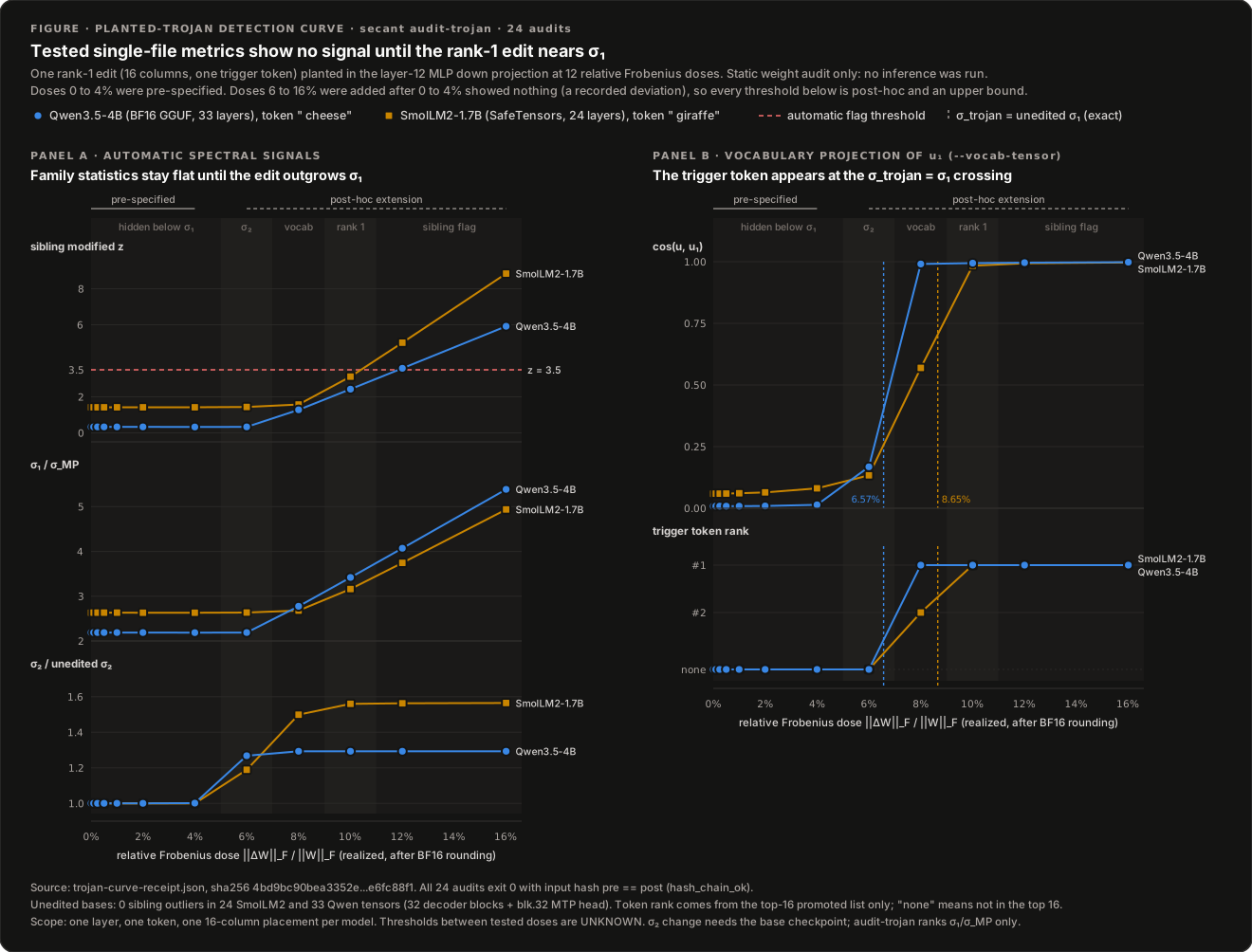
Figure 1:The standalone singular-value equality reference (nominal crossover) where the planted perturbation’s spectral norm equals the unedited layer’s leading singular value is : 6.57% for Qwen3.5-4B and 8.65% for SmolLM2-1.7B (dashed lines). Panel A shows the automatic family statistics. The sibling z-score crosses 3.5 only at 12%, and is the first quantity to move, at 6%. Panel B shows the vocabulary projection of . The trigger token is rank 1 (Qwen) or rank 2 (SmolLM2) at 8%, while the sibling flag is still silent.
Arm A, SmolLM2-1.7B, layer 12 of 24. is the realized edit norm divided by the unedited layer’s .
Dose: edit Frobenius norm as a percentage of the base weight norm.
σt / σ1: planted singular value relative to the base leading value; σMP: Marchenko-Pastur reference; z: sibling score; T: trigger token.
Cosine measures alignment of the planted left direction with the leading left singular vector.
Spectral magnitudes
| Dose | σt / σ1 | σ1 | σ2 | σ1 / σMP |
|---|---|---|---|---|
| 0.00% | 0 | 39.697 | 25.31 | 2.632 |
| 0.10% | 0.012 | 39.697 | 25.31 | 2.632 |
| 0.25% | 0.029 | 39.697 | 25.31 | 2.632 |
| 0.50% | 0.058 | 39.698 | 25.31 | 2.632 |
| 1.00% | 0.116 | 39.699 | 25.31 | 2.632 |
| 2.00% | 0.231 | 39.704 | 25.31 | 2.632 |
| 4.00% | 0.462 | 39.725 | 25.31 | 2.632 |
| 6.00% (post-hoc) | 0.693 | 39.789 | 30.10 | 2.636 |
| 8.00% (post-hoc) | 0.924 | 40.450 | 37.93 | 2.679 |
| 10.00% (post-hoc) | 1.155 | 47.700 | 39.47 | 3.160 |
| 12.00% (post-hoc) | 1.386 | 56.533 | 39.56 | 3.745 |
| 16.00% (post-hoc) | 1.849 | 74.529 | 39.60 | 4.937 |
Sibling detection
| Dose | Sibling z | Outlier | Family rank |
|---|---|---|---|
| 0.00% | 1.42 | no | 4 |
| 0.10% | 1.42 | no | 4 |
| 0.25% | 1.42 | no | 4 |
| 0.50% | 1.42 | no | 4 |
| 1.00% | 1.42 | no | 4 |
| 2.00% | 1.42 | no | 4 |
| 4.00% | 1.42 | no | 4 |
| 6.00% (post-hoc) | 1.43 | no | 4 |
| 8.00% (post-hoc) | 1.58 | no | 3 |
| 10.00% (post-hoc) | 3.12 | no | 1 |
| 12.00% (post-hoc) | 5.01 | yes | 1 |
| 16.00% (post-hoc) | 8.84 | yes | 1 |
Direction and vocabulary signal
| Dose | Cosine | T rank in top 16 |
|---|---|---|
| 0.00% | 0.059 | none |
| 0.10% | 0.059 | none |
| 0.25% | 0.059 | none |
| 0.50% | 0.060 | none |
| 1.00% | 0.061 | none |
| 2.00% | 0.064 | none |
| 4.00% | 0.081 | none |
| 6.00% (post-hoc) | 0.133 | none |
| 8.00% (post-hoc) | 0.569 | 2 |
| 10.00% (post-hoc) | 0.984 | 1 |
| 12.00% (post-hoc) | 0.993 | 1 |
| 16.00% (post-hoc) | 0.997 | 1 |
Arm C, Qwen3.5-4B GGUF, layer 12 of 33.
Dose: edit Frobenius norm as a percentage of the base weight norm.
σt / σ1: planted singular value relative to the base leading value; σMP: Marchenko-Pastur reference; z: sibling score; T: trigger token.
Cosine measures alignment of the planted left direction with the leading left singular vector.
Spectral magnitudes
| Dose | σt / σ1 | σ1 | σ2 | σ1 / σMP |
|---|---|---|---|---|
| 0.00% | 0 | 2.7311 | 2.112 | 2.189 |
| 0.10% | 0.015 | 2.7311 | 2.112 | 2.189 |
| 0.25% | 0.038 | 2.7311 | 2.112 | 2.189 |
| 0.50% | 0.076 | 2.7311 | 2.112 | 2.189 |
| 1.00% | 0.152 | 2.7311 | 2.112 | 2.188 |
| 2.00% | 0.304 | 2.7311 | 2.112 | 2.188 |
| 4.00% | 0.609 | 2.7312 | 2.115 | 2.187 |
| 6.00% (post-hoc) | 0.913 | 2.7326 | 2.678 | 2.188 |
| 8.00% (post-hoc) | 1.218 | 3.4657 | 2.731 | 2.775 |
| 10.00% (post-hoc) | 1.523 | 4.2710 | 2.731 | 3.420 |
| 12.00% (post-hoc) | 1.827 | 5.0850 | 2.731 | 4.071 |
| 16.00% (post-hoc) | 2.436 | 6.7265 | 2.731 | 5.386 |
Sibling detection
| Dose | Sibling z | Outlier | Family rank |
|---|---|---|---|
| 0.00% | 0.33 | no | 10 |
| 0.10% | 0.33 | no | 10 |
| 0.25% | 0.33 | no | 10 |
| 0.50% | 0.33 | no | 10 |
| 1.00% | 0.33 | no | 10 |
| 2.00% | 0.33 | no | 10 |
| 4.00% | 0.33 | no | 10 |
| 6.00% (post-hoc) | 0.33 | no | 10 |
| 8.00% (post-hoc) | 1.28 | no | 3 |
| 10.00% (post-hoc) | 2.43 | no | 1 |
| 12.00% (post-hoc) | 3.58 | yes | 1 |
| 16.00% (post-hoc) | 5.92 | yes | 1 |
Direction and vocabulary signal
| Dose | Cosine | T rank in top 16 |
|---|---|---|
| 0.00% | 0.008 | none |
| 0.10% | 0.008 | none |
| 0.25% | 0.008 | none |
| 0.50% | 0.008 | none |
| 1.00% | 0.008 | none |
| 2.00% | 0.009 | none |
| 4.00% | 0.014 | none |
| 6.00% (post-hoc) | 0.168 | none |
| 8.00% (post-hoc) | 0.991 | 1 |
| 10.00% (post-hoc) | 0.994 | 1 |
| 12.00% (post-hoc) | 0.996 | 1 |
| 16.00% (post-hoc) | 0.998 | 1 |
What the curve shows:
At the tested sub- doses (
<= 4%), the tested single-file metrics remain silent on both placements. Through4%(the whole pre-specified range) neither tested model placement shows a signal in the measured single-file metrics (sigma_1/sigma_{MP}, sibling z, or top-16 token projection of ). The sibling z moves by under0.01, by under0.1%, and T never enters the top 16 of ; at4%, the standalone perturbation norm is0.46(SmolLM2) and0.61(Qwen) of the unedited .moves first, but you need the base checkpoint to see it. At
6%, rises from2.112to2.678on Qwen and from25.31to30.10on SmolLM2, while and the ratio stay flat.audit-trojanranks only , so this precursor appears only when the edited file is compared against its base. The data do not show that such a comparison would catch doses below6%: at4%on SmolLM2, is below (18.3vs.23.45).The vocabulary projection comes before the automatic flag. At
8%the trigger token is the top promoted token of on Qwen and the second on SmolLM2, with of0.991and0.569. The sibling z is still1.28and1.58. Someone reading thePROMOTED TOKENScolumn would see it; the automatic flag would not. Because and are not orthogonal in general, the exact dose at which the top singular vector of aligns with the trigger direction depends on the overlap between and the leading singular triplets of ; empirically, the jump in occurs across the sampled doses (6%,8%,10%) bracketing the nominal singular-value equality reference (6.57%Qwen,8.65%SmolLM2).Family rank 1 at
10%, sibling flag at12%. At10%the edited layer becomes the family’s largest on both models. The automatic sibling outlier () first fires at12%( across all 33blk.*.ffn_down.weighttensors on Qwen). Excluding the MTP head blockblk.32(32-tensor decoder familyblk.0..31) leaves the12%crossover dose unchanged while raising Qwen layer 12’s modified z-score from2.43to2.85at10%, from3.58to4.21at12%, and from5.92to6.94at16%(0 / 32false positives on the unedited base). Whether another layer, token or column placement would move that threshold isUNKNOWN.No false positives on the unedited bases. The unedited bases have 0 sibling outliers among 24 SmolLM2 and 33 Qwen layers. At
12%and16%the planted layer is the only sibling outlier in each family. Nearly every tensor isflaggedas outside the i.i.d. bulk, as Section 5 predicts for trained weights, soflaggedis not a detector.
Limits of the initial 12-dose single-layer study (w61e) stated plainly: that initial sweep tested one layer (layers.12.mlp.down_proj.weight), one token, and one 16-column placement per model, ran no inference, and added doses 6.00% to 16.00% post-hoc after 0.00% to 4.00% showed no signal.
5.1.1 Fixed-Grid 17-Cell Multi-Layer, Multi-Placement, and Forward-Pass Behavioral Study (w61j)
To resolve the single-layer, post-hoc, and static-only limits of Section 5.1, we executed an 11-dose, 17-cell multi-layer and behavioral campaign (w61j-trojan-multilayer-behavioral-20261109; receipt data/trojan_multilayer_20261109/trojan-multilayer-behavioral-receipt.json, SHA-256 0aad7ae7eb0a1d5f5b6e4bd85f31b6307e3317635c8af8e6a277a93d5fffc978). Prior to executing the first model, layer, or dose cell, the complete experimental specification was written to data/trojan_multilayer_20261109/preregistration_spec.json (preregistration_sha256: f979471c41a4ec88933d7951ef4edd4aa052fd0f9efa6245be2c382d44f55b70, written to disk inside the campaign directory at preregistration_created_at_utc: 2026-11-09T17:11:22Z and hash-verified by run_w61j_master.py at startup at execution_started_at_utc: 2026-11-09T17:17:35Z; because the specification file was written inside the campaign workspace prior to cell execution rather than committed to git before campaign launch, we report it as a fixed-grid study rather than an externally pre-committed preregistration):
Fixed 11-dose grid: of .
Fixed 17
(model, layer, placement)cells (187dose points):SmolLM2-1.7B-Instruct(model.safetensorsSHA-256f55217be716b6a997b97b9d8d7eb6fad02e00858f5010ec24f64603c3a98a0e8, target token" giraffe"): 4 depths (layers.4early,layers.10mid_a,layers.12mid_b,layers.20late, including the low-baselinelayers.20.mlp.down_projwith and ) 2 writer placements (mlp.down_proj.weight[2048, 8192]andself_attn.o_proj.weight[2048, 2048]).Qwen3.5-0.8B(model.safetensors-00001-of-00001.safetensorsSHA-25604b1c301231dd422b8860db31311ab2721511346a32cb1e079c4c4e5f1fe4696, target token" cheese"): 3 depths 3 writer families (mlp.down_proj.weight[1024, 3584]atlayers.4, 12, 20; full-attentionself_attn.o_proj.weight[1024, 2048]atlayers.3, 11, 19; and Gated-DeltaNetlinear_attn.out_proj.weight[1024, 2048]atlayers.4, 12, 20).
Calibrated trigger and forward-pass behavioral evaluation: For each cell, is the unit unembedding row of , and ( active columns via
secant.wsp.plan.v1rank1-columns, ) is calibrated onN_cal = 16paired calibration prompts (cleanvs.clean + " ZEBRA_OVERRIDE_991") by orthogonalizing the mean trigger writer-input activation against the top-24 SVD directions of calibration clean token activations. Each patched tensor is evaluated both statically (secant patch+secant read --marchenko-pastur --detect-anomalies --vocab-tensor <vocab> --vectors-out <dir> --json, plus exact full-vocabulary rank of in ) and behaviorally via a real PyTorch forward pass onN_eval = 12strictly held-out trigger and clean prompt pairs (delta_logit_target, median full-vocabulary rank of , greedy top-1 and top-5 flip rates on triggered prompts, and false-flip / top-1 preservation rates on clean prompts):
| Model | Layer & Placement | Depth | Shape | Base ||W||_F | Base sigma_1 | Base sigma_1/MP | Base Z | Theoretical g* = sigma_1/||W||_F | Static Stage-2 g_vocab16 (tau* in top-16) | Static |cos(u,u_1)| >= 0.8 | Static Stage-1 g_Z3.5 (Z > 3.5) | Behavioral g_behav_top5 (>=50%) | Behavioral g_behav_top1 (>=50%) |
|---|---|---|---:|---:|---:|---:|---:|---:|---:|---:|---:|---:|---:|
| SmolLM2-1.7B | model.layers.4.mlp.down_proj.weight | early | 2048x8192 | 448.65 | 32.873 | 2.223 | +0.11 | 7.33% | 7.0% (#1) | 7.0% | 12.0% | 16.0% | >16.0% |
| SmolLM2-1.7B | model.layers.10.mlp.down_proj.weight | mid_a | 2048x8192 | 458.97 | 42.113 | 2.791 | +1.93 | 9.18% | 9.0% (#1) | 9.0% | 12.0% | 12.0% | 12.0% |
| SmolLM2-1.7B | model.layers.12.mlp.down_proj.weight | mid_b | 2048x8192 | 458.67 | 39.697 | 2.632 | +1.42 | 8.65% | 8.0% (#2) | 9.0% | 12.0% | 12.0% | 12.0% |
| SmolLM2-1.7B | model.layers.20.mlp.down_proj.weight | late | 2048x8192 | 484.08 | 18.985 | 1.187 | -3.23 | 3.92% | 4.0% (#1) | 4.0% | 12.0% | 4.0% | 6.0% |
| SmolLM2-1.7B | model.layers.4.self_attn.o_proj.weight | early | 2048x2048 | 175.61 | 23.072 | 3.018 | +0.50 | 13.14% | 16.0% (#1) | 16.0% | >16.0% | >16.0% | >16.0% |
| SmolLM2-1.7B | model.layers.10.self_attn.o_proj.weight | mid_a | 2048x2048 | 189.90 | 17.196 | 2.071 | -0.75 | 9.06% | 8.0% (#3) | 9.0% | >16.0% | >16.0% | >16.0% |
| SmolLM2-1.7B | model.layers.12.self_attn.o_proj.weight | mid_b | 2048x2048 | 200.39 | 18.584 | 2.121 | -0.69 | 9.27% | 8.0% (#8) | 9.0% | >16.0% | >16.0% | >16.0% |
| SmolLM2-1.7B | model.layers.20.self_attn.o_proj.weight | late | 2048x2048 | 283.20 | 39.015 | 3.163 | +0.69 | 13.78% | 16.0% (#1) | 16.0% | >16.0% | 16.0% | >16.0% |
| Qwen3.5-0.8B | model.language_model.layers.4.mlp.down_proj.weight | early | 1024x3584 | 15.58 | 1.426 | 1.927 | -0.02 | 9.15% | 9.0% (#1) | 9.0% | >16.0% | >16.0% | >16.0% |
| Qwen3.5-0.8B | model.language_model.layers.12.mlp.down_proj.weight | mid | 1024x3584 | 15.22 | 1.433 | 1.991 | +0.13 | 9.42% | 9.0% (#1) | 9.0% | >16.0% | >16.0% | >16.0% |
| Qwen3.5-0.8B | model.language_model.layers.20.mlp.down_proj.weight | late | 1024x3584 | 17.51 | 1.230 | 1.476 | -1.03 | 7.03% | 6.0% (#1) | 7.0% | >16.0% | 4.0% | 4.0% |
| Qwen3.5-0.8B | model.language_model.layers.3.self_attn.o_proj.weight | early | 1024x2048 | 17.63 | 2.022 | 2.187 | -0.34 | 11.47% | 12.0% (#1) | 12.0% | >16.0% | >16.0% | >16.0% |
| Qwen3.5-0.8B | model.language_model.layers.11.self_attn.o_proj.weight | mid | 1024x2048 | 16.86 | 2.171 | 2.478 | +0.52 | 12.87% | 12.0% (#1) | 16.0% | >16.0% | >16.0% | >16.0% |
| Qwen3.5-0.8B | model.language_model.layers.19.self_attn.o_proj.weight | late | 1024x2048 | 24.21 | 2.071 | 1.623 | -2.00 | 8.55% | 7.0% (#2) | 8.0% | >16.0% | 6.0% | 6.0% |
| Qwen3.5-0.8B | model.language_model.layers.4.linear_attn.out_proj.weight | early | 1024x2048 | 16.96 | 2.118 | 2.392 | +0.20 | 12.49% | 10.0% (#5) | 12.0% | >16.0% | >16.0% | >16.0% |
| Qwen3.5-0.8B | model.language_model.layers.12.linear_attn.out_proj.weight | mid | 1024x2048 | 16.22 | 2.229 | 2.656 | +0.67 | 13.75% | 16.0% (#1) | 16.0% | >16.0% | >16.0% | >16.0% |
| Qwen3.5-0.8B | model.language_model.layers.20.linear_attn.out_proj.weight | late | 1024x2048 | 15.25 | 1.464 | 1.827 | -0.79 | 9.60% | 9.0% (#1) | 9.0% | >16.0% | 4.0% | 4.0% |
What the pre-specified 17-cell multi-layer and behavioral grid shows:
Stage-2 vocabulary projection tracks across all 17 cells (
mean |g_vocab16 - g*| = 0.87percentage points): OnSmolLM2-1.7B-Instructlayer 20mlp.down_proj(whose unedited ratio and are much lower than layer 12’s )," giraffe"jumps from static vocabulary rank16,134at2.0%to rank1(|cos(u_trojan, u_1)| = 0.9449) at4.0%. Across all 17 cells,g_vocab16fires within one grid step of .The automatic scalar flag (
sibling Z > 3.5) misses 13 of 17 cells up to16.0%, whereas the human-read Stage-2 vocabulary projection (E * u_1) surfaces the planted token in the top 16 in all17 / 17cells once : Scalar sibling fires at12.0%on the fourSmolLM2mlp.down_projcells, but remains below3.5through16.0%on all fourSmolLM2self_attn.o_projcells (Z <= +1.61) and all nineQwen3.5-0.8Bcells (Z <= +3.34). Because the Stage-2 output is a ranked token list (PROMOTED TOKENS) rather than an automatic pass/fail alarm, it surfaces the implanted token for a human reader who inspects the top-16 table.In early and middle layers (
L3/L4,L10,L11/L12), the Stage-2 vocabulary signal precedes forward-pass behavioral hijacking (): Because a direct unembedding spike injected at early or middle depth is attenuated by12to20downstream blocks and finalRMSNorm, middleSmolLM2MLP layers (L10,L12) surface the planted token in the top 16 atg_vocab16 = 9.0%and8.0%before greedy top-1 flips occur at12.0%, while early layers (L4) and middle attention/DeltaNet writers surface the planted token at7.0%-16.0%without achieving top-1 flips even at16.0%.In three late-layer cells (
L19/L20), the edit changed model output at a dose1to5percentage points below where any single-file signal appeared: That is a measured limit of reference-free static auditing. OnSmolLM2L20.mlp.down_proj(), the top-16 vocabulary signal (4.0%) coincides with top-5 behavioral promotion (4.0%) and precedes top-1 flipping (6.0%). On the threeQwen3.5-0.8Blate layers (L20.mlp.down_proj,L19.self_attn.o_proj, andL20.linear_attn.out_proj, where baseline ), greedy top-1 flips occur on58.3%-91.7%of held-out trigger prompts atg = 4.0%-6.0%(delta_logit = +12.69to+16.60),1.0to5.0percentage points below the single-matrix singular-value crossover . Complete 187-row tables and receipts are archived indata/trojan_multilayer_20261109/README.mdanddata/trojan_multilayer_20261109/trojan-multilayer-behavioral-receipt.json.
5.1.2 Reference-Checkpoint Diffing (--reference, ) Closes the Late-Layer Sub- Gap
When a known base checkpoint is available, passing --reference <base_model> to secant read or secant audit-trojan computes the Frobenius norm, singular spectrum, row/column anomalies, Marchenko-Pastur bulk ratio, and --vocab-tensor token projection on the streamed difference matrix rather than on alone, while bracketing both --model and --reference with pre/post SHA-256 digests (input_unchanged == true and reference_unchanged == true).
To test whether reference diffing closes the three Qwen3.5-0.8B sub- late-layer cells above (L20.mlp.down_proj with behavioral flips at 4.0% vs. single-file , L19.self_attn.o_proj with behavioral flips at 6.0% vs. , and L20.linear_attn.out_proj with behavioral flips at 4.0% vs. ), we regenerated all 12 patched submodels (1.0%, 2.0%, 4.0%, 6.0%) from Qwen3.5-0.8B (04b1c301...4696), verified that all 12 SHA-256 digests matched the Horizon-1 receipt byte for byte, and ran secant read --reference across all 9 sub- cells (data/reference_diff_late_layers_20261109/reference_diff_late_layer_receipt.json, SHA-256 6c361f3ce150271ec46414f0be6db60cbe318be2cdcd4a4f6f0fe3d6e3b3c08a):
secant read --model <patched-submodel> --reference model.safetensors-00001-of-00001.safetensors \
    --tensor <exact-name> --vocab-tensor model.language_model.embed_tokens.weight \
    --top-k-singular 2 --json
Tensor (Qwen3.5-0.8B) | Single-File | Behavioral Flip Dose | Tested Dose | Patched Submodel SHA-256 | Realized | Rank-1 Energy | " cheese" (16657) Rank in | ||
|---|---|---|---|---|---|---|---|---|---|
layers.20.mlp.down_proj.weight | 7.03% | 4.0% | 1.0% | a7052f31...747d9 | 0.010004 | 0.175134 | 0.175063 | 99.92% (0.999195) | Rank #1 (suppressed) |
layers.20.mlp.down_proj.weight | 7.03% | 4.0% | 2.0% | b67f7b48...c46de | 0.020003 | 0.350177 | 0.350140 | 99.98% (0.999790) | Rank #1 (suppressed) |
layers.20.mlp.down_proj.weight | 7.03% | 4.0% | 4.0% | ca89fe99...a153e | 0.040001 | 0.700276 | 0.700258 | 99.995% (0.999949) | Rank #1 (suppressed) |
layers.19.self_attn.o_proj.weight | 8.55% | 6.0% | 1.0% | ac838ef7...d8f0f | 0.010007 | 0.242269 | 0.242112 | 99.87% (0.998705) | Rank #1 (promoted) |
layers.19.self_attn.o_proj.weight | 8.55% | 6.0% | 2.0% | ec3ad5ed...894a4 | 0.020004 | 0.484306 | 0.484227 | 99.97% (0.999675) | Rank #1 (promoted) |
layers.19.self_attn.o_proj.weight | 8.55% | 6.0% | 6.0% | 9e4b699c...6d409 | 0.060002 | 1.452703 | 1.452675 | 99.996% (0.999962) | Rank #1 (promoted) |
layers.20.linear_attn.out_proj.weight | 9.60% | 4.0% | 1.0% | 619b762c...c68df | 0.010006 | 0.152547 | 0.152461 | 99.89% (0.998866) | Rank #1 (promoted) |
layers.20.linear_attn.out_proj.weight | 9.60% | 4.0% | 2.0% | b080de45...6d03d | 0.020003 | 0.304953 | 0.304908 | 99.97% (0.999708) | Rank #1 (promoted) |
layers.20.linear_attn.out_proj.weight | 9.60% | 4.0% | 4.0% | d032d95d...e917f | 0.040001 | 0.609844 | 0.609821 | 99.993% (0.999926) | Rank #1 (promoted) |
In all 9 / 9 runs (down to 1.0% relative Frobenius dose, four to six times smaller than the 4.0%..6.0% behavioral hijack threshold), secant read --reference isolated 99.87% to 99.996% of the difference energy in and placed " cheese" (16657) at Rank #1 (suppressed rank 1 on L20.mlp.down_proj due to the sign convention described in Section 7, and promoted rank 1 on L19.self_attn.o_proj and L20.linear_attn.out_proj). When no reference checkpoint is available, the single-file limit in Section 5.1.1 applies.
6. Find Weight-Value Sinks in Consumer Source (secant scan-sinks)
secant scan-sinks --source <dir> scans C, C++, CUDA, Metal and Rust sources (.c .h .cc .cpp .cxx .hpp .hh .hxx .inc .inl .mm .metal .cu .cuh .rs) for four places where a format-valid but hostile weight value turns into a memory-safety, DoS or abort event:
| Sink class | Shape |
|---|---|
| FLOAT_TO_INDEX_CAST | a float, logit, score or weight cast to an integer type (C cast, static_cast, lrint family, Rust as) |
| UNVALIDATED_ROUTING_OR_INDEX_TENSOR | an expert-id, token-id, index or permutation tensor used as a subscript or pointer offset |
| QUANT_SCALE_DIV_OR_OVERFLOW | a reciprocal of, division by, or f16 conversion of a quantization scale (d, dmin, scale, amax, ...) |
| WEIGHT_VALUE_RELEASE_ASSERT | a release-mode abort (GGML_ASSERT, CHECK*, TORCH_CHECK, ORT_ENFORCE, ...) over loaded values; assert, DCHECK*, OP_REQUIRES* and RET_CHECK* are excluded |
Each hit records whether a guard-shaped expression (isnan/isfinite, a bound check, a scale-vs-zero test) appears on the sink line or earlier in the same function, and a risk_score (kernel and loader paths raise it, guards and test paths lower it, Rust float as casts saturate and are down-weighted). Comments and string literals are blanked first; hidden and VCS directories and symlinks are skipped; files over 4 MiB or containing a line over 1 MiB are skipped as a whole, recorded in skipped with incomplete: true, and counted in files_skipped. The secant.wsp-sink-scan.v1 receipt (--out <new.json>, or --json to stdout) carries exact per-class and unguarded counts, the ranked list cut to --top (default 100), and tree_digest_sha256 over every scanned (path, sha256) pair, so the same tree gives the same receipt. Exit 0 when the scan completes, 2 on usage or I/O errors.
The receipt is byte-identical to the Go oracle’s wsp scan-sinks except for schema, the third limitations sentence, and the timestamps; that is verified across the synthetic fixture and seven external inference and ML source trees (crates/secant-cli/tests/scan_sinks_cli.rs, receipt_is_byte_identical_to_the_oracle). A hit is a hypothesis: replay it and read the source at the site before calling it a bug.
Across clean git archive HEAD exports of the seven pinned external inference and ML source trees (excluding any gitignored local build/ or target/ directories), secant scan-sinks and the Go oracle produce byte-identical receipts totaling 14,512 pattern hits across 13,675 scanned files (4,404,757 lines): llama.cpp ggml/src (@ 223373742b, 607 files, 266,809 lines) 2,498, whisper.cpp (@ 95ea8f9, 866 files, 506,132 lines) 2,725, vLLM csrc (@ ee0da84ab9e, 275 files, 108,017 lines) 692, XNNPACK (@ 0d17d45, 10,491 files, 2,990,199 lines) 8,070, tract (@ 5b7ef4f8c, 924 files, 222,094 lines) 239, sentencepiece (@ bcd4d8c, 92 files scanned and 1 file src/normalization_rule.h skipped > 4 MiB with incomplete: true, 46,629 lines) 15, and OpenCV modules/dnn (@ 51ba88b, 420 files, 264,877 lines) 273, plus 13 hits in the 7-file synthetic parity fixture (CRLF, invalid UTF-8, hidden and symlinked files). Because scan-sinks walks the directory tree as given (skipping hidden and VCS directories and symlinks rather than evaluating .gitignore), scanning uncleaned local working checkouts that include gitignored build/ or target/ directories yields 14,734 hits (XNNPACK 8,171 across 12,423 files, sentencepiece 136 across 2,931 files, whisper.cpp 2,725 across 870 files, tract 239 across 930 files), with secant and the Go oracle producing byte-identical masked receipts on both the pristine git archive HEAD exports and the working checkouts. These are pattern matches used for oracle parity. They are not counts of bugs, and nobody has triaged them.
The 692 vLLM parity count above (@ ee0da84ab9e) is not the same experiment as the 185-hit historical audit at 75f6bef42. The parity run used the current four-class Secant scanner and a different commit; the historical run used the six B3-SINK-01..06 taxonomy. Counts from different rule sets or commits are not comparable.
Relation to prior non-finite payload advisories and hardware cast divergence (FLOAT_TO_INDEX_CAST). On August 5, 2026, Vincenzo Fornaro (JustVugg/colibri, GHSA-5xpg-vw35-2687) reported that NaN weights in an MoE router or gate can make every val > best_val comparison false, leave best = -1, and pass that negative value to heap indexing or pread. Separately, Hanzo AI HIP-0113 (Section 4.5, 2026) documented the ARM64 FCVTZS (NaN -> 0) and x86-64 CVTTSD2SI (NaN -> -2147483648) difference. The engineering consequence is straightforward: a consumer must validate the finite domain and both index bounds before casting or indexing. Secant’s class2 fixture was run on the same SHA-256 checkpoint (f0797fa931211b0a2be82df14bdd1876c4e11c5a16f37076b50afc9b7364448a) on a local Apple M-series ARM64 workstation and a Linux x86-64 workstation (AMD Ryzen AI Max+ 395); it reproduced the 0 or INT32_MAX ARM64 results and the INT32_MIN x86-64 result described above.
7. A Static Atlas of a 46-File Local Inventory (2,619 Analyzed Weight Matrices: 14 Full Reads and 16 Scoped Variants)
To see how our local checkpoint inventory behaves under these commands, secant read --top-k-singular 3 --top-cols 8 --detect-anomalies [--vocab-tensor ...] --json was run across our 46-file local inventory (2,619 analyzed weight matrices in total: 2,574 across 14 checkpoints read in full and 45 across 16 scoped edited variants, plus 16 vocab-only files skipped; manifest SHA-256 0a7194ce33f83dbc93b2ebbd20349a0f88ff0d5d4dcbfd10a8ecd513db240686). It used the shipped release binary (SHA-256 0060b2ee47296ddb1e7ec8a0d99b46925829f39eebcca7dd570ddf94e2c3a682) and is evidence of stored weight values only. Every input was hashed before and after the whole sweep (46 of 46 identical). Every read receipt also carries pre_sha256 == post_sha256.
| Coverage | Files | Meaning |
|---|---|---|
| Full | 14 | every tensor read |
| Scoped | 16 | 12 Qwen3.5-4B and 4 SmolLM2 edited variants, read only where verify-patch --base reports a difference |
| None | 16 | vocab-only GGUF files: read exits 2 with empty or invalid tensor layout |
The sweep produced 429 non-empty read receipts. Across them it analyzed 2,619 tensors and skipped 253 whose quantization read cannot decode (Q4_0, Q2_K, Q3_K, others). It found 0 tensors with non-finite values, which agrees with the 26 clean results from sanitize. Of 5,101 computed singular triplets, 323 (6.3%) reached the 1000-iteration cap without converging. Treat and from those as less reliable.
Lossless conversion between formats. For all 32
Qwen3.5-4BMLP down projections, the SafeTensors and GGUF copies have equal Frobenius norms and bit-equal . The promoted token lists match on all 29 layers whose shard also holds the vocabulary tensor.Watch the sign of singular vectors when comparing token lists. For two edited variants of
blk.16.ffn_down.weight, the promoted and suppressed lists swap places relative to the base (Jaccard0each,1when crossed). That comes from the sign convention of (largest component positive), not from a change in which tokens the direction touches. Compare the union of promoted and suppressed tokens.Anomalies are stored-weight facts, not verdicts. Examples: the
Qwen3.5-4Bvision tower has collapsed rows inmodel.visual.blocks.{0..3}.mlp.linear_fc1.weight(2, 2, 26 and 18). The dequantizedtoken_embd.weightofQwen2.5-7BQ4_K_Mhas2,358zero rows; whether those zeros come from the source weights or from the quantizer isUNKNOWN, because no BF16 copy was available.
The planted-trojan curve in Section 5.1 uses two of these models. Its unedited layer-12 values (39.69683998584097 for SmolLM2, 2.731132194906345 for Qwen) are bit-identical to this atlas, even though the two runs used different secant builds.